


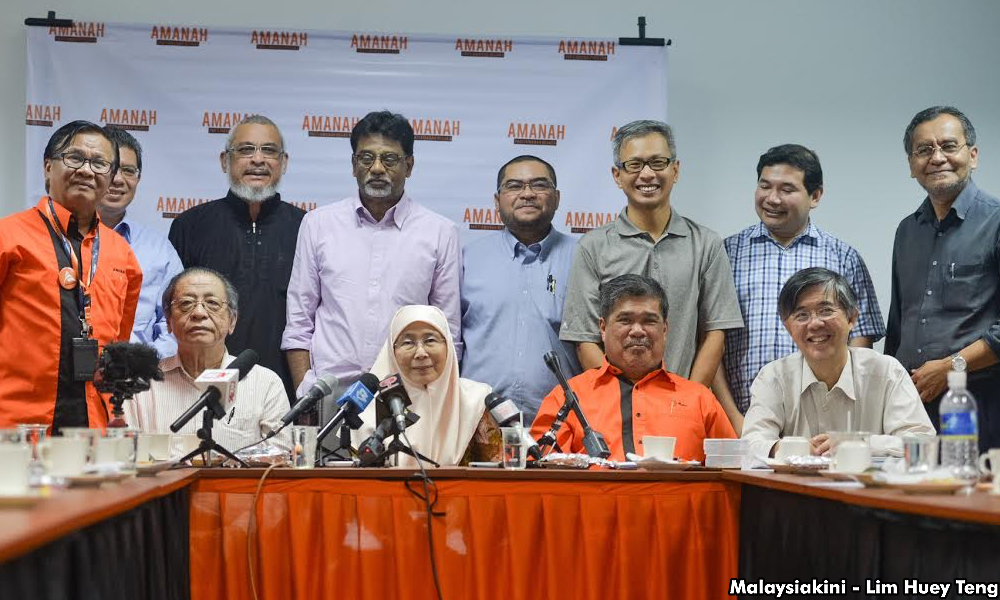

Absence of Anwar, Nik Aziz leaves vacuum in opposition
SPECIAL REPORT The absence of PKR de facto leader Anwar Ibrahim and the passing of late PAS spiritual leader Nik Abdul Aziz Nik Mat, has left a literal hole in the heart of the opposition coalition.Their presence some say, was the only thing holding the former Pakatan Rakyat together since the 12th general election of 2008 (GE12).
This was noted by political pundits, with tomorrow’s first anniversary of the death of Nik Aziz being just two days away from the jailing of Anwar in the same year, after the Federal Court upheld the Court of Appeal’s overturning of his earlier acquittal for Sodomy II.
Analysts have the matched the downfall of Pakatan and the current near-deadlock facing the nascent pact that took its place, Pakatan Harapan, as originating from when the opposition lost these two venerable leaders, just days apart.
As of now, PKR struggles to moderate seat negotiations among its allies and the now ‘pariah’ PAS as the opposition parties squabble among themselves, while leaders in the party Anwar helped to set up are training their guns on one another, with factions struggling to gain power in the vacuum Anwar left behind...
SPECIAL REPORT The absence of PKR de facto leader Anwar Ibrahim and the passing of late PAS spiritual leader Nik Abdul Aziz Nik Mat has left a literal hole in the heart of the opposition coalition.Their presence, some say, was the only thing holding the former Pakatan Rakyat together since the 12th general election of 2008 (GE12).
This was noted by political pundits, with tomorrow’s first anniversary of the death of Nik Aziz being just two days away from the jailing of Anwar in the same year, after the Federal Court upheld the Court of Appeal’s overturning of his earlier acquittal for Sodomy II.
Analysts have matched the downfall of Pakatan with the current near-deadlock facing the nascent pact that took its place, Pakatan Harapan, as originating from when the opposition lost these two venerable leaders, just days apart.
As of now, PKR struggles to moderate seat negotiations among its allies and the now ‘pariah’ PAS as the opposition parties squabble among themselves, while leaders in the party Anwar helped to set up are training their guns on one another, with factions struggling to gain power in the vacuum Anwar left behind.
"When Anwar was still the opposition leader, some complained he could have done better. When he was sent to jail, some optimistically said, 'leaders come and go'," observed political commentator Tang Ah Chai.
 "But it is undeniable that Anwar (
photo
) played a significant and influential role in coordinating the opposition parties. Under him, cooperation within the opposition was at its peak.
"But it is undeniable that Anwar (
photo
) played a significant and influential role in coordinating the opposition parties. Under him, cooperation within the opposition was at its peak.
"Under him, the parties strove to achieve common interests, rather than the objectives of individual parties. They supported and complemented one another," Tang opined.
Anwar rose to prominence in the opposition following the Reformasi movement, after he was sacked as deputy prime minister and subsequently sent to jail. Under his influence, PKR, together with PAS and DAP, denied BN its two-thirds majority in GE12, a phenomenon that has been dubbed the 'political tsunami'.
Pakatan Rakyat, forged in the Reformasi Anwar led in 2008, obtained 51.4 percent of the popular votes in the 2013 general election (GE13).
As for Nik Aziz, he had played a big role in guiding the Islamic party in its transition from a rural Malay-based Islamic party into the mainstream and a more inclusive entity that PAS was, prior to the ulama faction taking over after his death, and their eventual undoing of all that the late veteran did for the party.
 Nik Aziz also made it clear that he harboured no fantasy of PAS working with Umno, a principle that Tang said was self-evident in the close to five decades that the late spiritual adviser spent in the Islamic party and during the 23 years he served as the menteri besar of Kelantan.
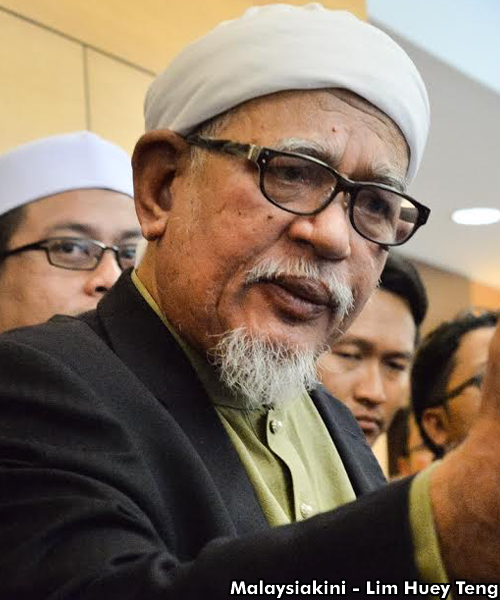
"PAS president (Abdul Hadi Awang, photo ) had tried to make himself look important by saying the party can play an advisory role to the BN government," Tang said, though Hadi never did manage to fill the vacancy that NIk Aziz's death left in PAS leadership.
Indeed, the absence of both Anwar and Nik Aziz from the political area has left a dearth of leadership that the opposition has thus far been unable to fill, he said.
Reluctant to talk of common interest
"The parties were reluctant to talk of their common interests, they now care only for their own interests.
"A typical example is DAP secretary-general Lim Guan Eng. He is quick to jump to safeguard the interest of his party, without having a second thought to moderate conflicts among the parties. This makes him a different person from Anwar," he noted.
Citing the coming Sarawak state election as another example, Tang said the parties had announced the seats they wanted to contest even before seat negotiations among the allies were completed.
"The coalition seems determined to take Putrajaya, but its actions tell otherwise. There is no strategy, no command and no concerted action. In fact, they do things their own way," he said.
"Opposition Leader Dr Wan Azizah Wan Ismail tried to fill the vacuum left by Anwar, but she is nowhere near (or as shrewd as) Anwar. She seems powerless in dealing with internal Harapan matters and inter-parties affairs," Tang said.
"Looking at the past experience, we still need a charismatic and unifying opposition leader to lead the opposition movement."
Move away from individual politics
Disagreeing on this, political analysts Maszlee Malik and Liew Wui Chern said the opposition should move away from a political culture where a particular ‘charismatic’ leader leads the opposition movement.
"I think the era of charismatic leaders or personalities to unite the opposition is over. They have gone through that, and it is impossible to revive it again in the current situation.
"Pakatan Harapan needs to go beyond individuals and personalities and needs to be seen as a strong group from different parties but with like-minded brains. What it needs now are a unifying group, unifying idea and unifying policies," Maszlee said.
The coalition needs to create a prevailing idea that can unite the parties in it, he added.
"We need to shift into a new paradigm in which there are contesting personalities, even within Harapan, to be trusted as the future prime minister, prepared to become, or in the making, and not only one prime minister candidate," said the International Islamic University Malaysia assistant professor .
"This is the new challenge," Maszlee stressed, adding that "we need a team that is beyond the partisan. Now Malaysians have lost hope on individuals".
Form 'Harapan party', not a coalition
Meanwhile, Liew suggested the Harapan parties form a single party instead of teaming up in a coalition as a measure to tackle the dilemma of the absence of a charismatic leader, as well as the possibility of a further break-up as a result of differences in political ideology.
"We have seen the break-up of Barisan Alternative and Pakatan Rakyat. The parties only had a common goal before a general election, but lost direction after the general election (as their partisan ideologies clashed).
"The country's political situation is unique in a sense that we have a two-coalition system. The weakness of a coalition system is that the parties need to spend much time dealing with internal affairs and intra-party problems.
"The coalitions seem to have neglected their administrative framework and common policies," said Liew, who is a Universiti Tunku Abdul Rahman lecturer.
 He proposed that Wan Azizah (
photo
) be made the spiritual leader of the new Harapan party.
He proposed that Wan Azizah (
photo
) be made the spiritual leader of the new Harapan party.
"Since the opposition has failed twice, why not resort to a new method ? It should brainstorm and come out with a better model," he said.
Both Pakatan Rakyat and Barisan Alternative broke up because of PAS' determination in implementing hudud, and nobody can replace Anwar's role in the opposition despite other leaders who are influential and important in their own way, said Liew.
It was an easy way out for the opposition parties to be led by a charismatic leader when they have different ideologies, he said.
Kit Siang will not be accepted
"PKR has a strong sense of insecurity. It still clings to the idea that Anwar is the future prime minister candidate, and it fears the party and the coalition will break apart without him," Liew said.
"Without Anwar, Wan Azizah and her daughter will lose power in PKR and Harapan. PKR is all about Anwar Ibrahim.
"PKR, on and off, reminds its allies of the existence of Anwar, so that it can secure the premiership for Anwar's wife."
But by doing so, Liew argued, the party is seen as losing touch with the reality and not attractive as before.
Another analyst, Phoon Wing Keong, opined that the country needs a trustworthy, prospective leader who can truly unify the opposition and fulfil the expectations of the nation.
"Only leaders with such qualities can fill the vacancy left by both Anwar and Nik Aziz. Without this, we cannot bid farewell to Anwar and Nik Aziz," Phoon said.
According to him, nobody can truly replace both Anwar and Nik Aziz, nor replicate their unifying impact on the opposition coalition.
 Being a non-Malay and non-Muslim, DAP parliamentary leader Lim Kit Siang (
photo
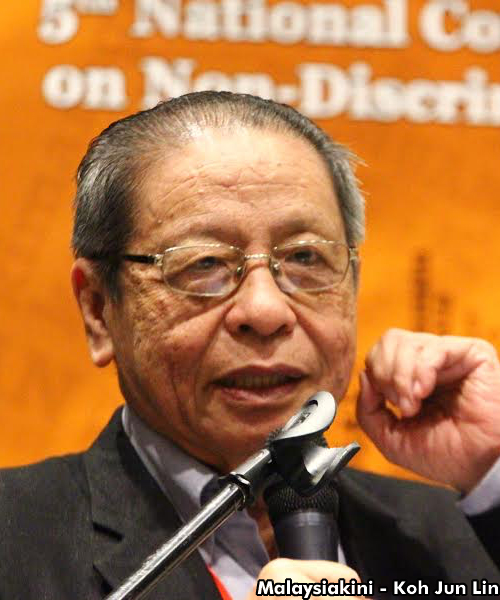
), despite his wisdom, will not be accepted by the community at large to lead the opposition campaign, though PKR deputy president Azmin Ali is also problematic as he seems to lack foresight and appears only to be interested in power, Phoon said.
Being a non-Malay and non-Muslim, DAP parliamentary leader Lim Kit Siang (
photo
), despite his wisdom, will not be accepted by the community at large to lead the opposition campaign, though PKR deputy president Azmin Ali is also problematic as he seems to lack foresight and appears only to be interested in power, Phoon said.
"The people will not feel so hopeless to see a corrupt government when they know they can lay hope in the opposition. But Malaysian voters have been depressed in the past two years, seeing the opposition break apart," he said.
"Look at Taiwan. The approval rate plunged when Taiwan Nationalist Party and Ma Ying Jeou ruled the state for eight years. The people have complained, but they are hopeful as they know another party is prepared to take over," he elaborated.
Azmin to replace Anwar?
"The opposition in Malaysia has been lucky that it was able to last so long simply on Anwar's leadership and deal-making skills (despite) not being able to strengthen the intra-relationship among the parties," said Ibrahim Suffian of Merdeka Centre.
"There is a lack of unifying leaders, particularly from the Malay segment of the opposition," noted the pollster.
Ibrahim pointed out that the opposition needs a well-respected leader who can battle for Malay support against Umno to present a credible political force.
"The opposition currently does not have anyone of repute at that level. Regardless of how unhappy voters are with Prime Minister Najib Abdul Razak, the opposition is unable to provide any alternative.
"For Harapan, to move away from Anwar or Nik Aziz, it needs a replacement. People trust other people. They don't trust institutions because they don't know what's in an institution.
"Leaders are important. They have to simplify and articulate issues for voters and overcome differences from separate parties in the coalition," Ibrahim said.
 He opined that Azmin (
photo
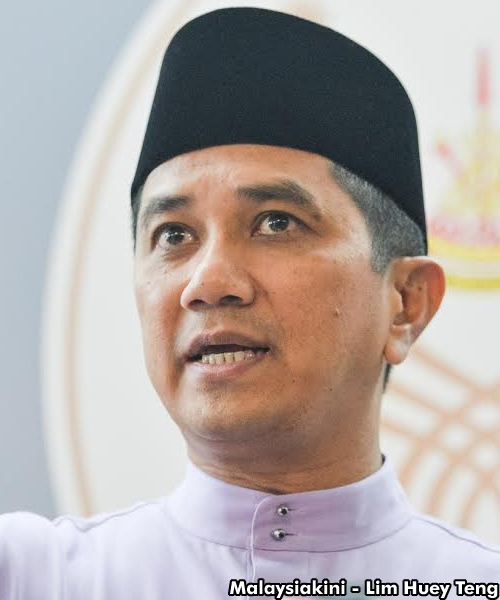
) could rise up to take the role, if his party overcomes its internal infighting.
He opined that Azmin (
photo
) could rise up to take the role, if his party overcomes its internal infighting.
"Well, he is fairly senior in the party to take the lead. He has some credential with Malay voters that can help overcome the deficit that that Harapan is currently experiencing in terms of endearing itself to Malay voters.
"Azmin’s position as Selangor menteri besar enables him to demonstrate policies that the opposition wants to carry out in tangible, practical terms," Ibrahim explained.
"Charisma is overrated. What's really needed is a hardworking person who is driven by goals to stitch together a durable coalition that can carry a common platform of issues that can communicate effectively with the voters," he concluded.
In any case, until Harapan comes up with a new way to shore up itself and fill the void left by the Anwar and Nik Aziz, or one of the possible candidates above finally steps up, one year on and indeed in the foreseeable future, the coalition will continue to be hobbled by the departure of their two main leaders.
Yesterday: A year since Anwar-Nik Aziz twin tragedies rocked opposition
Tomorrow: Opposition has lost its shine, fallen back to pre-2008 times


Are you sure you want to delete this comment?
This action cannot be undone.