


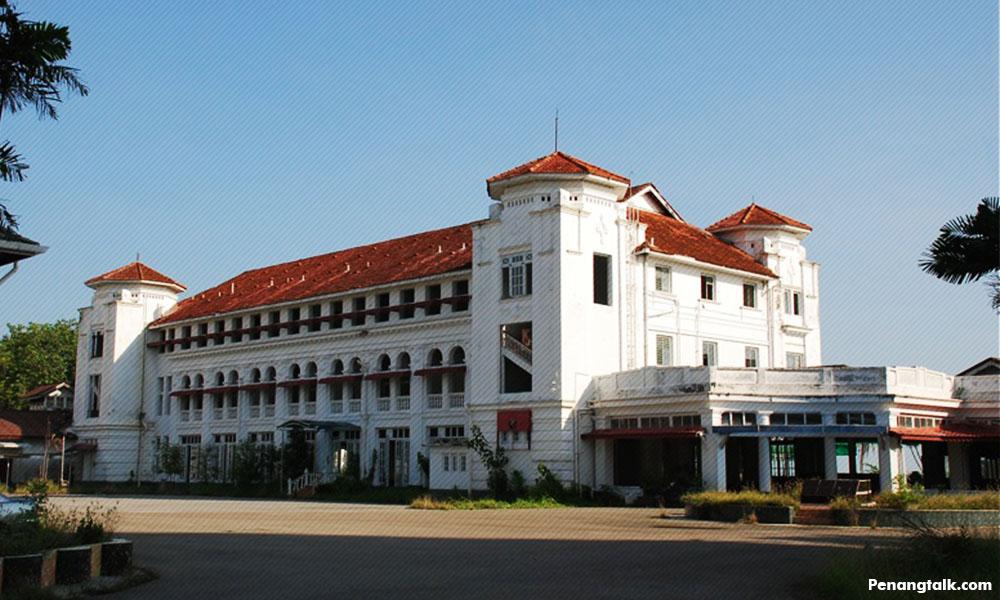

Historian: Close loopholes that allow heritage destruction
Marcus Langdon, a British-born Australian author and historian who has made Penang his home for about seven years ago, is disappointed that nothing could be done to preserve the cluster of heritage buildings surrounding the iconic Runnymede Hotel and which were demolished on Tuesday.
Langdon, 63, told reporters after attending a press conference with state executive councillor Chow Kon Yeow that what was more disappointing was that 'the demolition was legal .'
Marcus Langdon, a British-born Australian author and historian who has made Penang his home about seven years ago, is disappointed that nothing could be done to preserve the cluster of heritage buildings surrounding the iconic Runnymede Hotel and which were demolished on Tuesday.
Langdon, 63, told reporters after attending a press conference with state executive councillor Chow Kon Yeow that what was more disappointing was that 'the demolition was legal .'
“The fault lies in the Penang Island Municipal Council's (MPPP) 1999 planning permission but the fact that it couldn’t be varied was disappointing,” he said after the press conference held by Chow in George Town today.
Langdon said those who allowed the buildings to be demolished including developer Bandan Warisan Sdn Bhd did not do their homework and claimed that part of the demolished buildings were one-time home to Sir Thomas Stamford Raffles.
Raffles built them in 1808 and sold them in 1810 before leaving the island and later founding Singapore in 1819.
“It is easy to find the house, which is right in front of the gate. That building did burn down in 1900s but was rebuilt straight away,” said Langdon, who has already published the first volume of four historical books entitled 'Penang: The Fourth Presidency of India 1803-1830'.
“I do believe that the superstructures right inside Runnymede's compound were indeed the home that Raffles built,” he said.
Langdon said the demolished buildings were the last examples of Raffles' residences in the East and were of great importance to the historical studies of Malaysia, Singapore, Indonesia and the British.
“So it is disappointing that the powers-that-be gave permission to demolish them. They may say that their hands are tied but that again shows the need to close a loophole in the system,” he said.
“The developer knows full well the buildings' history as we had contacted them in the past and asked for discussions. Despite saying he would, the discussions never happened,” Langdon said.
“We also requested that we be allowed to enter, examine and record the buildings before they were demolished,” he added.
'No heritage value'
Penang Heritage Trust (PHT) council member Clement Liang said the buildings should not have been been demolished although they were not classified as heritage.
He urged the authorities to conduct a heritage impact assessment on the site.
“The site was once home to Raffles when he was assistant secretary to the governor of Penang in the early 1800s.
"We have asked for impact studies to be done but sadly we were not heard and the buildings were deemed to have had no heritage value," he said.
Other activists who were upset with the demolition included well-known Penang blogger and Aliran treasurer Anil Netto who said in a blog post:
"Heritage activists want MBPP to clarify this - if planning permission was given in 1999 when the MBPP was not aware of conservation and had not adopted a conservation policy, why was permission automatically renewed until 2015?
"Was the developer asked to do a heritage management plan and a heritage impact assessment?" he asked.
Penang Tourism and Malay Heritage Society (Sahabat) president Syed Kamarul Syed Kadiron Mustafa said they had wanted the buildings to be 'preserved at all costs' as they were located within the state's heritage enclave.
But Chow today said the buildings were not within the George Town Unesco World Heritage site, adding that permission to demolish the ancillary buildings to the Runnymede Hotel was granted by the MPPP in 1999 under the previous administration.
He claimed that according to the planning permission, the remaining Runnymede Hotel building would be preserved.
'Not reading history'
The land on which the buildings were situated was formerly owned by the Defence Ministry which later sold it to Runnymede Hotels Sdn Bhd in February 2014.
The colonial-era hotel was formerly used as an army base for the British in the early 1940s before the land was handed over to the Malayan government in 1957 upon independence.
Meanwhile, Mark Lay, who founded the George Town Heritage Group on Facebook, said if the building was in Singapore, it would have been classified as a 'national treasure'.
He said that a conservation management plan needs to be in place in Penang which will allow the history of a building or area to be determined first before any other steps are taken.
“Of course, the approval was given in 1999 and their hands are tied but surely 17 years later and with Penang now being touted as a Unesco World Heritage site, we can talk to the developer,” said Lay, who accompanied Langdon to the press conference in George Town.
“Obviously, they are not reading the history books when determining demolitions,” he said.


Are you sure you want to delete this comment?
This action cannot be undone.