
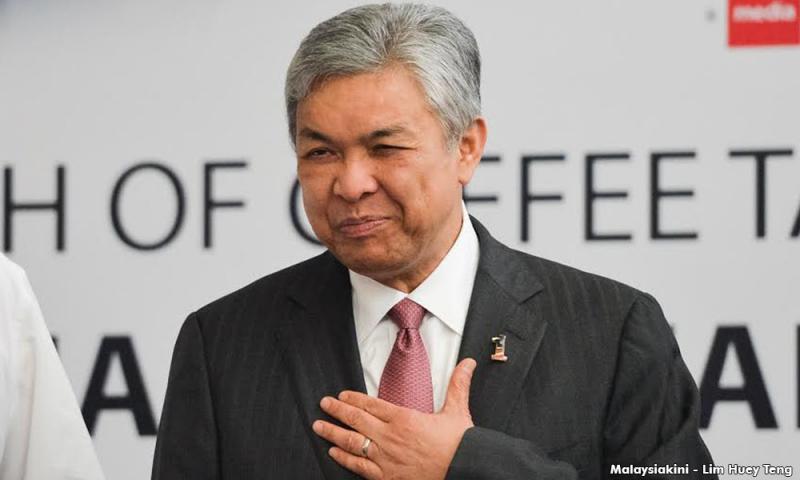
COMMENT Praises of the chief by the deputy is de rigueur, but Deputy Prime Minister Ahmad Zahid Hamidi found this task tough to bring off without embarrassment yesterday, when he officiated at the launch of a book about Prime Minister Najib Abdul Razak.

How do you praise when a lot of the vibes about the boss these days reek of disgrace?

Zahid could not possibly have drawn inspiration from the book itself, which is entitled ‘Najib Razak 40 Years 40 Pictures’.

Books about sitting prime ministers - and launched by deputies - cannot be anything but hagiographies.

In the circumstances, all the deputy can wish for is that the chief is out of town when the launch is held - in the hope that distance makes the compliments a tad less servile.

The PM's presence in the United States for the Asean leaders' meeting with US President Barack Obama, provided the pretext for the launch of the book.

Still, with ‘Najib Razak 40 Years 40 Pictures’ already an exercise in mythmaking, how could Zahid avoid overegging the pudding? How could he praise without seeming to fawn, sweet without being saccharine?

As one who recently challenged the Malaysian literary community to produce a Nobel Prize winner in a half century's time, perhaps there was a morsel of expectation that Zahid would bring some originality to his task yesterday.

It was a refreshing idea - Zahid's push for work that would merit Nobel recognition.

The American scholar on Southeast Asia, Benedict Anderson - who passed away recently - had previously noted that the region is the only one in the world that has not produced a Nobel literary laureate.

Anderson was of the opinion that the histories and cultures of Southeast Asian nations provided a rich matrix for work that would compel Nobel recognition, yet the region has not produced a scribe with the power to transmute this material into literary gems.

Zahid's dilemma

Indonesia's Pramoedya Ananta Toer came the closest (he died in 2006) with his Buru quartet of novels depicting his protagonist's voyage through the turbulent currents of Indonesian history in the 20th century, but the Nobel committee somehow ignored him.

So, kudos to Zahid for suggesting the possibility of a Malaysian Nobel literary apotheosis in 50 years' time; but pity he could not push things that way with a little originality of his own when placed on the spot.

Zahid's dilemma was how to sing an aria of praise to Najib without veering into persiflage.

He fluffed it badly.

Zahid reached back to a chapter of Najib's and the nation's history - the disturbances that gave rise to Operasi Lalang in late 1987 - to praise the current PM for displaying “great patience”, which his deputy hailed as the hallmark of a “great leader”.

Zahid said he witnessed Najib's cool under pressure of Special Branch questioning over the latter's involvement in an episode in which the participation of a few Umno Youth executive committee members had issued in their detention - together with 103 other social and political activists, including many from the opposition - under the Internal Security Act (ISA).

Zahid said he was impressed with Najib's equanimity under police questioning. He opined that the patience displayed was indicative of Najib's possession of “great” leader qualities.

Zahid left unsaid the cause for Najib's subjection to Special Branch questioning: his participation in an inflammatory gathering at a sports stadium in Kuala Lumpur on Oct 17.

In his capacity as Umno Youth leader, Najib had led the gathering and gave a speech that was incendiary - which was what led to the police questioning him.

He was lucky to escape ISA detention, which had befell then Pasir Mas MP Ibrahim Ali and Fahmi Ibrahim, both Umno Youth exco members.

Then PM and Home Minister Dr Mahathir Mohamad's selective use of the ISA during Ops Lalang was clear from how he allowed those in Umno - who had opposed him in the critical party polls six months earlier - to be detained.

Meanwhile those who had backed him, like Najib and then Selangor Menteri Besar Muhammad Muhd Taib - two of the more inflammatory speakers at the sports stadium gathering - were allowed to go free.

To say, as Zahid did yesterday, that Najib exuded “great patience” under police quizzing in 1987 is akin to saying that attorney-general Mohamed Apandi Ali showed admirable objectivity - in finding that Najib had done no wrong based on his perusal of the investigation papers on the RM2.6 billion donation in the PM's personal bank accounts.

Smart work by Najib

Perhaps Zahid could have made a better case for Najib's equanimity by citing how he, as deputy PM, navigated the choppy waters when the Umno supreme council members - under relentless prodding by Mahathir - were moving to dump then premier Abdullah Ahmad Badawi.

Abdullah, under pressure to quit following Umno-BN's loss of its traditional super majority in Parliament in March 2008, was crestfallen when faced with the desertion of his allies at a supreme council meeting in February 2009.

The desertion was painful, but Najib held off those in the supreme council clamouring for Abdullah's removal enough to provide the incumbent PM with a suitable interval to effect a face-saving exit.

That was considerate of Najib and it is paying dividends presently in the silence emanating from Abdullah's quarter amid the growing chorus of calls for Najib's ouster.

The dignified exit Najib brokered for Abdullah was smart work by the PM and prescient, too, in how it is now paying off.


TERENCE NETTO has been a journalist for more than four decades. A sobering discovery has been that those who protest the loudest tend to replicate the faults they revile in others.