




JE virus not behind death of pigs, says Muhyiddin
Whatever caused the death of more than 100 pigs at a Malacca farm since Jan 20, officials are convinced that it was not a Japanese Encephalitis (JE) or Nipah virus outbreak .
Whatever caused the death of more than 100 pigs at a Malacca farm since Jan 20, officials are convinced that it was not a Japanese Encephalitis (JE) or Nipah virus outbreak .
Agriculture and Agro-based Industries Minister Muhyiddin Yassin attributed the preliminary cause to food poisoning, but also said his ministry was awaiting the test results.
 He specifically gave the assurance that there is no indication of a recurrence of the deadly JE, when speaking to reporters at his office today after chairing a post-cabinet meeting.
"We have sent people to carry out an investigation. The situation is not alarming and there is no suspicion of JE, so there is no cause for alarm," he said.
Muhyiddin also described this as an "isolated case" and gave the all-clear for pork consumption.
Press reports earlier quoted the owner of the farm, located in Paya Mengkuang, as saying that the animals were among the 260 that had eaten local feed which he had bought earlier this month.
Disease control division director Dr Ramlee Rahmat, however, told malaysiakini that he was informed the cause of death was "swine fever".
Asked about preparations should the deaths be traced to JE after all, Ramlee said he has alerted hospitals in Malacca, as well as all state health departments, to be prepared and monitor patients that come down with suspected symptoms.
"I have reminded them to follow the guidelines imposed during the 1998 JE virus outbreak," he said when contacted.
Most JE virus-infected persons develop mild symptoms or no symptoms at all. It usually starts as a flu-like illness, with fever, chills, tiredness, headache, nausea and vomiting.
As there is no vaccine for the JE virus, Ramlee said infected patients would have to develop resistance to fight against the virus.
In 1998, the local pig industry was badly hit by an outbreak. The cause was initially said to be the JE virus but later it was discovered to be a different strain.
The new virus was named Nipah after the Sungai Nipah village in Bukit Pelanduk, where the outbreak was the worst.
The virus originated from the animals, but infected humans. Over 250 people were infected and more than 100 died from the disease.
Bird flu - contingency plan?
Responding to a question on bird flu, Muhyiddin said the cabinet has not discussed a contingency plan to deal with possible human-to-human transmission of this disease which has been detected in Vietnam.
"We acknowledge that neighbouring regions are facing a serious threat of this and we're aware of the latest move by the Thai government (to adopt a contingency plan). We have no such plan at the moment but we will be vigilant," he said.
The Thai government yesterday adopted a US$125 million emergency plan to deal with the possible human-to-human transmission of bird flu.
Thai deputy premier Chaturon Chaisaeng was quoted as expressing worry that the disease could kill up to two million Thais if there is an outbreak.
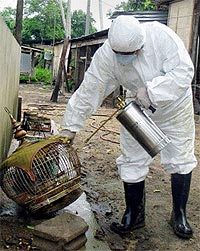 Elaborating on preventive measures in place in Malaysia, Muhyiddin said the government has maintained a ban on poultry imports from affected countries and will continue to monitor poultry farms.
He said the government will also be kept informed by neighbouring countries on the latest developments there.
"We cannot take it for granted that the bird flu will not occur again (here)," he cautioned.
The government declared Malaysia to be free of bird flu on Jan 6, following the country's first case of the H5N1 strain that was detected in a Kelantan village last August.
The H5N1 strain of bird flu killed 32 people in Asia last year.


Are you sure you want to delete this comment?
This action cannot be undone.