




Womens rights: Lets not wait another 20 years, say NGOs
While the government has taken several steps in the right direction to improve women's rights over the past two decades, many commitments it had made remained unfulfilled.
While the government has taken several steps in the right direction to improve women's rights over the past two decades, many commitments it had made remained unfulfilled.
In conjunction with the International Women's Day today, the Joint Action Group against Violence against Women (JAG-VAW) welcomed the amendments made by the government to rape laws in 1988 and the enactment of the Domestic Violence Act in 1994.
 "However, much remains to be done to ensure the enjoyment of these rights through the elimination of discriminatory of cultural practices, gender stereotyping, ensuring the allocation of resources, capacity building and adoption of temporary special measures, where necessary, for the full realisation of women's rights," said JAG-VAW executive director Maria Chin Abdullah.
For example, she said the country's rape laws do not adequately address the various acts of violence that occurred in such cases.
Maria called for urgent attention on redressing the exception where husbands may not be charged with raping their wives.
"This non-recognition of marital rape allows husbands to rape their wives with impunity. There is also an absence of any sort of compensation or assistance for rape survivors. Each of these factors inhibit a woman's ability to safely and completely exercise her rights," said Maria, whose organisation is also celebrating its 20th anniversary today.
20 years of struggle
Despite have spent 20 years of working, campaigning and lobbying, JAG-VAW - a coalition of six women's organisation - said many key issues which were brought up had not been dealt with satisfactory by the government.
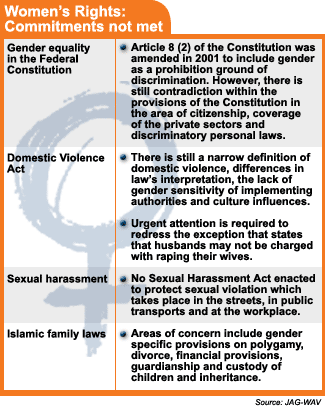 Among recommendations made by JAG-VAW include that the Sexual Harassment Act be enacted with immediate effect, the Islamic Family Law be reviewed and standardised at all state levels, a review all other laws that discriminate against women such as the Federal Constitution and the Immigration Act to guarantee equality to both foreign men and women.
JAG-VAW is made up of All Women's Action Society, Women's Aid Organisation, Sisters in Islam, Women's Centre for Change Penang, Women's Development Collective and Malaysian Trade Union Congress Women's Committee.
Maria said that with the ratification of the Convention on the Elimination of All Forms of Discrimination (Cedaw) in 1995, the government undertakes a legal obligation to "take all appropriate measures" to eliminate discrimination against women and ensure development and advancement in civil, political, economic, social and cultural aspects.
 Cedaw spells out the government's obligation towards gender equality, while the Beijing Platform for Action (BPFA) identifies specific action-oriented programmes in relation to the convention.
Malaysia will be participating a meeting in New York to review and appraise the implementation of BPFA this week.
Patriarchal culture
Meanwhile, Parti Keadilan Rakyat president, Dr Wan Azizah Wan Ismail - the only woman to lead a political party in Malaysia - paid tribute to "the efforts of millions of unnamed women who quietly and diligently serve the society as mothers, wives, daughters, workers, soldiers and a wide variety of trades".
"Women's struggle for equality is not merely to defend women's rights, but for the liberation of all human race," said Wan Azizah, in a statement released in conjunction with International Women's Day.
She lamented that the patriarchal culture remain strong due to the country's legal system and law enforcement, and the model of our national economic development.
 According to Wan Azizah, the latter focused on creating wealth for a selective group of people and as a result, the majority of the people suffer and were not included in reaping the fruits of economic growth.
"Women in particular, are still facing many unfair obstacles which hinder their participation in economic and political decision-making processes."
Women too, are usually the prime victim of crimes and violence, especially when economic decline in the country occurs.
Wan Azizah suggested tougher punitive laws or more police personnel to secure safety and peace, particularly for the women.
She argued that a society that practices universal human rights and rule of law will provide more space and opportunities for the women to advance themselves.


