




No durian! But space awaits teh tarik, roti canai and belacan
The 'king of fruits' will not be able to voyage into the last frontier as durian is strictly prohibited from leaving the earth's atmosphere. But teh tarik , roti canai , sambal belacan and batik get the nod.
The 'king of fruits' will not be able to voyage into the last frontier as durian is strictly prohibited from leaving the earth's atmosphere. But teh tarik , roti canai , sambal belacan and batik get the nod.
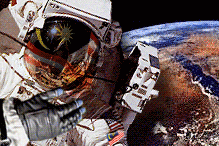
This is not a joke, but something which the National Space Agency (NSA) is putting in a lot of effort to realise when the nation's first astronaut joins a Russian space mission scheduled for October 2007.
"We just want our astronaut to enjoy Malaysian food in space and it will involve a lot of science in preparing them," NSA director-general Dr Mazlan Othman was quoted as saying by Bernama .
She said the agency would be sending a chef and a fashion designer to the National Aeronautics and Space Administration (NASA) in Houston, the United States, to conduct the research with the help of the American space agency.
"We just want our astronaut to share the local culture with the Russian colleagues during the mission," she added
Mazlan said ulama (religious scholars) might also be involved in the research should the successful astronaut candidate be a Muslim.
"Their (ulama) help is needed in determining the direction of kiblat (Kaabah) and prayer time in space," she added.
 Asked whether durians would be brought or allowed in the space craft, she said: "No. No."
The Malaysian astronaut programme costing about US$25 million (RM95 million) is part of an offset programme for the procurement of 18 Sukhoi SU-30 MKM multi-role combat aircraft worth US$900 million (RM3.4 billion) from Russia.
The deal was signed on Aug 5, 2003 in Putrajaya. The fighter jets will be delivered in stages from next year.
Russia will implement a transfer of technology and offset programme worth US$270 million (RM1.026 billion), constituting about 30 per cent of the contract value.
In a counter-purchase arrangement, Russia will buy US$270 million worth of palm oil from Malaysia, while the balance of the aircraft purchase will be paid in cash by Malaysia.
Not a passenger
Meanwhile, Mazlan said the Malaysian astronaut would not merely be "a passenger" during the space mission as he or she would carry out scientific experiments during the six to eight days stint at the International Space Station.
"It is not a glamorous trip. The trip will not be the end of the (Malaysian) astronaut career," she added.
Mazlan said two experts from Russia's space agency would arrive in Malaysia by the end of this month to help in the selection of candidates for the Malaysian astronaut programme.
She said 30 aspiring astronauts have been shortlisted from 3,700 applicants for the Russian space mission.
From the shortlisted candidates, 10 will be chosen by a team from the Russian space agency. They will then be sent to Russia by year-end for a thorough check-up.
Only two will be selected to undergo the two-year training. One will become the first Malaysian to journey into space while the other will be put on the reserve list.


