


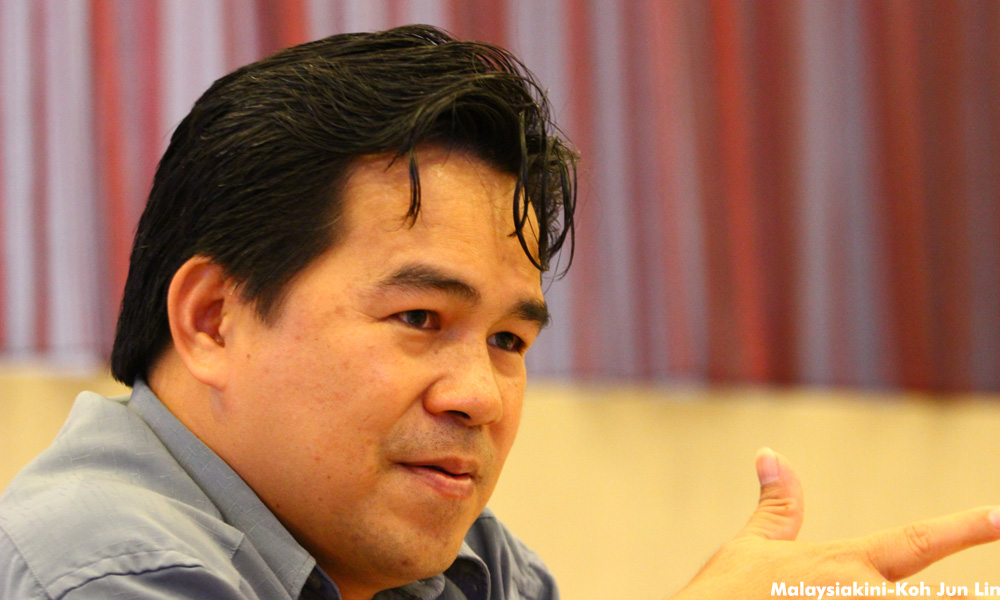

S’wak PKR candidate plots comeback with income scheme
INTERVIEW | Roland Engan did not win when he contested in the Sarawak state election, but he came very close. Tantalisingly close.
The Baram native first entered the fray in the 13th general election, but fell just 194 votes short of wresting the Baram parliamentary seat from BN.
He tried again at the Telang Usan constituency during the 11th Sarawak state election early this month. This time, he came up 167 votes short.
INTERVIEW | Roland Engan did not win when he contested in the Sarawak state election, but he came very close. Tantalisingly close.
The Baram native first entered the fray in the 13th general election, but fell just 194 votes short of wresting the Baram parliamentary seat from BN.
He tried again at the Telang Usan constituency during the 11th Sarawak state election early this month. This time, he came up 167 votes short.
This was among slimmest of majorities out of the 82 seats contested in the state election – second only to the 154-vote BN victory in Ngemah.
Far from disheartened however, the 44-year-old lawyer spoke with unwavering passion during an interview with Malaysiakini on Friday last week, and seems to have taken the near-miss in stride.
“Okay. No problem,” he said, when asked if he would contest for the third time. He snapped at the question without missing a beat.
Not only that he was prepared to contest, he already had a plan to help elevate the income of his fellow natives in Baram and hence reduce the influence of money politics at the polls.
The Baram constituency comprises the Marudi, Telang Usan, and the newly-created Mulu state constituencies. Baram borders with Brunei to the north, and Indonesia to the east.
Access and communications to these rural constituencies can be difficult especially in the latter two, which could entail travelling on dirt roads, on rivers, or no roads at all. Mobile phone coverage in these areas is spotty at best, and largely non-existent.
There are 33,458 voters in Baram, who are spread over an area slightly larger than the size of Perak. An overwhelming majority of them are classified as non-Muslim bumiputera.
It is here that Roland has set the Baram Heritage Association (Persatuan Warisan Baram) several months before the May 7 state election.
It is now in the process of recruiting members, he said, and once it has garnered enough support, the society will raise funds from amongst its members to set up a cooperative.
The cooperative would then help the Baram natives raise their incomes by helping to improve the yield of their crops and move away from subsistence farming, bringing their products to market, and helping to promote ecotourism.
Basic amenities
Compared to DAP’s Impian Sarawak programme and PKR’s own infrastructure programme, Roland said the two are more focused on providing basic amenities such as water and electricity.
BN can and has been able to match these with much larger projects of its own, hence nullifying the effectiveness of the programmes of DAP and PKR as a means of garnering political support.
In contrast, he said the Baram Heritage Association is more focused on raising incomes, which BN has not given much attention to.
Despite the association’s overtly economic goals, its ultimate purpose is political.
On one hand, having a steady source of income would reduce the influence of money politics.
All this while, Roland said, PKR has been telling its supporters to accept any goodies BN offers them as long as they vote for the opposition, but this may not be applicable in Sarawak.
“When we start to tell people to do that in the kampung, it won’t work because of our culture. We would be indebted and obligated to the person who gave you money.
“If you don’t vote for them, you would feel guilty,” he explained.
“I think it is better if we tell them that this is part of money politics, bribery. We must stop receiving this money.”
This is what happened in Ba’kelalan, he said, where voters were told to reject the election goodies offered to them and at least some groups did so.
Sarawak PKR chief Baru Bian not only managed to defend his Ba’kelalan seat, but is one of few opposition assemblypersons who managed to do so while improving the margin of his victory, even as BN reversed the opposition’s 2011 winnings in the rest of the state.
More incentive
Meanwhile, Roland said the Baram Heritage Association initiative would give locals more incentive to defend their customary land rights.
It gives them a bigger stake in the land, so they would no longer see selling it for a quick buck as the best way to use it.
The challenges he faced while campaigning on native customary rights (NCR) issues are two-fold, he explained, when asked about the Baram Dam issue.
For some of the older natives, Roland said they simply want to be rich beyond imagination once in their lifetime before they pass away, after living a life of poverty.
This comes at the expense of not having a legacy to leave to their children, but then, their children may have already left the longhouse for good in search of a better life.
As for the middle-aged, they are generally trying to save money while working in town in hopes of raising enough funds to work their land.
For the youth however, Roland said they do not seem to care about land and prioritise employment instead.
“To them, the Baram Dam is an opportunity to create jobs. So for us as politicians, we have to explain to them the effects of Baram Dam and the resettlement.
“You see, you have such a big area of NCR land, but suddenly when you go for resettlement, you may only get three acres of land for each family,” he said.
Roland had been campaigning against Baram Dam since 2009. Although the project has been cancelled just months before the election, he is wary that project may be revived again like the Bakun Dam project.
Asked about his performance at the recent election, Roland said he did not understand how he could have lost.
“Before the election, we even did some head-counting. We identified all our supporters. Before the election, we were so confident that those counted by us - about 4,000-plus - would vote for us.
“Some were in Miri away from their villages, but they were ready to go back to vote. But I don’t really know why we lost,” he said.
Not only that the support did not materialise and he ended up with only 3,064 votes, several large longhouses that traditionally voted in PKR’s favour had inexplicably turned against him.
He said this may have been due to the rumours of rampant money politics that he had heard of, and he was told that some voters were also turned-off by the clash between PKR and DAP.
The appearances of BN heavyweights such as Umno youth chief Khairy Jamaluddin Abu Bakar, Deputy Prime Minister Ahmad Zahid Hamidi, and Prime Minister Najib Abdul Razak also carried weight against him.
In particular, Roland pointed out, Najib launched an interest-free loan scheme for longhouses during his visit to Long Laput and Long Loyang, with on-the-spot approval.
Voters also held Sarawak Chief Minister Adenan Satem with high regard, he said.
On the other hand, he said the redelineation exercise last year did not affect his chances, although it involved carving up parts of Telang Usan and Ba’kelalan to form the Mulu constituency.
Roland also opined that this time round, the opposition’s campaigning was also worse compared to the 2011 state election, where the state opposition had a shadow cabinet and a common manifesto.
“Our preparation was totally worse than the 2011 election. It is a psychological war – in elections we must show the people that we are ready to rule, to take over from BN.
“Even now, we don’t have a shadow cabinet. We are so busy fighting over the seats, and up to the last minute of the nomination, the potential candidates were so busy spending time waiting for their appointment letters in Kuching.
“So people were busy fighting over the seat allocation, not busy thinking about the shadow cabinet,” he said.


Are you sure you want to delete this comment?
This action cannot be undone.