


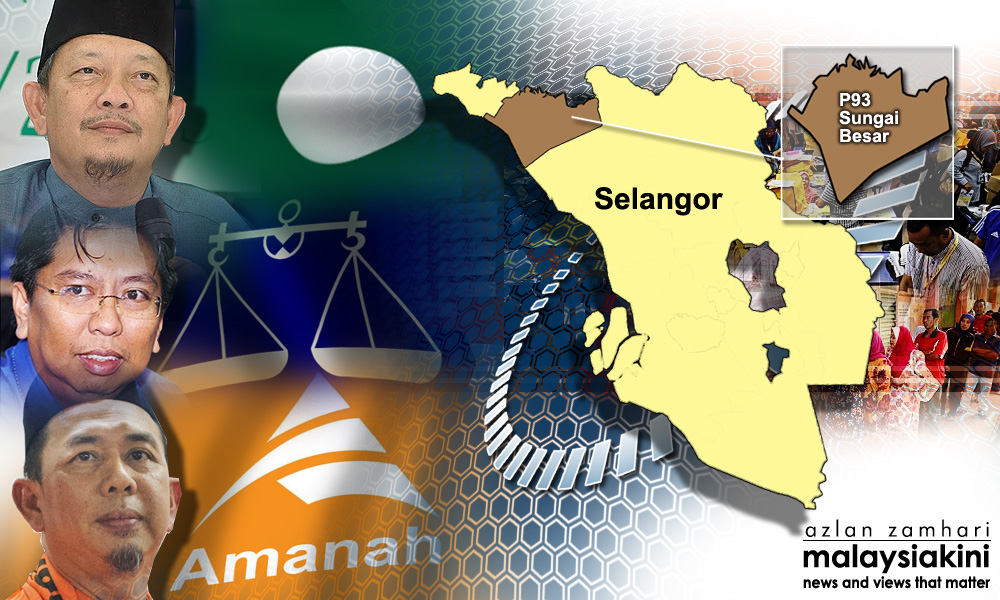

Analysts: Umno falls back on religious politics to win Malay votes
ANALYSIS Barely a week ago, the nation still looked at the twin by-elections in Sungai Besar and Kuala Kangsar as a gauge of Prime Minister Najib Abdul Razak’s approval rating following the 1MDB fiasco and RM2.6 billion ‘donation’ controversy.
However, the allowing by the government of PAS president Abdul Hadi Awang’s contentious Private Member’s Bill, dubbed Act 355, to be tabled in Parliament last Thursday, has changed perceptions.
Hadi has chosen to defer debate on the bill until the next parliamentary session, to be held from Oct 17 to Nov 24.
ANALYSIS Barely a week ago, the nation still looked at the twin by-elections in Sungai Besar and Kuala Kangsar as a gauge of Prime Minister Najib Abdul Razak’s approval rating following the 1MDB fiasco and RM2.6 billion ‘donation’ controversy.
However, the allowing by the government of PAS president Abdul Hadi Awang’s contentious Private Member’s Bill, dubbed Act 355, tabled in Parliament last Thursday, has changed perceptions.
Hadi asked that the debate on the bill be deferred to the next parliamentary session, to be held from Oct 17 to Nov 24.
While political analysts agree that Hadi's bill is a diversionary ploy to deflect the nation’s attention, they also see the move as Najib and Umno shifting their electoral agenda from multiracial to Islamic politics, a sign they are resorting to the religious card once again.
Signs can be found in the allowing of Hadi's bill, or the Syariah Court (Criminal Jurisdiction) 1965 (Amendment) Bill 2016 to be tabled in Parliament, and the fielding of a widow candidate even when she chooses to observe the ‘iddah’ (mourning) obligation that prevents her from leaving the house for four months and 10 days.
Umno is therefore using the religious card to work to its advantage, analysts said.
 “The usage of Islamic issues in politics has been part of the scene for the last 30 years. So, it is nothing new,” said Ibrahim Suffian (photo), programme director of independent pollster Merdeka Center.
“The Malays in the country increasingly take on Islam as part of their identity.
“So, Islamic topics, such as hudud and the moral piety of individuals and their compliance, have become part and parcel of the political discourse,” Ibrahim said.
Should not play with ‘iddah’
Agreeing, Universiti Kebangsaan Malaysia associate professor Mohd Faisal Syam Abdol Hazis noted that the strategy of playing the religious card was nothing new for both Umno and PAS.
“It was put aside in the last two general elections, when PAS worked with Pakatan Rakyat, while Najib tried to capture non-Malay voters with his transformation plans,” Mohd Faisal told Malaysiakini.
“But it didn't work out for Najib as he flip-flopped a lot. He backtracked with Perkasa and Umno conservative leaders, then he introduced the 'bumiputera agenda' as a counter-measure to the New Economic Model (NEM),” he said.
More than a decade ago, former prime minister Dr Mahathir Mohamad had to announce Malaysia as an Islamic state to compete with PAS, when the latter advocated for an Islamic state and hudud, Mohd Faisal said.
“This will surely be a trend in the future (general elections). Since PAS has taken up the hudud and the Islamic state (issues), definitely Umno will counter with its (own) Islamic narrative,” he added.
He said the recent developments show Najib as focused on gaining the Malay vote.
“Since most of the non-Malays are supportive of the opposition, the battle has shifted to winning Malay support by either BN or the opposition,” Ibrahim said.
Mohd Faisal expressed his disagreement with BN for capitalising on the ‘iddah’ issue in the Kuala Kangsar by-election.
“To me, playing up ‘iddah’ should not have happened. If you respect the widow’s decision to observe ‘iddah’, then you should not put her up as a candidate,” said Mohd Faisal.
“This is an election, it is unacceptable for the candidate not to meet the voters to explain her views on local and national issues, or her plan to serve the constituency,” he stressed.
“This is not an Islamic issue, but BN tries to bank on the sympathy votes... It is very unfortunate that Islam has been put forward and used in such a way,” Mohd Faisal said.
The political analyst also commented on Hadi’s bill, which he said saw Umno and PAS collaborating on the bill - which will ultimately allow Kelantan to implement hudud - as a move to kill both PAS and Amanah.
 Political commentator Tang Ah Chai (photo) said: “Umno will be the biggest winner. It initiated the move and put PAS on the spot. This will definitely scare the non-Malay voters away. It will not be easy to convince them to vote for the Islamic party.”
Umno won Sungai Besar with a slim majority of 399 votes or 49.6 percent of the votes in the last general election. It won Kuala Kangsar with a majority of 1,082 votes or 50.4 percent support.
Both seats are traditional BN strongholds that have never been won by the opposition.
PAS managed to secure its best result then in 2013 with the support of the non-Malays. Its Malay votes dropped in the last poll, after being branded as DAP’s proxy.
Zooming in on Jalan Kangsar, one of the 26 polling districts in Kuala Kangsar, PAS secured 62.7 percent of the votes in the 13th general election, as compared with 49.1 percent in 2008 in the Chinese majority mixed area, which consists of 50.6 percent Chinese and 33.5 percent Malay.
In Bukit Chandan, which consists of 90.8 percent of Malay voters, PAS only secured 43.3 percent of the votes in 2013, as compared with 50.5 percent in 2008 general election.
The dropping of support for PAS was similarly recorded in 15 other Malay-majority polling districts in Kuala Kangsar, while the Islamic party's votes increased in six Chinese-majority polling districts in the royal town.
In Sungai Besar, votes for PAS increased in all the seven Chinese-majority polling districts, out of 30, in 2013, compared with GE12 in 2008.
It recorded 76 percent of the votes in Sekinchan Tempatan, where 99.5 percent of the 2,500-plus voters are Chinese.
Back then, Umno had constantly demonised DAP as being an anti-Malay and anti-Islam party in its rural and semi-urban constituencies in past elections.
“It seems to me, PAS has no intention of winning in the by-election. It just wants to defeat Amanah. Its strategy has helped Umno more than it has in enhancing the opposition. This is a selfish move to defeat the opposition movement,” said Tang.
UKM associate professor Mohammad Agus Yusoff said both Umno and PAS may risk losing the support of the non-Malay community as they see Hadi’s bill as a hudud bill, he said.
“Thus they (the two parties) may have difficulty in explaining matters. But for Malay voters, they understood clearly that this has nothing to do with hudud,” Mohammad Agus claimed.
He also noted that national issues seemed to have quietened down for a while.
Sungai Besar and Kuala Kangsar have, respectively, 42,655 and 32,949 registered voters.
According to the statistics from GE13, Sungai Besar comprises 66 percent Malay, 31 percent Chinese and two percent Indian voters, while Kuala Kangsar comprises 68 percent Malay, 24 percent Chinese and seven percent Indian voters.
This is the 11th and 12th parliamentary by-election after the 2013 general election.
“Amanah will face an uphill challenge in gaining Malay votes because it is new, and may not have the resources to advertise itself and what it stands for.
“It also has to fend off accusations that it’s a DAP proxy, or the perception that it is a grouping of individuals who can’t fit in with PAS,” said Ibrahim.
So far, both BN and PAS have announced their candidates, with BN fielding a woman candidate in Kuala Kangsar and a state representative in Sungai Besar.
Amanah finally announced its candidate in Sungai Besar yesterday, and is to unveil its Kuala Kangsar candidate today.
'Either way, Amanah will lose'
Meanwhile, Penang Institute fellow Wong Chin Huat said Hadi’s bill appears reasonable to the Malay community, especially as it allows certain punishments outlined in the hudud law.
“If PKR and Amanah oppose the bill, they will be branded as traitors to Islam. They will risk losing the support of Malay voters,” Wong said.
“If they agree, then both Umno and PAS can claim credit for the bill. Malay votes will still go to both parties,” he explained.
“This will (also) discourage the turnout rate of the non-Malay voters,” Wong said, adding this would enable MCA and Gerakan, which suffered the greatest loss among the BN parties in the 2013 general election, to make a comeback.
Tang said that if it was true that the BN parties MCA and Gerakan had been aware of Hadi's bill before it was fast-tracked in Parliament, it might be part of the BN strategy to weaken the opposition.
“But if they were not aware of this, then it shows that these parties cannot play a check-and-balance role in the BN structure,” Tang said. “The spirit of BN is no longer felt here.”
Unless Amanah or Harapan can come up with a counter-measure that can bind both Umno and PAS together, or play up issues that are dear to the locals effectively, Tang said, Umno would stand a bigger chance of retaining both seats.
The Amanah candidate in Sungai Besar would be at the mercy of Umno if the Selangor government’s resources are not used in the by-election, Wong said.
“The religious card is always effective, be it in a by-election or in the general election, unless there is a another more pressing matter,” noted Wong.
While acknowledging the effectiveness of the religious card played by Umno and PAS, both Mohd Faisal and Tang see the people in general as being on the losing end.
“This is not healthy. This can split the community,” both analysts said.
“After the 2013 election, we have witnessed the country regress to an authoritarian mode, where Najib and Umno resorted to issues on race and religion,” Mohd Faisal said.
“We are dividing the Malaysian community apart due to religious politics. Ultimately BN will do anything to hold on to federal power,” he stressed.
“The fact is, the consequence of such a move (by Umno and Najib) may be bigger than winning or losing the twin by-elections alone,” Tang warned.


Are you sure you want to delete this comment?
This action cannot be undone.