




PAS and Amanah in desperate battle for second place in twin polls
ANALYSIS Deputy Prime Minister Ahmad Zahid Hamidi may have claimed BN is the underdog going into the Sungai Besar and Kuala Kangsar by-elections, but the contest is turning out to be a dog-eat-dog battle for PAS and Parti Amanah Negara.
BN is in a relatively comfortable position due to multi-cornered contests pitting the opposition against each other, making what would have been a good chance to upset the ruling coalition into a desperate attempt by both Amanah and PAS.
Even DAP veteran Lim Kit Siang conceded this, admitting that it would take a miracle for Amanah, which is representing Pakatan Harapan, to win in the Kuala Kangsar by-election.
“If we cannot win, we should at least emerge as second highest in votes,” Lim said.
He had similarly described an Amanah win in Sungai Besar as a “miracle”, although Harapan stands a better chance due to the substantial number of Chinese voters.
 Echoing similar sentiments is three-term DAP Sekinchan assemblyperson Ng Suee Lim (photo), who told Malaysiakini that Harapan hopes to, at least, secure the second highest number of votes.
Sekinchan is one of two state constituencies within the Sungai Besar parliamentary seat.
However, there are no winners coming out in second place in these by-elections.
If Harapan, or even PAS, is to stand a chance against BN, they will need to go beyond their traditional support base.
However, neither party appears to be putting significant effort in breaking new ground with both instead attempting to consolidate their support bases.
Harapan, for example, has poured substantial resources into non-Malay areas, which are seen as the coalition’s support base.
These voters preferred PAS in the 2013 general election, but are unlikely to do so again as PAS is no longer part of the Pakatan Rakyat coalition, which has reincarnated as Harapan.
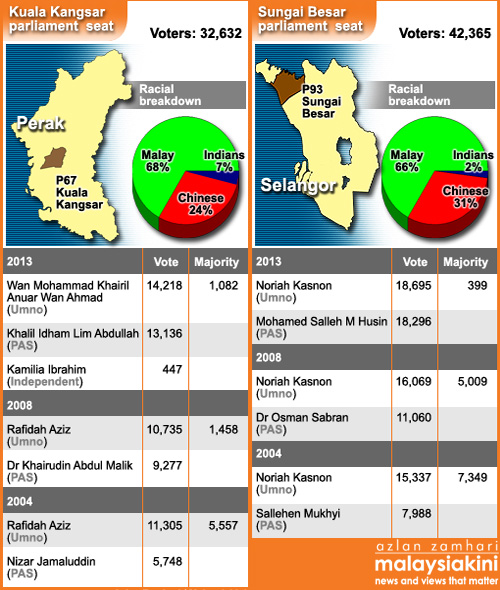
There are 31 percent non-Malays in Kuala Kangsar and 33 percent non-Malays in Sungai Besar.
The last general election saw BN win Kuala Kangsar with majority vote of 1,082 or 50.4 percent of the votes cast. In Sungai Besar, BN won with slim 399-vote majority, or 49.6 percent of the votes cast.
Harapan’s campaign machinery is particularly felt in the Chinese areas, where DAP has been entrusted to campaign for Amanah candidates.
In Kuala Kangsar, Amanah’s candidate Ahmad Termizi Ramli also spent substantial time in Chinese areas, having visited Kuala Kangsar town for three consecutive days.
PAS focuses on winning Malay support
PAS seems to focus on winning Malay support as most of its campaign has been focused on Malay-majority areas in the last four days.
 PAS president Abdul Hadi Awang and Kuala Kangsar candidate Dr Najihatussalehah Ahmad also marched into Kampung Baru Jerlun, the only Chinese new village, to explain the contentious hudud issue to 50 villagers.
PKR, which is entrusted to take care of half of the Harapan campaign in the Malay-majority areas, only saw its superstar speaker - PKR secretary-general Rafizi Ramli - appear at a ceramah on the fourth night after nomination.
Meanwhile, PAS is focusing on the Malay heartland, with only limited efforts in Chinese areas.
Even though PAS has vowed not to give Umno an easy win, PAS and Umno have barely traded barbs in the Malay heartland.
Instead, PAS has focused mainly on religious issues, and the rare occasions that it attacked the government was in Chinese areas, where its campaign is equally rare.
Speaking at a dialogue in Jerlun, a Chinese-majority area in Kuala Kangsar, the constituency’s PAS election director Idris Ahmad asked the people to vote for PAS to protest BN’s policies and the 1MDB scandal.
PAS also explained the hudud issue, with Perak PAS commissioner Razman Zakaria telling voters there that the prime minister would not “steal” RM2.6 billion if hudud was in place.
Prime Minister Najib Abdul Razak has said the money was a “donation” and denied taking public funds for personal gain.
Painting Amanah as a DAP proxy
In Sungai Besar, PAS candidate Abdul Rani Osman did voice support for Najib to step down as prime minister, but his campaigners also spent substantial resources painting Amanah as a proxy of DAP.
The move even forced Harapan to issue a joint statement denying that Amanah is led by DAP.
Amanah central committee Hu Pang Chaw told Malaysiakini that the party’s central committee had decided not to respond to PAS on the matter.
“Once you respond, the other side will counter, and sooner or later the people will believe the lies,” said Hu.
“Our strategy is to marginalise PAS, making the by-election as though a battle between BN and Harapan,” he added.
However, despite efforts to paint the by-elections as a battle between BN and Harapan, PAS has still been able to make its presence felt.
Under such desperate circumstances, Harapan is hoping to make the best out of a bad situation.
A DAP official, who is part of the campaign in Kuala Kangsar, told Malaysiakini that coming in second at the very least is essential in a situation where the chances of winning are slim.
'Impact on the next general election'
“It’s not easy to be number two either, and we will definitely not take this lightly.
“The by-election results will have an impact on the next general election, which is two years down the road.
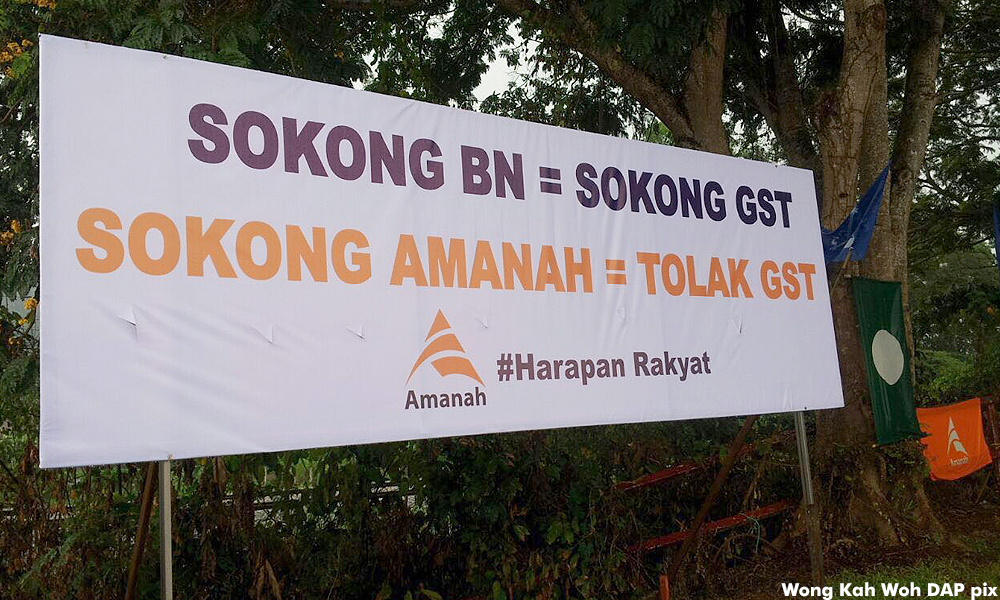 “Internally, this is a battle that will have an impact on the momentum of the opposition movement. Externally, this involves public confidence in us (Harapan),” the official, who did not want to be named, said.
He added that the twin by-elections would be a litmus test for seats that have similar demographics as Kuala Kangsar and Sungai Besar.
“We are targeting a 70 percent Chinese voter support, anything less than that is not good and will dampen our chances in the next general election,” the official said.
However, he admitted that it may be hard for Amanah to secure Malay votes, which will also be split between BN and PAS.
“If Amanah can get 15 percent to 20 percent of the Malay votes, that will be good enough,” he added.
According to him, PAS had secured 76.5 percent of the Chinese votes in 2013, as compared with 45.1 percent in 2008 when it was part of Pakatan Rakyat.
However, it obtained 35.8 percent Malay support in 2013, an 8.7 percent drop from 44.5 percent in 2008.
As for Sungai Besar, DAP’s Ng Suee Lim said the situation there was better, with a glimmer of hope for victory, albeit an uphill battle.
Both Ng and the other DAP official said the opposition would have to persuade the outstation voters to come back to vote.
The last polls saw a turnout of 84.1 percent in Kuala Kangsar and an overwhelming 88 percent turnout in Sungai Besar, which would be difficult to replicate in these two by-elections.


Are you sure you want to delete this comment?
This action cannot be undone.