




Q&A: Msia not snubbed by Clinton, Bush in tsunami tour, says US envoy
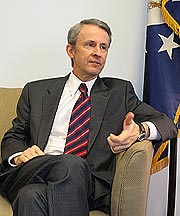
US ambassador to Malaysia Christopher J LaFleur talks about Malaysia's involvement in the reconstruction of Iraq, ex-premier Dr Mahathir Mohamad and deputy ex-premier Anwar Ibrahim in this first of a two-part series.
Malaysiakini: This is your first posting in Southeast Asia. Previously, you had spent some time in Japan and served a short stint in Taiwan.
 Christopher J LaFleur:
It was about four years in Taiwan and quite a bit of time in Japan. Back in Washington though, I was in charge of the office that dealt with Laos, Vietnam and Cambodia. My last job in Washington was in the East Asia and Pacific Affairs bureau. I was number two in the bureau and one of the things I was asked to do was to manage US relations with Asean as a group. So in that sense, I've had some opportunities to work with a number of Southeast Asian countries.
Christopher J LaFleur:
It was about four years in Taiwan and quite a bit of time in Japan. Back in Washington though, I was in charge of the office that dealt with Laos, Vietnam and Cambodia. My last job in Washington was in the East Asia and Pacific Affairs bureau. I was number two in the bureau and one of the things I was asked to do was to manage US relations with Asean as a group. So in that sense, I've had some opportunities to work with a number of Southeast Asian countries.
You're married to (former Japanese prime minister) Kiichi Miyazawa's daughter. How did that happen?
I don't know. We showed up at the same party - that's all I can tell you. She (Keiko) is a businesswoman ... we just happened to be invited to the same party and we also just happened to be seated right next to each other, and the rest is history, as they say. I have two daughters - the older one (Sarah) is 21, the other (Emma) is 16. One is in the United States, the other is in Japan.
US ambassador to Malaysia Christopher J LaFleur talks about Malaysia's involvement in the reconstruction of Iraq, ex-premier Dr Mahathir Mohamad and deputy ex-premier Anwar Ibrahim in this first of a two-part series.
Malaysiakini: This is your first posting in Southeast Asia. Previously, you had spent some time in Japan and served a short stint in Taiwan.
 Christopher J LaFleur:
It was about four years in Taiwan and quite a bit of time in Japan. Back in Washington though, I was in charge of the office that dealt with Laos, Vietnam and Cambodia. My last job in Washington was in the East Asia and Pacific Affairs bureau. I was number two in the bureau and one of the things I was asked to do was to manage US relations with Asean as a group. So in that sense, I've had some opportunities to work with a number of Southeast Asian countries.
Christopher J LaFleur:
It was about four years in Taiwan and quite a bit of time in Japan. Back in Washington though, I was in charge of the office that dealt with Laos, Vietnam and Cambodia. My last job in Washington was in the East Asia and Pacific Affairs bureau. I was number two in the bureau and one of the things I was asked to do was to manage US relations with Asean as a group. So in that sense, I've had some opportunities to work with a number of Southeast Asian countries.
You're married to (former Japanese prime minister) Kiichi Miyazawa's daughter. How did that happen?
I don't know. We showed up at the same party - that's all I can tell you. She (Keiko) is a businesswoman ... we just happened to be invited to the same party and we also just happened to be seated right next to each other, and the rest is history, as they say. I have two daughters - the older one (Sarah) is 21, the other (Emma) is 16. One is in the United States, the other is in Japan.
Malaysia has been held up as the model of a moderate Islamic state. Yet the US State Department has consistently criticised Malaysia in its annual freedom of religion reports.
I think you need to look at both the human rights report and the reports that we do annually on religious freedom for what they say. Both of the reports try to describe as accurately as we can what interested and concerned observers see ... in the country and assess the state of affairs in the country. It doesn't offer judgements, it doesn't offer report cards. It tries to describe what we understand is going on.
The second thing to say is that you need to look at these reports not in isolation to get into the sort of issues we're talking about. If you look at it from that perspective, Malaysia has some very admirable policies and traditions in terms of respect for the free practice of religion, etc.
I don't think it is for us to say how Malaysia should handle what are obviously some of the most sensitive issues in any country and so we'll leave it to you here in Malaysia to try to determine how best to protect freedom of religion which I understand is in the Constitution, while taking into account the fact that you do have large segments of the population that are adherents of one religion or another. That's an issue that I think Malaysians need to be the ones to do it.
Quite a number of Jemaah Islamiah operatives have either direct or indirect links to Malaysia. Some of them, though not Malaysians, had permanent residency status. In addition, a few of the top JI operatives (Noordin Mohd Top and Azahari Husin) are Malaysians. Is the US concerned about this?
The first thing to say is we have very good cooperation with Malaysia on counter-terrorism. Malaysia has taken action along with more than a hundred other countries on terrorist financing, to try and shut down financial networks that feed terrorist operations and we have every expectation that that cooperation is going to continue.
In so far one trying to point to one country or another as the origin of terrorism ... you would see that there are people from many countries who have ended up being associated somehow with terrorist organisations. I don't think it's appropriate somehow to point the finger necessarily at Malaysia or any other country in this regard.
Governments try to represent the interests of their citizens and ... they have a role in cooperating to prevent such people - whatever their nationality might be or wherever they might have lived - and try to prevent things from happening in our countries or cooperate to help others who might need it...
The FBI (Federal Bureau of Investigation) has been given access to Yazid Sufaat, an alleged JI operative held in Malaysia under ISA (Internal Security Act). What progress have you made?
I'm not in a position to talk about law enforcement or that sort of security issue. I'm not confirming anything. I wouldn't talk about it. Nobody in this position can go into issues that deal with that kind of activity.
What about BSA Tahir, the person who has been linked to nuclear proliferation and also held under ISA. The US is seeking access to question him but is having some difficulty. Are you still trying to get access?
We think it's a very good thing that the Malaysian government has apprehended Tahir. He clearly was in cooperation with this network that was providing materials for the production of nuclear weapons to others, so we're appreciative of what the Malaysian government has done. That's all I can say about that.
Can you confirm that you're still trying to get access to Tahir?
As I said, once you get into issues that involve law enforcement or security affairs, it makes it very difficult for me to give you a comment. You know the nature of these sort of things.
We're doing our job to ask the questions.
I understand, and I appreciate it. I'm just doing my job in not answering it.
The prime minister's son, Kamaluddin Abdullah, is somehow involved in this scandal - Tahir was his business partner and the whole operation was done through his company, Scomi. The Malaysian police has however cleared Kamaluddin from any involvement in the affair. What is the US position on that?
I don't think we have a position on that per se. I haven't seen the report personally, I would say we have very high respect for the Malaysian law enforcement authorities.
When Prime Minister Abdullah Ahmad Badawi met with President George W Bush, he promised that Malaysia would contribute in sending a medical team to Iraq. Somehow, this was later clarified that the team would only be dispatched when the situation in Iraq has stabilised.
We pretty much appreciated that the prime minister took the initiative to make some suggestions Malaysia and other countries could do to assist the new government of Iraq. It's clearly a government that faces many challenges and have other Islamic and Islamic-majority nations provide assistance would be incredibly valuable. We really appreciated his initiative on that.
I understand that Malaysia is still looking for the right conditions for more to be done directly in Iraq. Meanwhile, there are other things that could be done outside of Iraq.
But you would prefer this to be sooner rather than later?
Well, Iraq has just had elections. They're putting the process to gather a new government based on the results of those elections. It's obvious they face challenges as any government would in that situation.
I think there are a number of things that Malaysia and other countries could do to assist them. Malaysia has a lot of experience trying to manage the issues involved in establishing a multi-cultural, multi-religious, multi-ethnic community, and has a number of democratic traditions which may be helpful in informing what the Iraqis are doing.
It has experience in managing a complex society through the development process. There are a lot of things that I think Malaysia might have to offer in the way of training, passing on its experiences to the Iraqis. I think this is something that only Malaysia and other countries can determine what they have to offer.
Is the US surprised that somehow Malaysia didn't manage to come through with its promises?
As I said, we appreciate the initiative of the prime minister here and clearly every country has to determine what they are comfortable with in terms of assisting Iraq. Conditions are as they are in Iraq and we cannot foresee what's going on.
Malaysia and other countries have to (form their own judgements) about what kind of people they might be able to send to Iraq but as I said we appreciate the initiative and I think the prime minister had suggested to the OIC (Organisation of Islamic Conference) what it could do so I think these things are under active consideration.
Did the embassy seek clarification concerning the medical team?
Since the prime minister raised the issue, we've discussed it together from time to time. We understand that the considerations the Malaysian government has. Hopefully, there would be the right moment when that's going to be possible for Malaysia to look forward at. Meanwhile, there are many other things that can be done.
Recently, former premier Dr Mahathir Mohamad said that the US would use Israel to bomb Iran's nuclear facilities. Meanwhile, former deputy premier Anwar Ibrahim - in his visit to the United States - was received by key US officials such as (Deputy Secretary of Defence) Paul Wolfowitz. Can the individuals act as a thorn in US ties with Malaysia?
Both of these persons (Mahathir and Anwar) are former government officials, not current government officials. I don't think it's appropriate for me to comment on people who are not in official positions.
There are plenty of opinions out there and I think what our job here at the embassy is to try and represent US views as best we can to the (Malaysian) government and have dialogue with the government on those things, and to go out and try to explain to the people of Malaysia how we do things.
Some in the Malaysian government could be unhappy that Anwar has been given top-level access to key officials in the United States.
In the case of the former deputy prime minister, when he held an official position he met with a number of Americans some of whom were then and some of whom are now (officials) I guess he's visiting the United States, and he's attending a forum that the former defence secretary (Bill Cohen) is organising.
But he (Anwar) is a private citizen and he's meeting Americans that he knew from the past, and it's old friends getting together so I don't think I'd be able to (comment on this).
Why did ex-presidents Bill Clinton and George Bush bypass Malaysia in their trip to tsunami-hit nations last month?
They didn't go to India. In any case, they weren't by-passing Malaysia. The reality is, right after the tsunami, we had a mission that went through here. Then secretary of state Colin Powell and Jeb Bush, the governor of Florida and the brother of the president, made a swing through the area. That was approximately two weeks after the tsunami struck. At that point, they were focusing on the areas that had been determined to be worst affected.
But since there had been some damage to Malaysia from the tsunami, Assistant Secretary (of State for East Asian and Pacific Affairs) James Kelly, who had been with secretary Powell on that trip, broke off and came here and together we went up to Kedah to see what the damage looked like there and what we saw was, indeed there had been some terrible damage, but that the Malaysian government had organised very effectively to deal with it and we were impressed, and particularly assistant secretary Kelly was very impressed, given that he had just come from Aceh, to see how much Malaysia had been able to accomplish to deal with its problems.
Our overall assessment was that Malaysia was capable of dealing with its problems and indeed, more than that, capable of helping others. Both in terms of what we were doing then and in terms of what the two former presidents are doing now, the focus is on trying to help those who are assessed as needing a lot of outside help.
So it wasn't a snub.
On the contrary, it's a recognition of Malaysia's capabilities... I mean, we contributed a small amount of money to the effort here. You collected many, many millions of dollars in Malaysia to help people here but also people elsewhere. So it's really more a question of how we could cooperate and in fact, during the relief effort during the initial weeks, the Malaysian government took the unusual step of opening up its airfields so that our military aircraft could stage some of their relief operations, which was very helpful because of the proximity to Aceh.
It made it much easier for us to help people there and of course I know the Australians and United Nations aircraft were staged in other airfields here. So it was very helpful. There's no question, this has nothing to do with snubbing. You're doing well and you're helping others. We very highly value it.
US mum on access to nuclear black-marketeer Tahir
Tomorrow: Malaysia - biggest exporter of pirated digital discs


Report this comment
Are you sure you want to delete this comment?
This action cannot be undone.