




Human trafficking still plaguing our country
COMMENT The latest US Department of State’s Trafficking in Persons (TIP) report was released mid-last week on the heels of yet another devastating news of migrants dying in our shores because of abuses and mistreatments.
The latest TIP report showed that there was no improvement in Malaysia’s position in regard to fighting and eliminating human trafficking. We are now second consecutive year in Tier 2 Watch List.
While this is above the lowest band of Tier 3, it is below Tier 2 and denotes “countries whose governments do not fully meet the TVPA’s minimum standards, but are making significant efforts to meet those standards”...
COMMENT The latest US Department of State’s Trafficking in Persons (TIP) report was released mid-last week on the heels of yet another devastating news of migrants dying in our shores because of abuses and mistreatments.
The latest TIP report showed that there was no improvement in Malaysia’s position in regard to fighting and eliminating human trafficking. We are now second consecutive year in Tier 2 Watch List.
While this is above the lowest band of Tier 3, it is below Tier 2 and denotes “countries whose governments do not fully meet the TVPA’s minimum standards, but are making significant efforts to meet those standards”. It also denotes:
1. “That the absolute number of victims of severe forms of trafficking is very significant or is significantly increasing;
2. “There is a failure to provide evidence of increasing efforts to combat severe forms of trafficking in persons from the previous year, including increased investigations, prosecutions, and convictions of trafficking crimes, increased assistance to victims, and decreasing evidence of complicity in severe forms of trafficking by government officials; or
3. “The determination that a country is making significant efforts to meet the minimum standards was based on commitments by the country to take additional future steps over the next year.”
Just slightly more than two weeks before the report, the Nepali government said that there were 461 deaths of Nepali workers in Malaysia last year, 32 percent up from 348 deaths in 2014. This makes a horrifying average of nine deaths weekly; there are more Nepali workers death in Malaysia than days in a week!
An International Labour Organisation (ILO) report showed that the Nepali deaths were due to “poor working conditions, high level of occupational stress and lack of adequate medical care.”
The Nepali ambassador to Malaysia Dr Niranjan Man Singh Basnyat was reported as saying that Nepalis had to work up to 12 hours a day mostly under the hot sun, while “30 percent (of the deaths) was due to fatal accidents at workplace, consuming too much alcoholic drinks while a few had committed suicide due to monetary reasons.”
While these Nepali workers are legal migrants, the condition of workers like them are sometimes as dire as those without documents or worse, victims of trafficking. The TIP reports through the years have highlighted the plights of legal migrant workers in Malaysia who are “subjected to forced labour or debt bondage by their employers, employment agents, or informal labour recruiters… have heightened vulnerabilities to exploitive labour conditions and reduced ability to resolve disputes”.
In fact, due to these and other abuses, source countries in the region such as Cambodia and Indonesia had at one time imposed moratorium on their citizens being recruited as domestic helpers in Malaysia.
Malaysia in the TIP reports
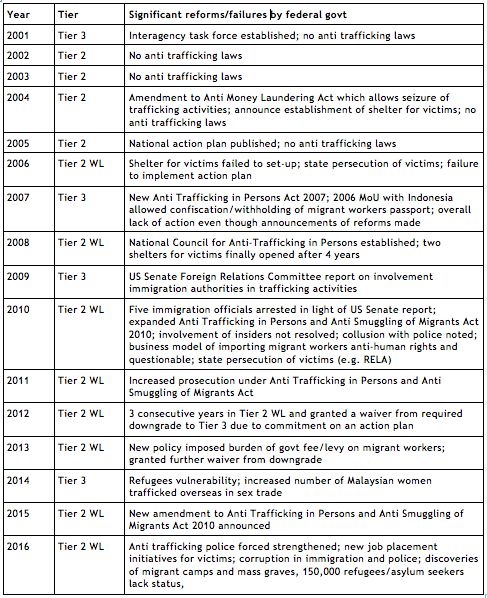
Malaysia’s human trafficking crisis is not new. We started with the lowest rating at Tier 3 in the inaugural TIP report in 2001. In the 16 years, we were ranked Tier 3 four times the last being just two years ago in 2014. When an additional tier, Tier 2 Watch List was established in 2006, we dropped from Tier 2 to the Tier 2 Watch List.
From 2010 to 2013, Malaysia was even granted waiver from being downgraded to Tier 3 every year on the grounds of commitments made by the government to improve things substantially. When improvements failed to materialise after four years, we were downgraded to Tier 3 in 2014.
The chronology of Malaysia in the TIP report reads almost like a cat-and-mouse chase. When the cat comes close, the mouse retreats a little bit, but the chase is frustratingly never ending. It was as if to “please the Americans” that our government pays lip service to fighting human trafficking but after 16 years rated badly on the chart, we barely scratched the surface to deal with this hideous crime.
Look at the way our Anti-Trafficking in Persons Act was created and then amended. In 2007, when we dropped to Tier 3, the act was enacted by Parliament.
Within two years, in 2009, we were downgraded to Tier 3 again. Hence, Parliament once again amended the act now expanding it to the Anti-Trafficking in Persons and Anti-Smuggling of Migrants Act 2010. We improved to Tier 2 Watch List and was subsequently given waiver for four years from being downgraded on the promise by the government that it will get its act together.
Four years later in 2014, we were once again in Tier 3, and thus, launching once again the whole “we-are- now-at-Tier-3- so-let’s-amend-the-Act” theatrics in Parliament in 2015.Don’t just “please the Americans”, deal decisively with the “insider syndicate”.
It is fruitless to merely do a cosmetic makeover to “please the Americans”. (The caveat to this statement is the TIP report is a commendable and excellent effort spearheaded by the US government.)
In my parliamentary debate speech on the amendments to the Anti-Trafficking in Persons and Anti- Smuggling of Migrants Act in 2015, I called on the government to deal decisively to quash the “insider syndicate” in order to end human trafficking in Malaysia.
In 2009, the US Senate Foreign Relations Committee published a shocking report on the involvement of “insider” in human trafficking activities in Malaysia. The report alleged that “Malaysian government officials” were involved in the “trafficking and extortion of Burmese and other migrants in Malaysia and from Malaysia into Thailand for personal profit”. The report referred to these government officials as, Rela voluntary corp, immigration and police officers
In 2015, the deputy inspector-general of police, Noor Rashid Ibrahim, was reported by the media as saying that the Royal Malaysian Police (RMP) did not rule out the possibility of “insider” involvement in the intricate network of human trafficking and human smuggling on the Malaysia-Thai border.
Last year, the New Straits Times also exposed a report by the Special Branch of the the RMP stating 80 perceent of our border guards are “on the take”.
We are not only talking about border guards in some obscure jungle posts along our national borders.
In May 2016, two Malaysian immigration officers were among those arrested for being part of a forged passport syndicate.
In May 2016, more than 100 people within the Immigration Department, mostly stationed in Kuala Lumpur International Airport (KLIA), were implicated in sabotaging the MyImms computerised immigration management system to facilitate various violations of immigration laws. Fifteen were
sacked while 14 were suspended with various actions taken against the others. On the admission of the director-general of the department, this insider syndicate has been in operation since 16 years ago.
In June 2016, three immigration officers stationed in the southern Malaysia Johor-Singapore checkpoint were arrested for being part of a syndicate which facilitates an inter-state vice ring between the two neighbouring countries. I believe this is just the tip of the iceberg.
In 2014, I have raised the question on how the NERS system, another immigration management system, has been compromised. I have highlighted discrepancies where either the NERS private contractor was overpaid RM35.9 million in 2013 or, what is scarier, at least 718,000 migrants were let in without proper immigration record.
The government has thus far refused to respond to questions raised by MPs on this issue.
Both the MyImms and the NERS system were awarded without open tender to private contractors. This itself points to another big can of worms, the Migrant Industrial Complex. I have earlier argued that the business of importing, registering and renewing of migrants, especially workers, rakes in billions of ringgit each year for a handful of private contractors closely linked to the ruling regime. Due to the lucrative profit, national interest and security and human rights were set aside.
Conviction rate still very slow
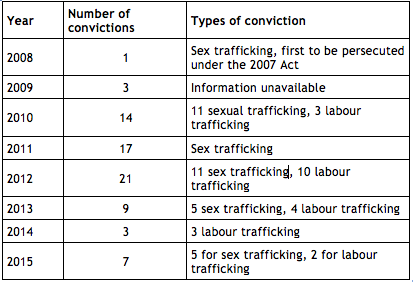
Despite the massive network of insider syndicate making up to a billion ringgit from human trafficking activities over more than a decade, with law enforcers and deputised citizen corp being implicated in domestic and international investigations, discovery of death camps and mass graves in our northern border, the conviction rate has been very slow.
Over a period of almost 10 years from when the first anti-human trafficking law was enacted, while there were thousands of files opened and investigated, only 75 traffickers were actually convicted in the Malaysian courts.
Despite repeated reports of insider involvement, and news report of immigration officers and police officers being arrested - most notably, 12 police officers arrested in connection with the discovery of mass graves in Perlis in 2015 - we do not know if any of these “insiders” were convicted.
While about 100 immigration officers were implicated in the MyIMMs case, with 15 sacked and 14 suspended, only 12 were arrested so far.
The rest are presumably still in employment.
Even when there is a conviction, “the majority of sentences were weak and not commensurate with those prescribed for other serious offences, including a trafficker who was sentenced one day in prison plus a fine of RM20,000, and three others who given sentences of one to three and one-half years’ imprisonment”.
Human trafficking is a horrible crime, a modern-day slavery. It must and can be stopped at all cost.
The most recent experience Malaysians had was the images of over 10,000 Rohingya boat people stranded just outside our waters a year ago. Indeed it was heart-wrenching seeing the images and knowing that these refugees had braved dangerous waters risking their lives in order to preserve them in a foreign country.
Over 1,000 of these refugees were then granted permission to land and were housed in a detention centre in Kedah. My colleagues and I visited them but were disallowed entry into the centre. A total of 371 of them eventually received refugee status by UNHCR, but in Malaysia, besides a lower risk of deportation, such status almost means nothing with the constant bullying and oppression, sometimes by state authorities. Morethan 300 are still stranded in the detention centre even after one year.
Yet these are already the “fortunate” ones. There are others, possibly tens of thousands who are scattered in camps in the jungle, imprisoned in our cities and towns, subjected to torture and abuses, women and children being sold as sex workers. Or consider legal migrant workers thrown into debt bondage, forced to work in harsh condition, denied of their freedom. Or simply the “stares” migrants had to endure as they go into town for the weekend recreation.
A nation of migrants
According to statistics, Malaysia is now host to about two million documented migrant workers. Undocumented ones, including refugees and asylum-seekers are estimated to be another two-three million persons. Together, these migrants make up about 16 percent of our total population. That is more than the Indian, Kadazan and Iban population in this country put together.
I have elsewhere written about our disorganised, haphazard, random and senseless migrant workers policy. I will not touch on this here.
But just imagine that at least one in 10 persons in Malaysia is an undocumented migrant. It is understandable that Malaysians are worried about the influx of foreigners. It is also understandable that some of us may even exhibit xenophobic sentiments against them. Given that Malaysians are already heavily taxed in all sorts of ways by a corrupt and incompetent government, why should we be accommodating foreigners?
But the truth is, human rights aside, we already have migrants here. One in 10, but almost two in 10 if we include the documented ones. Because there is no institutionalised solution to deal with their presence - especially the undocumented ones - they all go underground. When they do, they are exploited. For example, we read news of dead bodies, wrapped up and left on the streets, simply because these people have no legal status and dared not seek proper medical attention when sick.
Estates and farms are hiring illegal migrants and sometimes refugees to work with low pay and horrible working condition. The oppressors are not only by private individuals or business corporation; we hear even of law enforcers exhorting money from migrants. Once a Rohingya man told me how his hard-earned money from a day’s work as a labourer had to be handed over to “officers” who threatened to arrest him. Heart-wrenching human stories.
And this is not happening in some Third World warzone somewhere, but right in our midst.
When the migrants go underground, exploited by locals and traffickers alike, denied of human rights and dignity, they will in turn give rise to other social problems. In 2014, there were over 20 gruesome murder cases involving Myanmar nationals in Penang. Under Ops Kelar, the police arrested 17 Myanmar nationals suspected to be involved in the murders. Police informed me that there is already a gang syndicate operating among some of the migrant communities as they were forced to go underground. Eventually, you and I, the locals, will be affected. Thus, inaction is not an option.
We are a nation of migrants, all of us. In fact, our glorious history started when our forefathers came to this land as refugees, led by the asylum-seeker par excellence, the great Parameswara. Malaysia is built layer upon layer by people who left their countries of origin in the Malay archipelago, in China, in India and elsewhere to make this land their home.
Today, when we are faced with the problems of migration, our policy solution must be one which does not victimise the migrants. Instead of sweeping the problem under the carpet, allowing the government to manipulate the granting of citizenship, for example, in the notorious Projek IC in Sabah, we should deal with the question of migrants empirically, objectively and transparently.
In the 80s, the government projected that our population should be 70 million by 2100. At this current rate, by natural birth, it is highly unlikely. I am not suggesting at this point that we fling open our doors. But I want to point out that there is clearly still space for us to accommodate others.
However, we must first have a clear goal and strategy, one which safeguards local interests, upholds human rights as well as capitalises on the global talent and human resource pool to drive Malaysia into our second half-century. These are not easy targets much less are they easy to reconcile with one another.
But, once again, it is clear that indifference, inaction and prejudice will not do.
STEVEN SIM CHEE KEONG is MP for Bukit Mertajam and deputy spokesperson, DAP Parliamentary Committee for Human Resources.


Are you sure you want to delete this comment?
This action cannot be undone.