


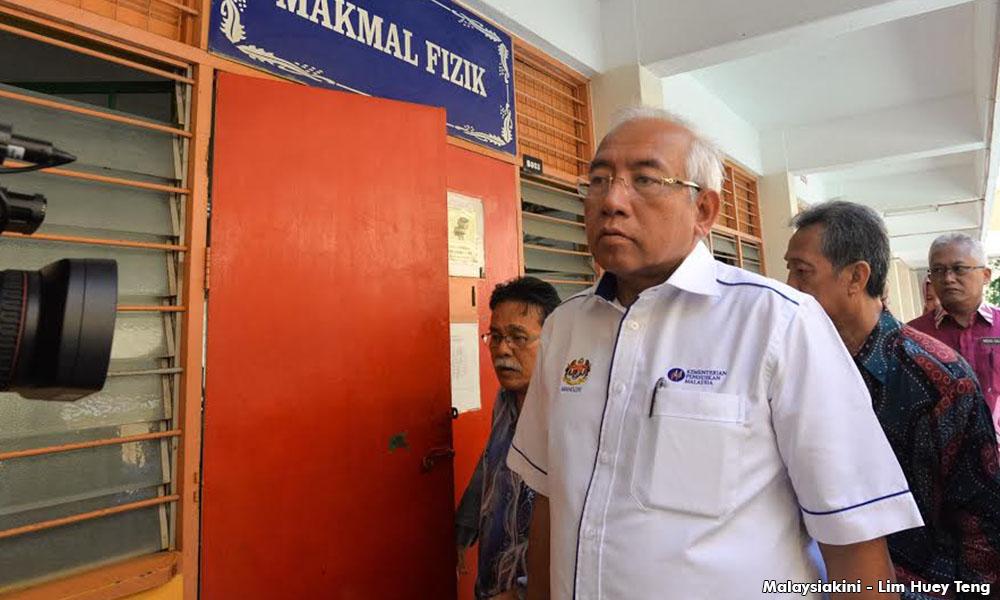

School maintenance gov't obligation, says Education Minister
Education Minister Mahdzir Khalid said there is no need to compel Parent-Teacher Associations to raise funds for school infrastructure maintenance as this falls under ministry purview.
This is after Urban Well-being, Housing and Local Government Minister Noh Omar proposed PTAs raise funds to ease school infrastructure maintenance costs.
"I believe he had good intentions of assisting the government (but) the Education Ministry has funds allocated for development and procurement (for schools) and it is the government's obligation.
Education Minister Mahdzir Khalid said there is no need to compel Parent-Teacher Associations to raise funds for school infrastructure maintenance as this falls under ministry purview.
This is after Urban Well-being, Housing and Local Government Minister Noh Omar proposed PTAs raise funds to ease school infrastructure maintenance costs.
"I believe he had good intentions of assisting the government (but) the Education Ministry has funds allocated for development and procurement (for schools) and it is the government's obligation.
"That said, there are already schools where PTA raise funds. For example, Chinese vernacular schools (SJKC) construct buildings using funds raised by the PTA.
"However, there are also parents who already find school fees a burden, so contributions should be according to one's means," he told reporters after officiating the Setiawangsa Umno division general meeting at Hotel Seri Pacific, Kuala Lumpur.
Noh earlier proposed that PTA raise funds for school maintenance if the RM500 million allocated for this under Budget 2016 is insufficient.
Malaysiakini's straw poll found that parents are not receptive to Noh's proposal.
Chinese vernacular school popularity not nationwide trend
On a separate matter, Mahdzir dispute findings by Majlis Penasihat Pendidikan Kebangsaan (MPPK) that Chinese vernacular schools can replace natinonal schools as a mainstream choice in the next decade.
MPPK's two year study found the student body for Chinese vernacular schools are more multicultural, compared to national schools.
However, Mahzir says this is not a nationwide trend and only persists in rural areas.
"In my parliamentary constituency of Padang Terap, 50 percent of Chinese vernacular school students are bumipitera, while most students in Chinese vernacula schools in rural Sabah and Sarawak are bumiputera.
"However, the same cannot be said in urban areas where Chinese vernacular students are mostly ethnic Chinese. So it is not likely (that Chinese vernacular schools will be the mainstream choice)," he said.
Nevertheless, Mahdzir said the ministry will review the MPPK student before making further comment.
MPPK member Teo Kok was earlier reported as saying that non-Malay enrollment at national schools rose only four percent during the study period while non-Chinese enrollment at Chinese vernacular schools rose by 18 percent.
The rate of non-Chinese enrollment in Chinese vernacular schools are expected to rise in the next decade, Teo Said.
As such, Teo said, the Malaysian Education Blueprint 2013-2025 is unlikely to meet its aim of attracting more non-Malay students to national schools by 2025.


Are you sure you want to delete this comment?
This action cannot be undone.