


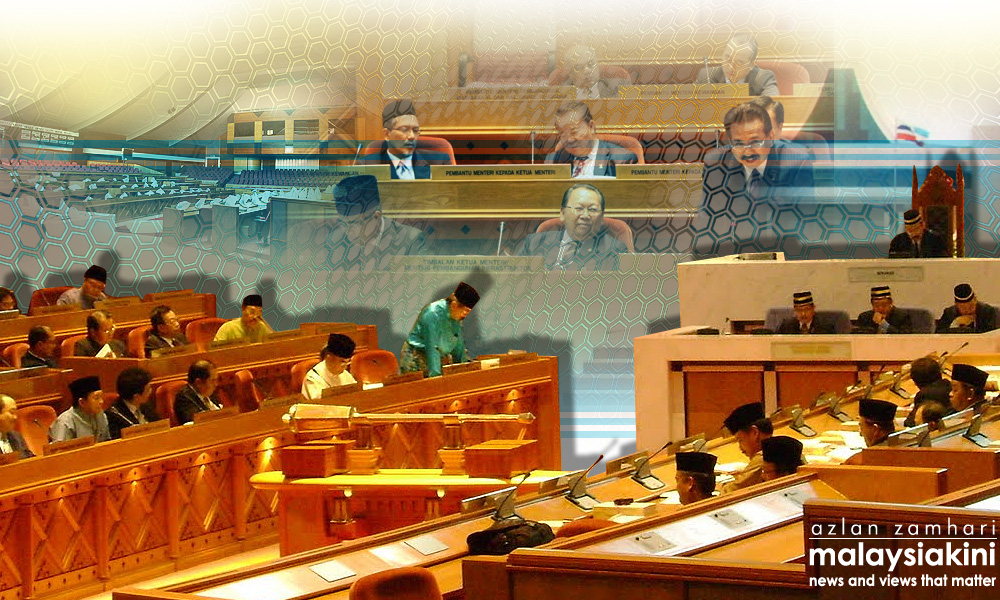

Sabah opposition lawmakers divided over redelineation bill
Sabah opposition leader Lajim Ukin and Sabah DAP whip Edwin Bosi voted for the government bill that saw the state legislative assembly seats increased from 60 to 73 during the assembly sitting on Aug 9.
This has again raised concerns as to whether the opposition in the state can be united for the next general election.
Local newspapers reported that Sabah Pakatan Harapan, in a pre-council meeting chaired by Lajim himself, had agreed that Harapan would reject the Sabah state constituency redelineation bill.
Sabah opposition leader Lajim Ukin and Sabah DAP whip Edwin Bosi voted for the government bill that saw the state legislative assembly seats increased from 60 to 73 during the assembly sitting on Aug 9.
This has again raised concerns as to whether the opposition in the state can be united for the next general election.
Local newspapers reported that Sabah Pakatan Harapan, in a pre-council meeting chaired by Lajim himself, had agreed that Harapan would reject the Sabah state constituency redelineation bill.
Besides Edwin, who is the Kapayan assemblyperson, all the six Harapan assemblypersons attended the Aug 8 pre-council meeting.
The redelineation bill was passed on Aug 9 with an overwhelming majority, with 55 assemblypersons out of 60 voting for the bill, while three voted against it.
A DAP lawmaker abstained from voting while BN’s Lahad Datu assemblyperson Mohd Yusof Apdal, a brother of former Umno minister Mohd Shafie Apdal, was not present.
It is widely believed that the opposition lawmakers changed their mind as they eyed the opportunity to contest in the 13 additional seats.
These new seats also allow them extra room to talk on seat negotiations.
 "Yes, it is a U-turn. The reason is that both sides (BN and opposition) think they need additional seats for new candidates," said the director of the Asia Institute, University of Tasmania, James Chin (photo).
"There is so much pressure from the grassroots for talented ones to move up," Chin said via text message in response to questions.
"Also, both PKR and DAP in Sabah are not united," he noted.
Sabah BN holds 48 state seats, while DAP and PKR have three and four seats respectively.
State Reform Party (Star) holds only one seat, while three former PKR state leaders and one former Umno leader, who quit their parties, are now independent members.
BN, the then Pakatan Rakyat allies and at least five parties were engaged in multi-cornered fights in Sabah in the 2013 general election.
Shafie to launch own party?
Speculation has been rife that Shafie will launch his own Sabah-based political party soon.
Another academician believes there is no hope for the opposition to grab power in Sabah or deny BN a two-thirds majority in the state assembly in the next general election.
"The Sabah opposition is only good at splitting votes, not in providing an alternative leadership," said the politics and international relations department head at Universiti Malaysia Sarawak (Unimas), Arnold Puyok.
Chin added he has yet to see Shafie as a factor to enable the opposition to win in the next election, or even to deny BN the two-thirds majority.
"Shafie is not a factor yet. Nobody knows if he will join Dr Mahathir Mohamad's new party. Conflicting information from his people," Chin said. "He is not strong outside the east coast. The most he can win is one to three state seats."
Arnold added: "The opposition should look at it as an opportunity to expand its influence and explore new possibilities.
"However, for the opposition to remain relevant in Sabah, it should not depend so much on the rhetorics of Sabah issues alone. It should go beyond by focusing on real policy issues affecting Sabahans."
This, Arnold said, would give the Sabah opposition greater fighting power.
Right after the redelineation bill was passed, DAP Sri Tanjong assemblyperson Chan Foong Hin expressed disappointment that his allies in DAP and PKR made a U-turn in the state assembly and opposed what had been agreed upon at the state Harapan pre-council meeting.
'Opposition has been too naive'
"The opposition has been too naive to believe that the Election Commission (EC) will conduct the redelineation exercise in a fair and transparent manner," Chan was reported as saying.
Chan, Roland Chia (PKR-Inanam) and Terence Siambun (PKR-Moyog) rejected the bill in state assembly.
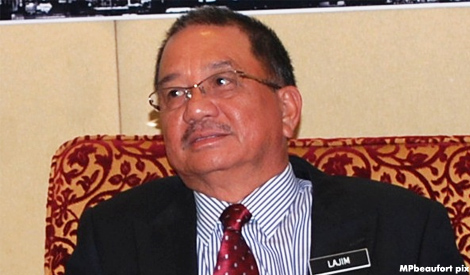 Besides Lajim (photo) and Edwin, PKR’s Api-Api member Christina Liew also voted for the state seats redelineation bill.
DAP’s Likas assemblyperson Wong Hong Jun abstained from voting.
Others who voted for the redelineation bill included Bingkor assemblyperson Jeffrey Kitingan of the State Reform Party (Star), and independent assemblypersons Wilfred Bumburing (Tamparuli), Jelin Dasanap (Matuggong), Jeremmy Ukoh Malajad (Kandamaian) and Jaujan Sambakong (Sulabayan).
When contacted, Lajim apologised over the "mistake" he made, saying he forgot to tell his comrades about his latest decision.
"We received the bill on the day I conducted the pre-council meeting, on the morning of Aug 8. We didn't know much about (the bill).
"Later, I discussed it with Jeffrey, Wilfred and Edwin. I just forgot to tell them (about my latest decision)... I made a mistake by forgetting to tell them," Lajim said.
He went on to deny that the Harapan parties were split over their differences on the redelineation bill.
"Everyone in the opposition does not believe in BN. I voted only for the bill and I do not support BN," he said.
Lajim said he supported the bill as the population has increased in Sabah and because the state constitution allows the EC to conduct redelineation of state seats every eight to 10 years.
"This is good for the state," he added.


Are you sure you want to delete this comment?
This action cannot be undone.