


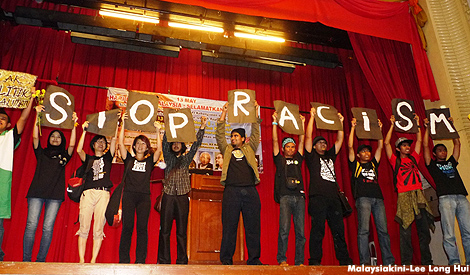

Can we really take racism out of the M'sian equation?
COMMENT We make a mistake in believing racism is an inextricable part of life. The platitude goes, “I can’t change the direction of the wind but I can adjust my sails.” In other words, there’s nothing we can do about racism, so let’s just move on. But this is wrong.
Consider how many once seemingly inextricable problems we’ve collectively overcome.
We forget that for centuries women were something akin to property. Legal systems ensured married women had few rights as an individual beyond her husband. This meant the vast majority of women couldn’t own property, sign documents, obtain an education, or work without their husband’s permission. Forget casting a vote or becoming a member of parliament.
COMMENT We make a mistake in believing racism is an inextricable part of life. The platitude goes, “I can’t change the direction of the wind but I can adjust my sails.” In other words, there’s nothing we can do about racism, so let’s just move on. But this is wrong.
Consider how many once seemingly inextricable problems we’ve collectively overcome.
We forget that for centuries women were something akin to property. Legal systems ensured married women had few rights as an individual beyond her husband. This meant the vast majority of women couldn’t own property, sign documents, obtain an education, or work without their husband’s permission. Forget casting a vote or becoming a member of parliament.
And slavery? Owning other human beings was for generations seen as part of the natural order of things. Slave owners often cast their relationship to their human property in a benevolent light: those brutes needed the care of more evolved races. The era of colonial empires saw that idea writ large.
The point is that things we once said would never go away - did.
Depth of institutionalised racism disheartening
Race is a social construct, a tool to differentiate and discriminate. Nevertheless, the idea that race is “natural,” that race is a necessary part of the Malaysian fabric, is often accepted without question. It shapes assumptions that are the foundation for systems of politics and education and law. Given the longstanding, pervasive norms these systems perpetuate, even opposition politicians and independent activists find it expedient to embrace racist politics (the latest iteration being Parti Pribumi Bersatu Malaysia, or Bersatu) and racist education systems (such as vernacular schools).
The depth of racist institutionalisation in the country is disheartening. If we haven’t succumbed to cynical despair, then we’re likely holding onto blind optimism: if only we were all colour-blind! Then, only then, will racism be gone!
But racism is more than spouting comments about swathes of people because of the colour of their skin. Research has shown that racism is so deeply ingrained it informs our behaviour almost unconsciously (colour-blind folk should take the skin-tone or race tests here). These tiny internal processes can lead to huge social consequences. The turmoil over Black Lives Matter in the United States is a perfect example: institutionalised racism may be illegal, but that doesn’t guard against the consequences of the unexamined prejudices of many police officers.
Clearly, we should aim for more than institutional reform alone here at home.
Change the norm
We need to change the norms that govern our daily lives. How can we do this? Norms are basically socially acceptable behaviour. Ten years ago, tapping away on your phone amongst company was outright rude. Today, because everyone has a phone, seeing someone else doing it sends the signal that it’s okay to do so. So one becomes two, two becomes three, and in time it becomes a norm. Norms become culture. Culture becomes institutionalised.
We know that the abused and oppressed, over time, begin to internalise their abuse and oppression. They begin to believe and parrot their abusers, often insisting they are worthless, that they deserved whatever punishment they received. The result is they then begin to live accordingly.
Your one female friend in a group of mostly males may laugh along at the casual sexist jokes, but that doesn’t mean it’s okay. It sends the signal that sexist comments are socially acceptable. The victim can’t respond angrily, because then she’d be told to calm down. She can’t ignore it, because then she’d be weak and sensitive. She has to laugh it off.
Many regard cracking a joke about not being able to see an Indian in the dark - unless he smiles! - as harmless. But such jokes are possible only from a position of majority (it’s probably not that funny in India). Like casual sexism, it puts the minority in a position in which laughing it off is the best response. It “otherises” the minority, signalling skin colour is a legitimate measure of one’s place in society.
It’s just a joke! I didn’t mean anything by it!
Social workers are taught to give more weight to the word of the victim, especially a child, than the alleged abuser. This rule of thumb holds true when it comes to forms of discrimination and oppression as well. We need to start listening more carefully to what those not in positions of majority power are saying.
We can start by changing those norms, by standing with those subject to “harmless” jokes. We can pointedly not laugh at racist comments that make anyone awkwardly grin and fidget. Better still, we can pointedly say that it’s not okay. We can call out casual sexism when we see it. If enough of us do this, behaviour that “otherises” will no longer be socially acceptable.
In some sense, the cynics are right: racism may well never go away. It’s because racism as it is today is just an incredibly efficient way to discriminate. But we can work, together, to make it incredibly inefficient. And sure, there will always be discrimination. All that means is we never stop fighting it whatever shape or form it takes next.
This may all come across as wishful thinking, the stuff of fairy tales. Maybe. But I like how Neil Gaiman put it: “Fairy tales are more than true - not because they tell us dragons exist, but because they tell us dragons can be beaten.”
ETHAN TAN is a candidate for a master of science in social policy at the University of Pennsylvania. He's a Malaysian married to an American, and misses banana leaf rice very much (even if he loves his wife's cooking).


Are you sure you want to delete this comment?
This action cannot be undone.