




Set up select committee on corruption, PM told
Prime Minister Abdullah Ahmad Badawi has been urged to set up a parliamentary select committee on national integrity to oversee the National Integrity Plan (NIP), the Anti-Corruption Agency and anti-corruption campaign.
Prime Minister Abdullah Ahmad Badawi has been urged to set up a parliamentary select committee on national integrity to oversee the National Integrity Plan (NIP), the Anti-Corruption Agency and anti-corruption campaign.
Opposition Leader Lim Kit Siang said the premier should also agree to appoint an opposition MP as chairperson of the committee to show his support for the NIP.
He said the country should not make the mistake of other countries by indulging in the hocus-pocus of fighting corruption without actually fighting corruption.
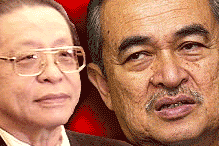 Lim said it was unfortunate that the prime minister has missed the opportunity to inject a new sense of commitment in the war of 'zero tolerance for corruption' in his keynote address at the
World Ethics and Integrity Forum
yesterday.
Lim said it was unfortunate that the prime minister has missed the opportunity to inject a new sense of commitment in the war of 'zero tolerance for corruption' in his keynote address at the
World Ethics and Integrity Forum
yesterday.
"Abdullah seems to have succumbed as a new victim of denial syndrome in refusing to acknowledge the continued pervasiveness and seriousness of corruption in the country in the past 18 months," he told reporters in a press conference at parliament lobby today.
In his speech yesterday, Abdullah defended his anti-corruption drive against widespread criticisms and vowed to press on with the campaign through a two-pronged strategy.
Police commission report
Meanwhile, Lim also called on the prime minister to divulge the content of the report submitted by the royal commission on the police force to him and the Yang di-Pertuan Agong yesterday.
The report, which made recommendations to enhance and modernise the police force, has been classified as 'confidential'.
The premier said he would submit the report to the cabinet to discuss and decide whether to make the report public.
Lim said it is an 'embarrassment' that the cabinet is to decide whether to disclose the report to the public.
"The premier should release the full report for public consumption, as it is essential for good governance," he said.
"There is no need for the cabinet to censor the report. It should go public," he added.


