


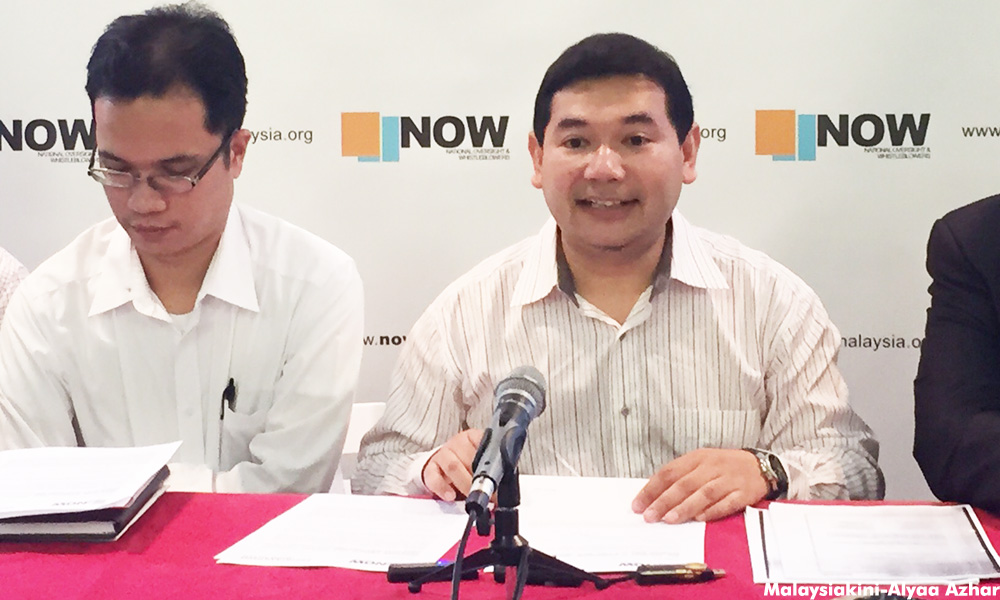

NOW: Everyone can track gov't wastage with new index
Pandan MP Rafizi Ramli hopes the government will adopt his NGO's newly-launched government wastage index (NGWI), an empirical index to track corruption.
Rafizi, founder of the National Oversights and Whistleblowers' (NOW) said they are ready to discuss with ministries and government agencies to explain how to use the index to quantify wastage within their department.
Pandan MP Rafizi Ramli hopes the government will adopt his NGO's newly-launched government wastage index (NGWI), an empirical index to track corruption.
Rafizi, founder of the National Oversights and Whistleblowers' (NOW) said they are ready to discuss with ministries and government agencies to explain how to use the index to quantify wastage within their department.
Even if they do not want to talk to NOW, the PKR secretary-general said he would be willing to send copies of the first NGWI report to them.
"This is not politics, this is mathematics. Mathematically, it (the index) is proven," he told reporters after the launch of the NGWI report in Sungai Besi last night.
The NGWI is a scientific way of assessing government wastage, he said, as opposed to other measures of corruption such as the corruption perception index (CPI), which relies on perception.
For the first NGWI report, NOW executive director Akmal Nasir said they extrapolated data from the three sets of the auditor-general's report for 2014.
Rafizi said they intend to publish a NGWI report every year, as he believes it might have more impact on public opinion than the annual auditor-general's report.
"Before this, departments or ministries can just ignore the auditor-general's report as far as public opinion is concerned, because it comes and it goes.
"After this, if there's an index, the same way the government has the corruption perception index as a KPI, when they have an index, there will be public pressure for them to improve the index," he said.
The auditor-general's report, he added, is on a micro, case-by-case basis and its contents are also very cut off from the public so its impact is minimal.
Giving bigger picture
The NGWI complements the auditor-general's report, he said, because the auditor-general is bound by his mandate and cannot do the sort of macro analysis that NOW, as an NGO, can do.
The NGWI would provide a macro analysis by pulling together and contextualising data from the auditor-general's report, and as such would hopefully be more impactful, he said.
"They can't make a judgment call on the government because the government won't accept it.
"So long as we use genuine and factual findings and bring it up to a more macro and bigger picture, it's something that I think will refocus the public's attention on wastage and corruption on all levels of government.
"You (also) can't arrest us for the auditor-general's findings. We're just putting context and meaning to the findings," Rafizi said.
The NGWI report describes their index as an unprecedented one to measure corruption in an empirically-tested way.
NOW employed a two-step procedure in their methodology in producing the NGWI: a compilation of sample size data and the calculation of average percentage of government wastage via the confidence interval (CI) formula.
Their index concluded that in the audit year 2014, the average government wastage was 15.50 percent.
They noted it is highly unlikely that the actual government wastage is lower than their results, as their two-step procedure is conservative in nature.
On the contrary, NOW said the actual government wastage would be higher than their results, as many items of corruption, mismanagement and wastage are "hidden" from the budget.


Are you sure you want to delete this comment?
This action cannot be undone.