




Nepali media stands up to censorship
The 'freest press in Asia' lived up to its tag even when it seemed impossible to get around direct censorship in Nepal's newsrooms when emergency rule was imposed from February to April.
The 'freest press in Asia' lived up to its tag even when it seemed impossible to get around direct censorship in Nepal's newsrooms when emergency rule was imposed from February to April.
Nepali Times editor Kunda Dixit drew a picture of guile and courage among the Nepali media during the three-month period following the sacking of the prime minister and his elected government, and invocation of emergency powers by King Gyanendra.
Telecommunication services including mobile phones and Internet connections were initially removed and the media found itself under tight control, as the king moved to prevent discussion of his decision.
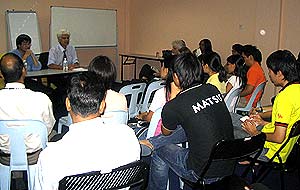
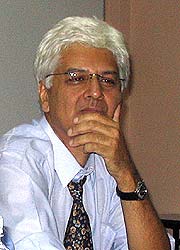 Dixit was speaking at a dialogue organised by
malaysiakini
and journalists' grouping Media Agenda Malaysia in Kuala Lumpur on Monday, in conjunction with May 3 World Press Freedom Day .
Dixit was speaking at a dialogue organised by
malaysiakini
and journalists' grouping Media Agenda Malaysia in Kuala Lumpur on Monday, in conjunction with May 3 World Press Freedom Day .
He told his audience of journalists, civil society representatives and students that censorship in Nepal led the media to employ unconventional methods to continue reporting the news without fear or favour.
"Before Jan 31, Nepal had the freest press in Asia - we could write about anything and even criticise the king. This changed drastically on Feb 1. All of a sudden we had army officers in fatigues sitting in newsrooms and scrutinising our articles to see if these were fit to be published.
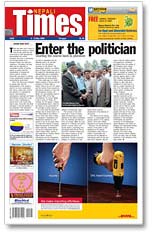 "Any reports that were critical of the king's actions were censored, with some yanked out right before being sent to the printers. We did not replace these items," he said, holding up a copy of the
Nepali Times
with glaring spaces on some pages.
"Any reports that were critical of the king's actions were censored, with some yanked out right before being sent to the printers. We did not replace these items," he said, holding up a copy of the
Nepali Times
with glaring spaces on some pages.
In one instance, the army censor ordered the removal of a long report that was critical of the government's dismissal. In doing so, he also insisted that editors should not leave the space blank.
"Luckily, we managed to find a picture of a baby, born on the day the king announced the sacking of the prime minister. The headline, 'Ten days old', accompanied by the photo of the crying baby sufficed in getting our message across," said Dixit.
 The fortnightly newspaper also ran a daily check on the state of press freedom, illustrated by a 'liberty gauge' on the front page. The position of the dial was indicative of the day's situation regarding censorship of the newspaper.
"This image has now been included in the masthead, and our readers understand its significance," he said.
Assistance online
Dixit noted that access to online publishing also helped journalists and free-expression advocates to get around the restrictions imposed on the print and broadcast media.
This created an explosion in the number of websites and blogs on press freedom, with most being left intact because the medium was not deemed to be much of a threat - Internet penetration is low in Nepal.
Dixit said his newspaper moved all censored reports to its website , albeit with additional precautions - the text remained invisible until the page was highlighted by the cursor.
 As an English-language weekly, the
Nepali Times
found slightly more latitude in which to operate, as the authorities appeared confident that the language and cost would make the publication less accessible to the Nepali-speaking public. (A copy costs 30 rupees, compared to the average price of two rupees for a Nepali-language daily).
As an English-language weekly, the
Nepali Times
found slightly more latitude in which to operate, as the authorities appeared confident that the language and cost would make the publication less accessible to the Nepali-speaking public. (A copy costs 30 rupees, compared to the average price of two rupees for a Nepali-language daily).
The same consideration was extended to foreign news agencies - whose journalists were allowed to report without hindrance - and other English-language print organisations. Cartoonists and party political organs were similarly spared.
Dixit, however, said this probably served the official agenda to show that 'human rights' were alive and well, despite the suspension of democracy and the reported arrests of some 3,000 people including activists.
Fallout for radio
The clampdown was particularly difficult for the Nepali-language media, indicating that the move was primarily targeted at suppressing information from locals. Nepal has a population of 25 million, with many living below the poverty line.
The nation's vibrant radio sector took the brunt of censorship, with an outright ban on news broadcasts. About 800 journalists are currently out of work and countless stations have gone bankrupt because they have been unable to sustain their operations without advertising revenue.
"Despite the ban, talk-show hosts or deejays would bring up issues of the day in conversations with one another, especially in the early morning slots," Dixit said.
"A sizeable number of stations switched completely to education programmes. In fact, one station broke even after running on-air tuition services, bringing in teachers to conduct these sessions."
Journalists have used any material available to question or comment on the different political motivations at play. If trees were being cut down, questions would be asked as to who was cutting them and who was getting money for doing so.
"Indian radio news programmes were banned because the Hindi language is understood by the majority of the Nepalese," he said.
Another downside of control was the intrusion of Bollywood music over radio stations that were unable to continue filling air time with local cultural and folk music.
Limits being tested
Asked how journalists had reacted to the rules, Dixit replied: "They (the media) are pushing the envelope all the time... they vary the level of self-censorship from one day to another to see what the response from the state will be.
"By testing their limits, they determine how far they can practise freedom in their reporting without being persecuted by the government."
Nepali politics have been tumultuous since 1995, oscillating between democratic governance and attempts at absolute monarchy. The country has also struggled to contain a long-running communist insurgency, led by Maoists .
In 2001, Crown Prince Dipendra shot and killed 10 members of his family, including his parents King Birendra and Queen Ashwarya. Dipendra himself died 48 hours later of wounds sustained during the massacre.
 The current king (
photo
), the brother of King Birendra, had also sacked the government of then Prime Minister Sher Bahadur Deuba in October 2002 on
grounds of incompetence
, for failure to call a general election.
The current king (
photo
), the brother of King Birendra, had also sacked the government of then Prime Minister Sher Bahadur Deuba in October 2002 on
grounds of incompetence
, for failure to call a general election.
Since lifting emergency rule on April 30, following intense international pressure, King Gyanendra called together leaders of political parties to work out a road map to restore democracy under a constitutional monarchy.


Are you sure you want to delete this comment?
This action cannot be undone.