




Match words with deeds, govt told
An unequivocal stand against corruption matched with concerted action is the singular requisite to paving the way for reform in the country, said former deputy premier Anwar Ibrahim.
An unequivocal stand against corruption matched with concerted action is the singular requisite to paving the way for reform in the country, said former deputy premier Anwar Ibrahim.
"There is now a culture of corruption with the government failing to curb it, and even acting in complicity with it. The emphasis on big projects have used up the country's resources and Malaysia has lost its competitiveness," he said.
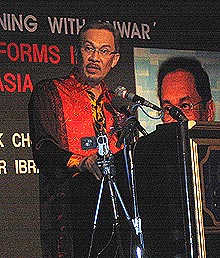 He was speaking at a public forum themed 'Political Reforms in South East Asia: An Evening With Anwar', organised by Parti Keadilan Rakyat.
"Malaysia now has the lowest GDP growth in the region and one can see the effects of this through issues such as unemployment among graduates and the Inland Revenue Board desperately seeking dues even from bankrupt companies.
"As for foreign investment, we are losing out rapidly due to our own inaction, worsened by the increasing attractiveness of our competitors. Yes, India and China do pose a threat to our position but this can't be the excuse used for a lack of transparency and rampant corruption on the home front."
Citing The Freedom House and World Bank report , 'Governance Matters IV: Governance Indicators for 1996-2004', he stated that Malaysia is weakening in various aspects of democratic and accountable governance and lagging behind its neighbors.
"According to the report, Malaysia has deteriorated in six core areas including upholding of rule of law, accountability, government effectiveness and regulatory authority. Our democratic institutions are very weak, indeed we are worse off than our neighbors in this regard."
Criticising the government's lackadaisical attitude to stamping out corruption, he highlighted the response of cabinet ministers to the recently-released report of the Royal police commission.
"I was not shocked by the outcome of the report as much as I was by the pretentious reactions of the ministers, feigning outrage and shock at the findings of corruption in the police force...so taken aback at the police officer who (allegedly) embezzled RM30 million.
"Why so, when you yourself pocketed RM 300 million?" he said to laughter from supporters, foreign diplomats and leaders of opposition political parties.
Future plans
Lamenting the state of transparency in governance, he took a swipe at the media, saying that they would never carry reports deemed critical of the current administration.
"When international reports find that we are faring poorly in issues such as democratic governance, we will of course never hear this in Utusan (Malaysia) or NST ( New Straits Times )."
Anwar also shared his future plans with the audience, in response to what he said were concerns that he was too occupied with his stint as an academic and policy advisor abroad to be involved in the local political scene.
"Some people say I should be magnanimous now that I am a free man, while others are worried that I am enjoying myself overseas too much to be committed to the struggle back home.
"I want to say here that I will never neglect my duty and will remain committed to the reform agenda and struggles of Keadilan, PAS, DAP and all other progressive forces in the country.
"As I am away a lot this year, I shall be back only from time to time. But I want you all to know that from next year I shall be based in Malaysia and ready to continue with our struggle."
Apart from his academic stints in Johns Hopkins, Georgetown and Oxford, he has also been invited to be an advisor on macro-economic policies to countries such as Qatar, Bahrain and Saudi Arabia.
Six-point agenda
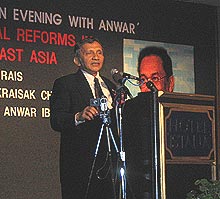 The event was also attended by former Indonesian Parliamentary Speaker DrAmien Rais (
left
) and Thai senator Kraisak Choonhovan, who spoke on political reforms in their own country and in the region.
The event was also attended by former Indonesian Parliamentary Speaker DrAmien Rais (
left
) and Thai senator Kraisak Choonhovan, who spoke on political reforms in their own country and in the region.
Relating his experience as a key member of Indonesia's reformasi movement, Amien said he was pleased with the overall outcome of the movement's six main agendas, although he admitted that a lot remains to be done.
"In 1998, Suharto had entered his 32nd year in power and introduced a so-called Pancasila democracy, which was democratic in form but authoritarian in substance. This form of democracy was ironic, as it did not permit opposition and demonstration.
"Unfortunately, he could not differentiate between the interests of the nation and those of his own family. Eventually, the people came together and we decided that true reform could not possibly happen while Suharto was still in office."
He said four of the six agendas have been achieved - amendments to the constitution, restructuring of the armed forces, decentralisation of authority and rebuilding of democracy with full political liberty and press freedom.
"Indonesia now has a much better constitution, with Parliament ceasing to be just a rubber stamp with the advent of direct (presidential) elections. Our constitution now has a long article on human rights, and 20 percent of national and local budgets must be allocated to education."
On the reviewed role of the armed forces, he said: "Previously, 20 percent of national and local parliamentary seats had to go to Abri (Armed Forces of the Republic of Indonesia), but now all seats have to be occupied by elected members.
"The freedom of the press is so wide now, that one can no longer distinguish between freedom of the press in voicing an opinion and that of fabricating news!" he said, drawing laughter.
He acknowledged that eradicating corruption and upholding the rule of law are the two remaining agendas that have yet to be tackled effectively.
"These two issues are at a gridlock right now in Indonesia. Our former vice-president, Mohammad Hatta, once said that corruption is institutionalised. Now, we say it is a way of life, that there is even a saying that 'autonomy' in the Indonesian context means the transfer of corruption from Jakarta to the provinces.
"Unfortunately, the enforcement of rule of law is still very discriminatory in Indonesia, where those with money and power can stand above the law. There is a saying singa besar selalu menang (the big lion always wins) and it can be applied to this situation in Indonesia."
Commenting on the current situation, Amien was careful to point out the challenges and critical areas.
"As in any reform, the mental reconstruction is the most difficult to carry out. With corruption, we witness the game remaining only with different players. Corruption is still very much there. At the national level, the leadership is still adopting a wishy-washy attitude in tackling corruption.
"We need a fully dedicated government to eliminate this threat to society's well-being. There has to be more action and not just discourse, with only the small fish being caught while the big ones are allowed to swim freely."
MPs lauded
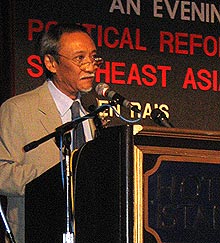 Emphasising the importance of regional co-operation in pursuing political reform, Kraisak (
left
) heralded the response of regional political leaders to Myanmar's impending assumption of the Asean chair as the first example of such political interaction.
Emphasising the importance of regional co-operation in pursuing political reform, Kraisak (
left
) heralded the response of regional political leaders to Myanmar's impending assumption of the Asean chair as the first example of such political interaction.
"I salute the Malaysian parliamentarians for voicing their displeasure over the conduct of the military junta in Myanmar. There was a domino effect to this pronouncement, as neighboring countries began to follow suit and Asean formally addressed the issue. We need more of such instances in talking about political reform.
"The Malaysian Parliament should be commended for the progressive resolution which criticised the Thai government's handling of the situation in the southern part of the country which led to the death of 70 prisoners. For the first time, we have begun to express opposition to injustice and speak up for one another.
"However, when talking about reform we should remember that all the Southeast Asian governments engage in business with Myanmar. The worst example would have to be Thailand, where the government has begun giving excuses on behalf of the Myanmar leaders and blaming the situation there on Aung San (Suu Kyi)."
He also spoke on the negative aspects of reform, which he said included increase in poverty and human rights violations.
"Today, Thailand is among the top 10 countries with the highest class differences, with 12 million people living below the poverty line. Should it be that the more reform we carry out, the poorer we get? The lives lost and sufferings brought upon by struggles against dictatorship, is this the reform we seek?"
In defining reform, he said: "Reform means not only political freedom, but economic freedom as well. A reformed nation must be one with food security, social security and the space to allow the continuation of tradition, of culture. Sadly, in Thailand the government is destroying this.
"The importance of big business now overrides that of the people in Thailand. Free trade agreements are formed without prior research or study, much less consultation with the people. From the example of Mexico in Nafta ( North American Free Trade Agreement), we know that it would just be disaster to proceed with such agreements blindly.
"Now, Thailand has a huge deficit with China and Australia, and our agricultural sector has declined tremendously, with cheaper goods being dumped into our market by countries with higher efficiency in production.
"We have to emerge from the patronage of our feudalistic past and work together as neighbors. We must never forget the struggles and plight of our neighbors, the worst case being Myanmar."


Are you sure you want to delete this comment?
This action cannot be undone.