


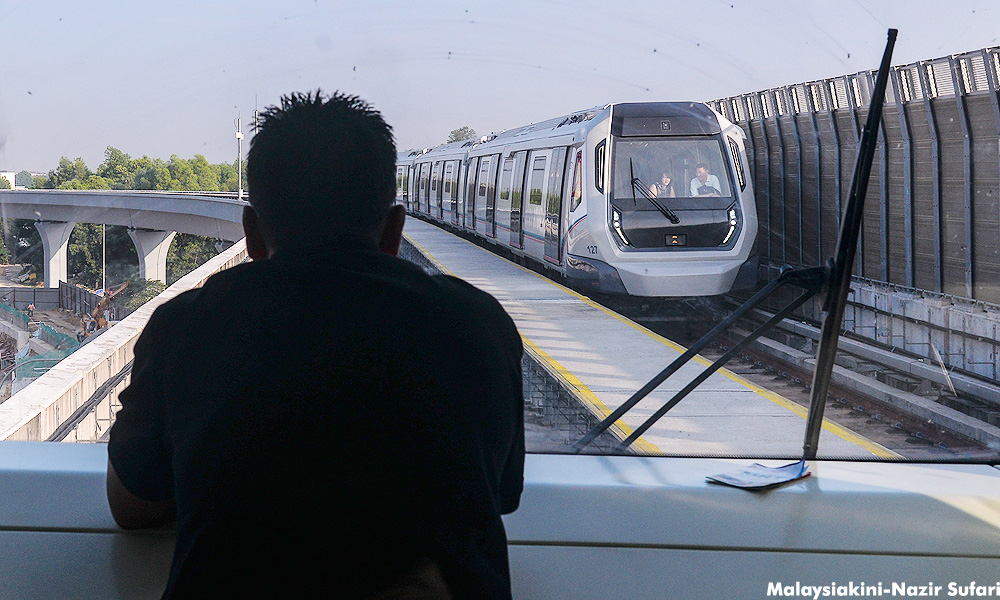

Rafizi and BN continue to rumble over MRT cost
PKR vice-president Rafizi Ramli and a BN communications team continue to trade barbs over the cost of the MRT 1 project in contrast with the Seoul Line 9 MRT project.
At the heart of it, both sides are arguing over the formula used to evaluate how much Seoul Line 9 cost per kilometre.
PKR vice-president Rafizi Ramli and an anonymous BN communications team continue to trade barbs over the cost of the MRT 1 project in contrast with the Seoul Line 9 MRT project.
At the heart of it, both sides are arguing over the formula used to evaluate how much Seoul Line 9 cost per kilometre.
According to a statement by an unnamed group calling itself the BN strategic communications team (SCT), publicly available documents showed that the 37km Seoul Line 9 project cost South Korea US$5.7 billion or US$152 million per kilometre.
This sum would make Seoul Line 9 more expensive than the MRT 1 project, said the SCT, although they did not provide their own cost per kilometre figure.
In a statement yesterday, Rafizi said that the SCT's calculations were flawed because if Seoul Line 9 was to be used for comparison, it must undergo a "normalisation" process, since the entire track was underground, while 80 percent of MRT 1 runs on elevated tracks.
Following this, Rafizi devised a formula to "normalise" the two systems based on a Halcrow report in 2000 which estimated that underground MRT tracks cost three times more to build than elevated tracks.
Therefore, his formula involved multiplying the entire Seoul Line 9 track length and the MRT 1 underground track length by three, before the total cost is divided by the new track lengths.
For Rafizi, after the "normalisation" process, Seoul Line 9 cost US$50.7 million per kilometre, while MRT 1 cost US$110.2 million per kilometre (based on the 2012 - 2016 average exchange rate of RM3.5773 to one US dollar).
'Formula too simplistic'
However, the SCT retorted that Rafizi's formula, which considered Seoul Line 9 was 112.5km long instead of 37.5km, was "astonishing" and that he had made some factual errors.
"It was Rafizi who publicly claimed Seoul Line 9 was 27km at USD43 million per kilometre. We corrected him using verifiable sources that it was 37.5km long at US$152 million per km.
"He agreed with us but in his strange underwater world, he now astonishingly claims that we are lying as the physical 37.5km long line should be considered to be virtually 112.5km long or exactly 3 times longer," said the SCT.
On the Halcrow report used by Rafizi to devise the formula, SCT said the formula was too simplistic and that the report stated that the cost difference ranges from two to three times.
"The study cited by Rafizi actually claimed that cost difference ranges between 2 times to 3 times. It is unknown why Rafizi would use the upper limit of 3. Using the lower limit of 2 would show very different results," said the SCT.
Additionally, the SCT claimed that Seoul Line 9 is not completely underground and that tunneling costs varies according to geology. They argued that tunneling works for Seoul Line 9 was cheaper because boring works were purportedly conducted on soft sand, while Kuala Lumpur sits on hard granite and limestone.
The SCT said that even if Rafizi insists that Seoul Line 9 costs only US$43 million per kilometre, he should question why Penang's LRT project cost 50 percent more at US$64 million per kilometre.
"And again, we request Rafizi should question the Penang Chief Minister Lim Guan Eng why does the Barcelona tunnel cost US$39 million per kilometre (based on 2011 exchange rates) while the Penang Tunnel project cost four times higher at US$162 million per kilometre (based on 2011 exchange rates)," said the SCT.


