


Federal Court doesn't recognise Iban customary practices
In a landmark majority decision delivered late last year that raised the eyebrows of the Sarawak indigenous people, the Federal Court ruled the Iban practice of “pemakai menoa” and “pulau” regarding customary land ownership was not enforceable in law.
Ten Sarawak civil society groups criticised the decision and in expressing disappointment said they were appalled with the Federal Court’s decision in the case of Tuai Rumah Sandah Anak Tabau vs director of Forest and State Government of Sarawak in not recognising the rights of the indigenous community.
Although the decision was delivered on Dec 20 by the Federal Court's deputy registrar, the written judgments - two of them, one dissenting - were only uploaded online recently.
"Pemakai menoa" is defined by Dr Dimbab Ngidang in the book "Ethical Values of Sarawak Ethnic groups" as a territorial domain of a longhouse community, where customary rights to land resource were created by pioneering ancestors.
"Pulau" is a term used to denote primary land under primary forest maintained under the Iban custom, from which they derive food, medicines, wildlife and other produce.
In allowing the appeal by the director of Forest Sarawak and the Sarawak government against 22 others from the Iban community in Kanowit on a 3-1 majority decision, Court of Appeal President Justice Md Raus Sharif disagreed with the view of the High Court and Court of Appeal, which ruled "pulau" and "pemakai menoa" as native customary law that had recognition in law under Article 160 (a) of the Federal Constitution.
“With respect, we disagree. This is not a case where we are called upon to consider whether such practice exists or otherwise. Rather, what is pertinent here is whether such practice which exists has any force of law,” the second highest judicial officer in the country said in his 43-page judgment.
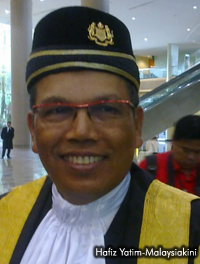 Justice Md Raus (photo) further cited Article 160 (2) of the Federal Constitution, which defines law to include written law, the common law in so far in operation of the federation and any custom or usage having the force of law.
He said the word “having the force of law” must be taken to mean not all customs or usages come within the definition and implies that there are customs and usages that do not have the force of law, and hence not within the definition of law.
'Look at definition of customary laws'
He said the courts below should have looked into the definition of customary laws under Sarawak state laws, which are customs that Sarawak state laws recognise.
“We must not lose sight of an important fact that recognition alone that such custom or practice exists is not enough. Clearly, recognition of the existence of such practice had brought with it regulations and restrictions,” Justice Md Raus added.
The judge further said the court and the Sarawak laws recognised the "temuda" custom of land cultivation for occupation and cited that this majority decision's position is consistent with the Nor Anak Nyawai case, where it was held that native customary rights (NCR) over land is founded upon the concept of continuous occupation and does not extend to areas where the natives had entered in search of food and jungle produce.
Besides Justice Md Raus, the other judges who agreed with him were Federal Court judges Justice Ahmad Ma'arop and Justice Abu Samah Nordin.
Federal Court judge Justice Zainun Ali wrote the dissenting judgment while the fifth judge, Justice Abdull Hamid Embong, had retired earlier last year.
Justice Abu Samah Nordin also wrote a separate 31-page judgment supporting Justice Md Raus where he agreed that central to the question was whether "pemakai menoa" and "pulau" are recognised as parts of the law of Sarawak and whether the claimants had successfully established their claim to the disputed land.
The judge ruled that the claimants had failed to prove their claim on a balance of probabilities due to one of the claimants not knowing the location of his longhouse on the land map when cross-examined during trial.
Dissenting judgment
Meanwhile, Justice Zainun in her 68-page dissenting judgment said what was critical, in her view, was the definition of customary laws under the Sarawak state laws, which has been defined to mean customs that the laws of Sarawak recognise.
“Again, there is this assumption that 'laws of Sarawak' must mean ‘legislation of Sarawak’ rather than ‘legislation and the common law of Sarawak’ or some other more expansive definition. The implication is that the lack of recognition under Sarawak’s ‘laws’ (read: legislation) means that they are merely practices,” Justice Zainun said, adding this completely missed the nuance of Article 160(2).
“There are aspects of our law that are only found in case law and I see no reason why they should be excluded from any understanding of what ‘law’ is. To fit usufructuary, NCR into the picture, they would fit either as an aspect of 'common law' or ‘customs’ that are recognised by the common law’ and thus have the ‘force of law’,” she explained.
Justice Zainun further cited the Nor Anak Nyawai case, where she noted that the then Federal Court did not disturb the High Court’s finding on the Iban concept of 'pemakai menoa' and that NCRs do not owe their existence to statutes.
“It affirmed the High Court’s major legal conclusions that the common law respects the pre-existence of rights under native laws or customs and such rights may only be taken away by clear and unambiguous statutory language.
"The Federal Court judge further recognised that "pemakai menoa" or "pulau" continued to exist from time immemorial in the Iban community since 1800 and said such custom is certain, reasonable and acceptable by the community.
“It must be recognised and upheld by this court. A claim for NCR is enforceable if it satisfies the sui generis nature of the custom. The sui generis nature of native rights requires that the content of native titles must not be explained by reference to common law.
“The challenge lies in the understanding of the nature of such rights as to how the natives who practice those rights perceive them. The law that governs a claim for NCR in respect of pemakai menoa or pulau has been established,” she ruled.
Looking at the facts of the case, Justice Zainun further cited Tuai Rumah Sandah's testimony in describing the boundary to uphold the High Court and Court of Appeal decision.
Such activities, she said, formed the real character of the customary practices of the affected Iban community who are the claimants.
"They depend on the virgin jungle in the vicinity of their longhouses and within their communal boundary. The trial judge was satisfied that they had proved their claim for NCR on a balance of probabilities."
Justice Zainun further ruled that the High Court trial judge's findings of facts should not be challenged and that the issues raised by the Sarawak government in the appeal involved questions of law on the Iban’s custom of "pemakai menoa" and "pulau".
See also the related court judgments:


Report this comment
Are you sure you want to delete this comment?
This action cannot be undone.