


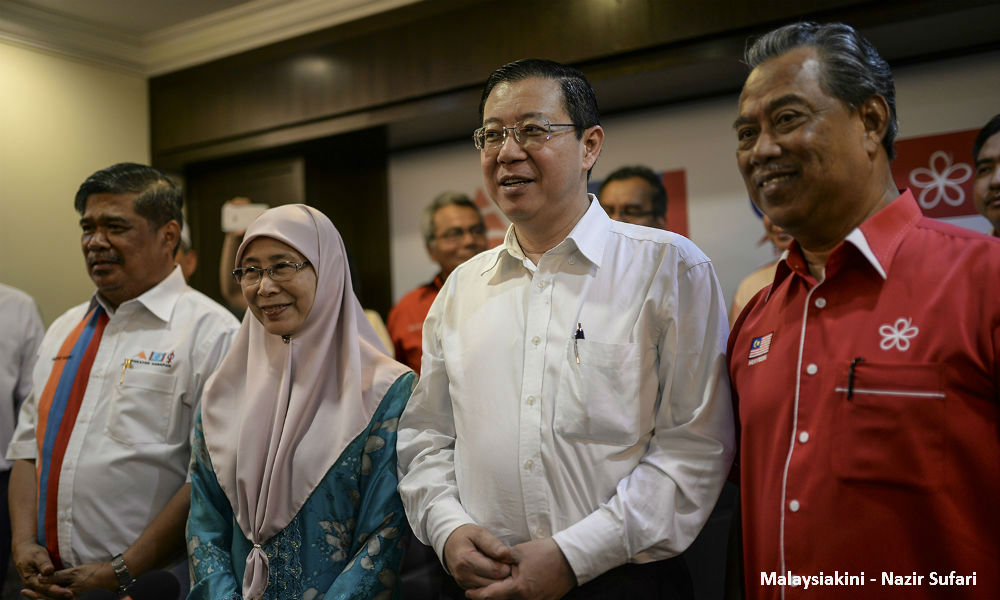

PKR, Bersatu will not abandon Harapan for PAS, say analysts
PKR and Parti Pribumi Bersatu Malaysia (Bersatu) will not respond to PAS’ suggestion that they ditch Pakatan Harapan and join a third bloc, said political commentators.
They opined that a third bloc, formed by Malay-based or Malay-dominated parties, would not stand a chance to take over Putrajaya in the next general election.
PAS vice-president Mohd Amar Nik Abdullah had claimed that the opposition would be stronger if the two parties join third the bloc, or Gagasan Sejahtera, led by PAS.
PKR and Parti Pribumi Bersatu Malaysia (Bersatu) will not respond to PAS’ suggestion that they ditch Pakatan Harapan and join a third bloc, said political commentators.
They opined that a third bloc, formed by Malay-based or Malay-dominated parties, would not stand a chance to take over Putrajaya in the next general election.
PAS vice-president Mohd Amar Nik Abdullah had claimed that the opposition would be stronger if the two parties join third the bloc, or Gagasan Sejahtera, led by PAS.
Amar also said the party prefers not to work with its former allies in the now defunct Pakatan Rakyat, and Parti Amanah Negara (Amanah), the splinter party set up to substitute for PAS in Harapan.
University of Tasmania’s Asia Institute director James Chin said PKR and Bersatu are unlikely to leave Harapan for PAS as they need DAP which controls 37 multi-racial parliamentary seats.
“PAS is proposing an all-Malays- or all-Muslims-led coalition. The bottom line is, this will not happen as the opposition cannot afford to lose DAP seats.
“PKR needs Chinese votes in mixed seats. Both PKR and Bersatu want a multi-cultural and multi-religious coalition,” he told Malaysiakini.
Despite forming a political pact with Harapan on Dec 13, 2016, Bersatu agreed with PAS to form a joint technical committee to work out a framework to unite the opposition in the next polls.
Chin’s opinion was shared by Universiti Kebangsaan Malaysia associate professor Mohd Faisal Syam Abdol Hazis.
“I disagree that PAS will be stronger with Bersatu and PKR. I don’t see the rationale of excluding them (DAP) and getting a strong opposition.
“PAS’ suggestion is good if it wants to make a breakthrough in the Malay-majority seats by having the Malay-based parties come together. But if you are thinking of forming the federal government, you cannot exclude DAP,” he told Malaysiakini.
Faisal added that it would not be appealing to the middle-class Malays who had voted for the opposition for a change in government in the last elections.
He also raised concern that it might create a deeply divided society.
“If this is the kind of politics that the opposition are trying to promote, then it is not much different from BN. Why do people want to vote for them?”
Faisal, however, felt that the opposition still need to rope in PAS if they want to seriously challenge BN in the next general election.
“The opposition cannot be strong and put up a credible challenge against BN if they exclude PAS, as the Islamic party is the strongest Malay opposition party,” he added.
‘Bersatu wasting their time with PAS’
Meanwhile, Universiti Malaya associate professor Awang Azman Awang Pawi said there is a need for the opposition to bring PAS to the negotiating table.
He said the pact simply can’t afford to neglect the role of PAS, which had won 21 parliamentary seats in 2013 polls, especially when Amanah has yet to withstand the test of time.
Azman said PAS should have an open mind by admitting that its main enemy is Umno.
The Islamic party extended the olive branch to PKR and Bersatu only after the grassroots in PAS and Umno had rejected the notion of Umno-PAS cooperation, he added.
“Umno in Kelantan was particularly reluctant as they will not give their seats to PAS, their main enemy in the state.
“The voice of the grassroots needs to be taken into consideration (by PAS), so that they could read the political situation more accurately,” Azman said.
Chin also argued that Bersatu is wasting their time with PAS.
“As long as Abdul Hadi Awang is the PAS leader, nothing will change. (PAS president) Abdul Hadi Awang really wants to isolate DAP. It’s actually a trap by PAS for the benefit of Umno,” added the academician from Sarawak.
Political analyst Liew Wui Chern said PAS finally realises its awkward position that it is not possible to fight a lone battle.
“PAS tried to tell its former allies that they cannot do without the Islamic party by inviting PKR and Bersatu to join the third bloc.
“PAS also planned to disturb Harapan’s plans in facing the next polls. If PKR and Bersatu fail to handle the issue properly, it will be used to PAS’ advantage,” he said.
For instance, Liew said PAS might portray both parties as anti-Islam if they turn down its proposals.
While agreeing that PKR and Bersatu would not work with PAS before the next polls, he did not discount the possibility of the opposition parties working together after elections, both at the state and federal levels.


Are you sure you want to delete this comment?
This action cannot be undone.