



Newsroom errors and religious profiling
COMMENT | I felt compelled to buy a copy of The Star yesterday morning in support of the newspapers after it was forced to suspend two of its senior editors and was investigated by the police for its controversial front page last Saturday.
I am no fan of The Star.
And the suspension of The Star’s editors is dwarfed by the suspension of The Edge, the termination of The Malaysian Insider, the online blocking of Sarawak Report and the prosecution of Malaysiakini’s editor-in-chief and chief executive officer for or linked to reporting on Najib’s 1MDB scandal.
And I even hear some opposition supporters now offering their conspiracy theories that this is but a “sandiwara” (play) of the BN to stir up communal tensions and that the public should just let it die down. After all, The Star is owned by a government party, MCA...
COMMENT | I felt compelled to buy a copy of The Star yesterday morning in support of the newspapers after it was forced to suspend two of its senior editors and was investigated by the police for its controversial front page last Saturday.
I am no fan of The Star.
And the suspension of The Star’s editors is dwarfed by the suspension of The Edge, the termination of The Malaysian Insider, the online blocking of Sarawak Report and the prosecution of Malaysiakini’s editor-in-chief and chief executive officer for or linked to reporting on Najib’s 1MDB scandal.
And I even hear some opposition supporters now offering their conspiracy theories that this is but a “sandiwara” (play) of the BN to stir up communal tensions and that the public should just let it die down. After all, The Star is owned by a government party, MCA.
So, why should we bother to speak up for The Star? Two important reasons.
Human errors
First, page-setting failure is a common mistake in the newsroom because people do overlook things.
Cairns Post in Australia once put a picture of a happy pilot on top of the screaming frontpage headline: “Rapist in Training”.
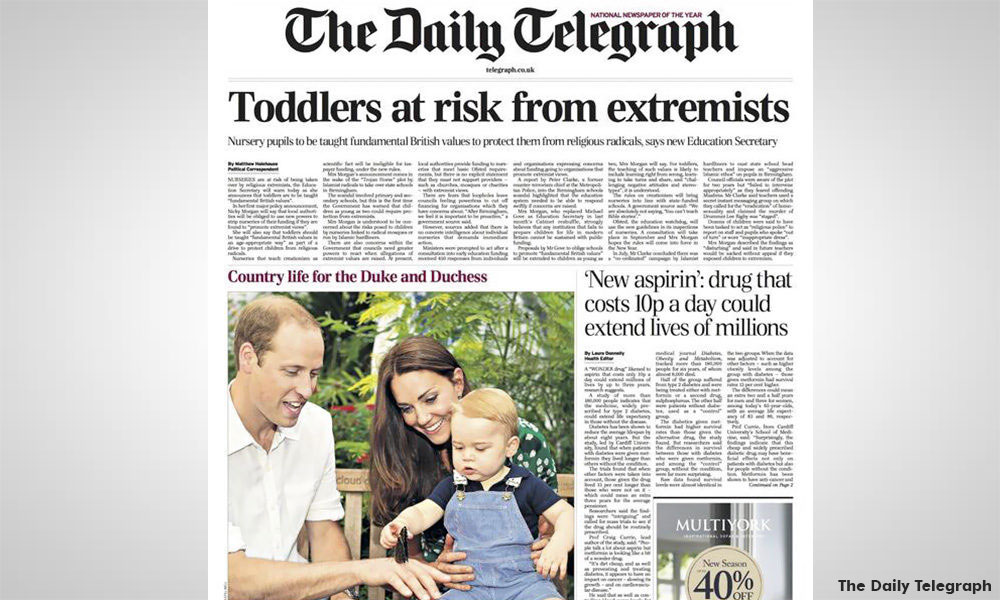
The happy family of Prince William, Kate Middleton and their son George once appeared in The Daily Telegraph under an alarming headline: “Toddlers at risk from extremists”.
Worse, the Liverpool Echo once put a picture of a happy boy enjoying his ice-cream titled “Boy, it’s hot!” next to the front page main story “Priest admits child sex”.
Have a look at more classic examples here.
The editors who make mistakes deserve a laugh by readers and teasing for years by their peers, and in the more serious cases, they also owe an apology to the offended parties.
But do they deserve to be investigated by police? Or be suspended under populist pressure?
Such overreaction is nothing but a witch-hunt on editors and journalists. It will not promote greater professionalism but only nurture timidity and self-censorship.
And who gains when editors and journalists constantly feel the sword of Damocles hanging over the head? Who loses when the media is tamed by arbitrary witch-hunts?
Inconveniently, press freedom comes in a package. If we have little tolerance for human errors, then we won’t have press freedom.
Religious Profiling
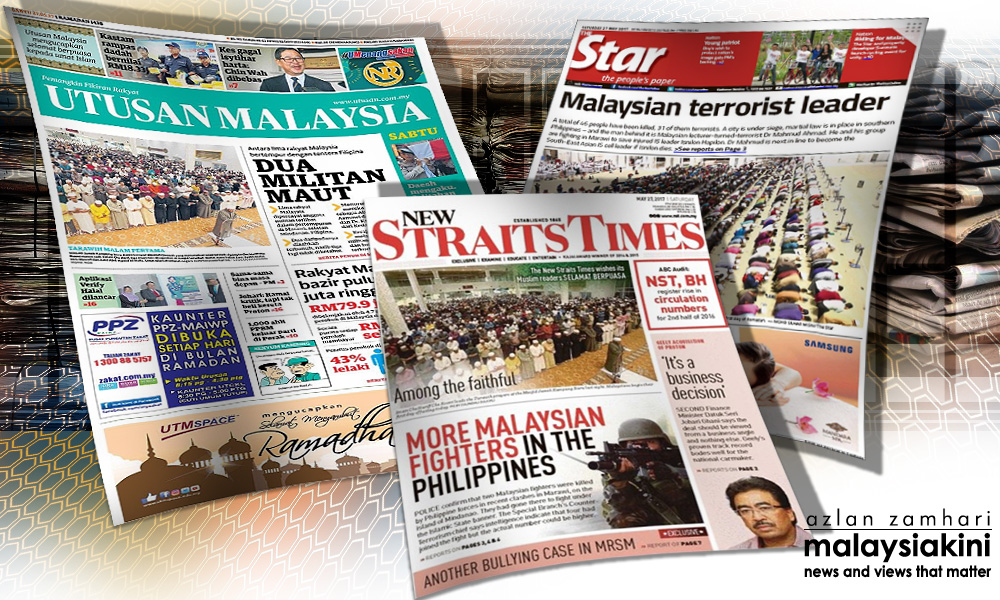
The second alarming reason is that The Star was singled out Utusan Malaysia and New Straits Times (NST) also put a news headline on terrorists and a photo of Muslims performing terawih prayers on their front pages that day.
If The Star is therefore anti-Islam and out to associate Islam or Muslims with terrorism, are Utusan Malaysia and NST not doing the same?
Take the Utusan Malaysia front page for example.
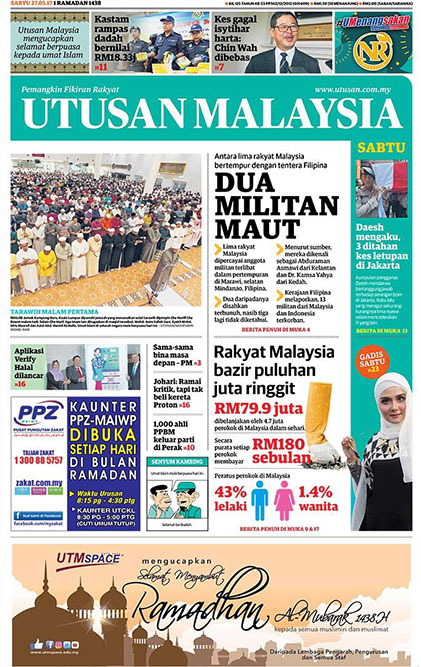 It was a photo of the praying congregation titled “Tarawih Malam Pertama” on the top left and big headlines “Dua Militan Maut” on the top right.
Why would this not associate Islam with terrorism, when a photo of the praying congregation titled “Holy month starts” was placed under the headline “Malaysian terrorist leader” would?
Is it because The Star’s photo caption was smaller than that of Utusan Malaysia? Would a larger caption – say larger than that of Utusan Malaysia’s – have saved The Star and the two editors from the trouble? Is that the lesson we need to teach in newsrooms and journalism classrooms?
Or, it has nothing to do with technicality but everything to do with identity?
Why does no one question if the editors in Utusan Malaysia were out to put Islam in a negative light? “Too obvious, the Utusan Malaysia editors couldn’t have been suspected because they are Muslims”?
If that is the answer, then what we have here is not a newsroom error of insensitivity.
The issue is religious profiling in an atmosphere of Muslims feeling under siege, where the same thing is all right if done by Muslims and all wrong if done by non-Muslims, because non-Muslims are easily thought to harbour negative agendas against Islam and Muslims.
So, how low must we go?
How to avoid an 'error of judgment'?
That three newspapers, including two English language dailies with multi-ethnic readerships, decided to put the photo of the first tewarih prayers on their frontpage is no coincidence.
It is actually a sign of respect that Islam and Muslims enjoy in Malaysia. The start of the fasting month would not be newsworthy if Islam is not revered and Muslims respected in this country.
Try newspapers in countries like UK and France with sizeable Muslim populations to see if you find such news.
The Star’s trouble is that the Islamic State’s (IS) Southeast Asian chapter seized the city of Marawi in the Philippines three days before the Holy Month started. And the inconvenient news came on June 26 that Malaysians were among the terrorists killed by the Filipino army.
So, what “error of judgment” should The Star have avoided in hindsight?
Any journalism lecturer would tell you that the Marawi conflict is certainly newsworthy for Malaysian readers for at least three reasons: impact, conflict and proximity. It deserved front page treatment, didn’t it?
So, how should The Star have avoided the perceived association of Islam with terrorism?
One option would have been to not run the terawih prayer photo and just highlight the Marawi conflict. This is what Berita Harian did with its front page on May 27: “Sah rakyat kita terbabit”.
Not highlighting that the Holy Month had started may have made The Star look less Muslim-friendly as compared to the NST. But The Star should accept that there is no level playing field in that direction, given the demography of its owners and staff.
The other option then is to run the terawih prayer photo and run the Marawi story entirely. That would probably be the safest way.
Bad news and Muslims just cannot appear on the same page – would this be the new rule in The Star’s newsroom from now on to avoid “error of judgment” in the future?
Who taints the Holy Month?
I can understand the stress and anger of true practising Muslims when reading the news of atrocities committed by IS terrorists in not just Marawi, but also in Minya, Egypt, as Ramadan was about to start.
In Minya, on May 26, 28 male Christians were shot dead when they defied their IS captors’ order to recite Shahada (the Islamic recitation of faith).
In Marawi, the local police chief said on May 27 that carpenters captured by the IS terrorists were killed when they failed to recite al-Quran.
Some would say all these are but anti-Islam propaganda.
But if these reports were true, these acts are forced conversion and religious cleansing, which go against Islam’s respect for religious freedom. What the IS terrorists are doing is the antithesis of Islam’s promise as “rahmatan lil alamin” (blessing to the universe).
If PAS, Umno, Perkasa, MJMM, IRIMM, DESMMA and even Amanah Youth are angered by The Star’s front page, they must have been totally enraged by what happened in Marawi and Minya. After all, the Holy Month is really tainted by the terrorists who make news, not the media that report news.
I tried looking for these parties’ and groups’ condemnation on the Marawi and Minya murders but have yet to find one. Let me know if you do.
WONG CHIN HUAT is a research fellow with Penang Institute, the state government think-tank on public policy.
The views expressed here are those of the author/contributor and do not necessarily represent the views of Malaysiakini.


