



No more 'switcheroos' at Fomema clinics
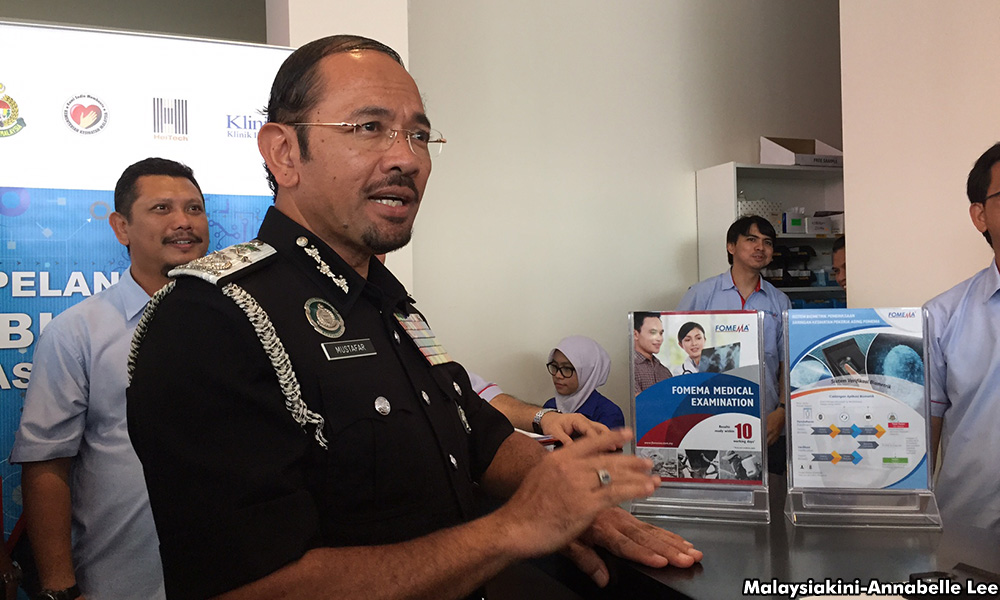
Migrant workers will be subjected to biometric fingerprint screening before undergoing medical examinations to prevent cheating, said Immigration director-general Mustafar Ali.
"We have that there is a certain percentage of migrant workers who use other people to represent them during medical examinations.
"They cheated during the examinations," he said at the soft launch of the biometric fingerprint identification system at a clinic in Shah Alam this morning.
Migrant workers will be subjected to biometric fingerprint screening before undergoing medical examinations to prevent cheating, said Immigration director-general Mustafar Ali.
"We are aware, a certain percentage of migrant workers who use other people to represent them during medical examinations.
"They cheated during the examinations," he said at the soft launch of the biometric fingerprint identification system at a clinic in Shah Alam this morning.
More than 3,000 Foreign Workers' Medical Examination Monitoring Agency (Fomema) clinics are required to have biometric fingerprint readers installed by October this year.
Mustafar explained that the fingerprint readers will be integrated with existing migrant workers database.
"The beauty of this system is it is an online system. It is hard to cheat with your fingerprints.
"If they cheat (by using a different person), the system will be alerted immediately and we will take action on both the employer and worker," he said.
Tuberculosis scare
Employers are required to register their workers at Fomema clinics for a medical examination comprising a blood test, urine test, chest X-ray and a physical examination.
Registration costs RM190.80 for each male worker and RM201.40 female worker, inclusive of the goods and services tax (GST).
Fomema CEO Mohd Hatar Ismail, who was also present at the soft launch, told reporters that the health screening was important, especially to screen migrant workers for tuberculosis.
"The problem is more than 50 percent of workers fail their medical examinations because of abnormalities shown on their X-ray reports, due to either active tuberculosis or signs of formerly having had tuberculosis.
"The Health Ministry is concerned about this because tuberculosis (can be spread through) airborne (particles)... it is a (highly contagious) disease," he said.
According to Mustafar, of the 470,890 screened by Fomema during the first half of 2017, 2.6 percent had failed the medical test. The largest number of were from Indonesia (3,129), followed by Nepal (3,021) and Bangladesh (1,643).
Blacklist problem resolved
Among others, these individuals tested positive for tuberculosis, Hepatitis (type not specified) and sexually-transmitted diseases (STDs).
"Those who have these diseases are not allowed to work in the country, to safeguard the health and safety of Malaysians," added Mustafar.
Those who fail the medical examination would be repatriated with the cost borne by their intended employers.
On the 2016 Attorney-General Report's discovery that the vast majority of undocumented migrants deported between 2014 and 2016 are not flagged from the Immigration Department's database, Mustafar said that the problems brought up in the report have been resolved even before the report was tabled.
"We have updated our system. We took immediate action once the audit was done.
"We did not wait till the report was tabled yesterday," he said.


