


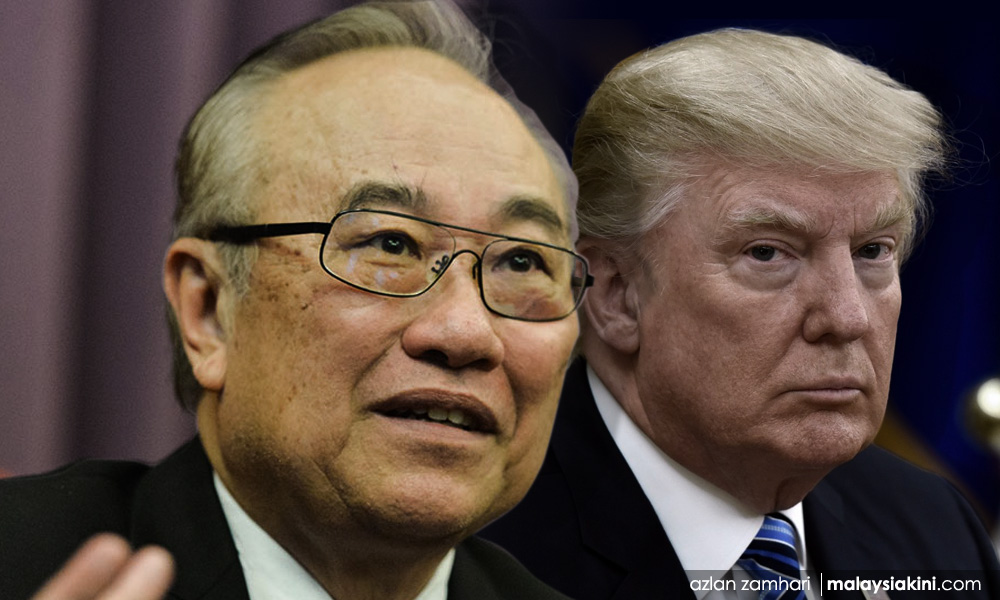

Paul Low sympathises with Donald Trump over rise of 'fake news'
The proliferation of “fake news” due to the rise of social media in Malaysia had made Minister in the Prime Minister’s Department Paul Low sympathise with US President Donald Trump.
“I believe that I sympathise with Donald Trump. I think he also faces that problem (of fake news) in America.
“But that is part and parcel of the new (social media) where everybody can say anything and everything, regardless of whether it is true or not,” Low said in his speech at the ‘Demcracy in Southeast Asia: Achievements, Challenges and Prospects’ conference in Kuala Lumpur today.
He had earlier explained that the impact of social media had provided easy and fast access to information which created an intensive political competition in communicating the right information to the voting public...
The proliferation of “fake news” due to the rise of social media in Malaysia had made Minister in the Prime Minister’s Department Paul Low sympathise with US President Donald Trump.
“I believe that I sympathise with Donald Trump. I think he also faces that problem (of fake news) in America.
“But that is part and parcel of the new (social media) where everybody can say anything and everything, regardless of whether it is true or not,” Low said in his speech at the ‘Demcracy in Southeast Asia: Achievements, Challenges and Prospects’ conference in Kuala Lumpur today.
He had earlier explained that the impact of social media had provided easy and fast access to information which created an intensive political competition in communicating the right information to the voting public.
Unfortunately, he said, the openness of social media can also be abused by politics of hate, condemnation and fake news.
Trump has often decried US media as reporting “fake news” about his administration, with cable news provider CNN most notably bearing the brunt of his accusations.
Low said that there are news organisations which are bipartisan and neutral just as there are those which are “not neutral”.
“But that is part of the political process where views are expressed from different angles and in different ways.
“And the challenge of any government in a democratic society is how to handle this.
“It is also a challenge for the Malaysian government, of the degree of intervention or appropriate regulation that is necessary,” he said.
He also reminded that though there are those who believe there should be complete freedom of expression without any boundaries or limitation, this belief must be set in the context of Malaysian society.
“Because as much as we would like to believe in a very free society, we do have sensitivities and we do have a certain degree of immaturity in our society.
“For us, it is a rule of thumb to ensure issues of security and harmony takes priority in many cases over just complete freedom expression.
“What is the point of having freedom of expression if we do not have harmony, peace and our society is in chaos,” he questioned.
Former Indonesian president Susilo Bambang Yudhoyono, who gave the keynote speech at the launch of the conference today, also addressed the problem of fake news.
“Yes, lies and fabrication have always been part of politics. But information technology and social media have made this problem rise to a new level and scope,” he said.
This is a problem that will not go away anytime soon and which no one knows how to deal with, he said.
“What is certain is that this problem of fake news will reduce the quality of our politics and of our democracy.
“It may also reduce people’s trust in both our leaders and in our media,” he said.
Similarly, another speaker at the conference launch, former Belgian prime minister Yves Leterme also spoke on the downsides of the “social media boom” in political debate.
While he acknowledged that social media facilitates political participation, he explained that the speedy and bite-sized nature of information propagated through social media may not always be appropriate for long-term democratic processes as well as a nuanced debate on democracy.
“Democracy ultimately takes time and that time perspective may be forgotten in the social media frenzy,” he said.
Susilo Bambang also pointed out that populism is a “double-edged sword” as it can serve a good purpose or advance bad intentions.
“It can charm as much as it can harm,” he said.
He gave the example of a populist leader trying to earn political stock by going the extra mile to deliver public services for his constituents.
This “positive” populism is a good thing, he said.
“But a populist leader may also appeal to the dark side of power by committing short-sighted acts that would excite the people but harm democracy and human rights.
“Such a negative populism would not be a good thing,” he said.
The problem now, he said, is that many politicians think that shallow populism can be a shortcut to earning a public office.
“Meanwhile, leaders who say and stand for the right thing are in danger of losing office,” he said.


Are you sure you want to delete this comment?
This action cannot be undone.