




Govt pledges battle against HIV as UN says crisis spreading
Malaysia has pledged to step up its battle against HIV/Aids after the United Nations said the virus had infected many more than the official government estimate, a report said today.
Malaysia has pledged to step up its battle against HIV/Aids after the United Nations said the virus had infected many more than the official government estimate, a report said today.
 "We have to halt the sexual spread of HIV/Aids and this can only be done through education," Health Department director-general Ismail Merican was quoted as saying by the
New Straits Times
.
"We have to halt the sexual spread of HIV/Aids and this can only be done through education," Health Department director-general Ismail Merican was quoted as saying by the
New Straits Times
.
He said Malaysia had set up a new surveillance system to monitor the HIV/Aids situation in the country.
"We have also sought the cooperation of non-governmental organisations to reach out to as many people as possible and talk to them about HIV/Aids and how it can be prevented," he said.
"We need to see a plateau soon, and then hopefully we will see a decline."
Ismail said that some 65,000 people in Malaysia had been diagnosed with HIV by the end of 2004. But the Joint United Nations Programme on HIV/Aids (UNAIDS) said it believes some 81,000 Malaysians could be infected.
Needles and condoms
Nafis Sadik, UN special envoy for HIV/Aids in Asia, told the New Straits Times Monday that the situation in Malaysia had developed into a "generalised epidemic" with the virus having spread beyond high-risk groups.
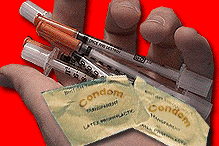 Sadik urged Malaysia to cast aside the denial and stigma commonly attached to HIV/Aids patients, and hailed the government's move to provide fresh needles and condoms to HIV-positive drug addicts.
"In some areas, you need to bring in the religious and community leaders. There are many people who are conservative but you cant exclude or condemn them," she reportedly said.
A recent survey revealed that Malaysians are alarmingly ignorant about how HIV/Aids is spread, with 40 percent of them believing that beautiful women cannot get infected.
Aids activists say that a lack of education about the virus, as well as a deep-rooted reluctance to discuss sex or admit the extent of the problem, have hindered the country's fight against HIV/Aids.
The government's plan to distribute free needles and condoms to intravenous drug users has been attacked by critics as going against religious teachings and being a waste of public funds.
Some 75 percent of HIV-infected Malaysians are intravenous drug users.


