
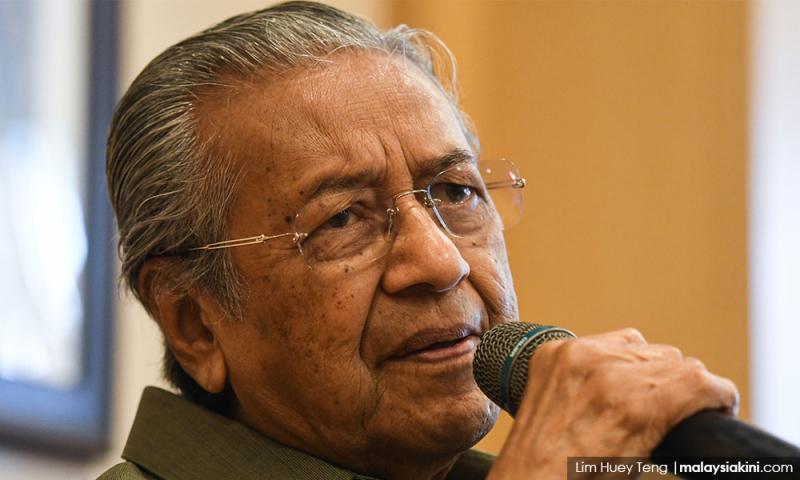
Dr M continues to defend privatisation policy
More than a decade since resigning as prime minister, Dr Mahathir Mohamad continues to defend his privatisation policy, which critics claimed created the culture of crony capitalism and widened the income gap in Malaysia.
In an interview with CNN Indonesia, Mahathir said only successful individuals leading companies in the private sector were labelled as cronies, despite them contributing to the nation’s development through taxes on profits made.
“When there are people who benefited from the development, then they are the ones labelled as cronies. But if they fail, they won’t be called a crony.
“So if we want to ensure that there will be no allegations of cronyism, all the private ventures must fail. But then we will suffer,” he argued...
More than a decade since resigning as prime minister, Dr Mahathir Mohamad continues to defend his privatisation policy which critics claimed had created the culture of crony capitalism and widened the income gap in Malaysia.
In an interview with CNN Indonesia, Mahathir said only successful individuals leading companies in the private sector were labelled as cronies, despite them contributing to the nation’s development through taxes on profits made.
“When there are people who benefited from the development, then they are the ones labelled as cronies. But if they fail, they won’t be called a crony.
“So if we want to ensure that there will be no allegations of cronyism, all the private ventures must fail. But then we will suffer,” he argued.
Mahathir said this when asked whether possibilities of corruption were considered when embarking on the policy first introduced in 1983, and his views on the current state of corruption in Malaysia.
While conceding that there were some failures, Mahathir said that a majority of the privatised infrastructure and services were successful and profited the government.
The Pakatan Harapan chairperson also claimed that the term cronyism was created by foreign powers to criticise developing nations, at the time seen to progress at a faster pace than during their period of colonisation.
“I admit that there were people whom we helped because they have the business skills.
“We helped individuals who were already successful in the private sector and we like to see them succeed further, because a large portion of the profits will go back to the government,” he recalled.
When pressed whether he viewed cronyism as an essential part of developing a nation, Mahathir insisted that there was no cronyism practised during his time and assistance were given on considerations of potential profit for the government.
“If we were to help a poor person with no knowledge about doing business, we will fail,” he said.
In the interview, Mahathir also highlighted how the government’s income during his time, including through profits from newly privatised companies, were spent on developing infrastructure projects including the KLCC and Putrajaya as the nation’s new administrative capital.
Looking at Washington DC in America and Canberra as existing models for an administrative capital, Mahathir said his administration had anticipated Kuala Lumpur’s potential growth rate and the need to relocate all government offices in a new area for better coordination.
In the early 2000s, it was reported that the government had spent billions in taking over a number of previously privatised projects, including Malaysia Airlines Berhad and property developer UEM Group.
Responding to his critics at the time, Mahathir, who was also finance minister until his resignation in 2003, repeatedly defended the privatisation policy as a catalyst for Malaysia’s infrastructure development.


Are you sure you want to delete this comment?
This action cannot be undone.