
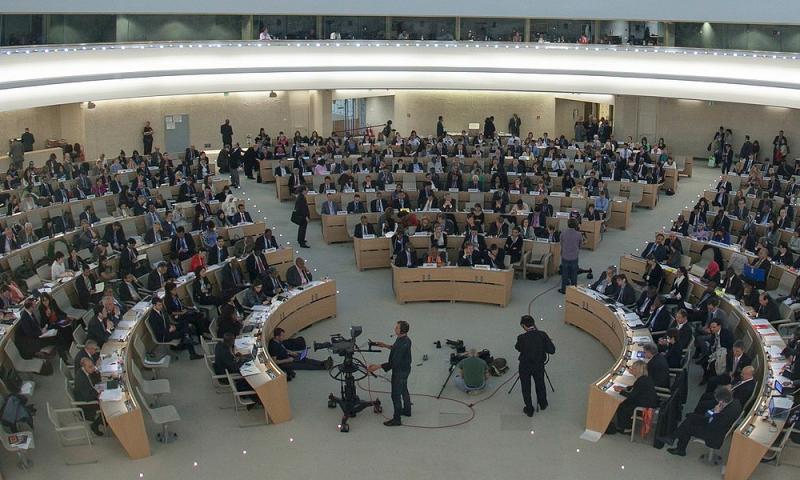
Human rights organisations have come out to say that Malaysia is a "wholly unsuitable" candidate for a seat on the United Nations Human Rights Council (UNHRC).

Following an announcement declaring the country's intentions to run for the 2018-2020 UNHRC term, UK-based Article 19 and Suara Rakyat Malaysia (Suaram) said the country has to "reverse" its crackdown on free expression first.

"Article 19 and Suaram consider that Malaysia’s record on human rights makes it a wholly unsuitable candidate for UN Human Rights Council membership, following the announcement of its intention to run for the term 2018 to 2020 and public pledge.

"Malaysia’s worsening record on the rights to freedom of expression, association and peaceful assembly...requires that the government urgently initiate legal reforms and fundamentally change its approach to UN engagement.

"This is so Malaysia can demonstrate its genuine intentions to meet its responsibilities as a Human Rights Council member," read a statement released by the two groups yesterday.

The UNHRC is an inter-governmental body that is tasked with promoting and protecting human rights in its member countries.

Malaysia is now among five countries in the Asia and Pacific region seeking election to four vacancies in the council during its next elections in October 2017.

The council currently has 47 members, including Indonesia, the Philippines, India, and China. Malaysia was previously a member of the council from 2006 to 2009, and then again from 2010 to 2013.

During its last UNHCR tenure, Suaram and Article 19 noted that Malaysia "routinely engaged" in violations of freedom of expression, citing crackdowns on the Bersih 2 and 3 rallies, and harassments faced by Suaram for bringing the Scorpene corruption scandal to light as examples.

'Free speech is not thriving'

The same trend followed suit in the years after.

"In 2017, the Malaysian Government has continued to curtail the right to freedom of expression, both online and offline, against international human rights law and Article 10(a) of the Malaysian Constitution.

"Contrary to Prime Minister Najib Abdul Razak’s April 2017 claim that 'free speech is thriving in Malaysia', this year has seen an escalating crackdown on persons who engage in dissent or openly criticise the government," the statement read.

Among others, Suaram and Article 19 have urged for the repeal of the Sedition Act 1948, the Printing Presses and Publications Act 1984, and reform the Penal Code.

They have also asked all investigations and charges made against social media users to be dropped, on the account of them exercising "their rights to freedom of opinion and expression."

"There has been no accountability for these human rights violations, and the legislation enacted in that period continues to be used to target legitimate dissent.

"Any claims of the Malaysian government that its potential Human Rights Council membership will lead to a change in direction should, therefore, be scrutinised closely."