



US a safe place for M'sian investments, says don
Amid brickbats for Prime Minister Najib Abdul Razak’s pledge to boost investments in the US, the National Council of Professors’ Mohamed Mustafa Ishak pointed out that the US is a safe place for investment.
Mohamed Mustafa, who heads the council’s politics, security and international affairs cluster said even China has been investing in the US.
“As we all know, the United States is a very important trade partner for Malaysia. Otherwise, in the past, we would not enter the Trans-Pacific Partnership Agreement (TPPA). Now that TPPA has been cancelled, the trade between Malaysia and the US is still very important."
Amid brickbats for Prime Minister Najib Abdul Razak’s pledge to boost investments in the US, the National Council of Professors’ Mohamed Mustafa Ishak pointed out that the US is a safe place for investment.Mohamed Mustafa, who heads the council’s politics, security and international affairs cluster said even China has been investing in the US.
“As we all know, the United States is a very important trade partner for Malaysia. Otherwise, in the past, we would not enter the Trans-Pacific Partnership Agreement (TPPA). Now that TPPA has been cancelled, the trade between Malaysia and the US is still very important.
“Malaysia has a need to put money in a safe place where there will be a good return or a high return. Investing in the US is not a bad idea at all.
“China has always been putting their money there because everyone knows that from an economic point of view, the US is one of the safe places to put your money in. What more if the investment is in the infrastructure sector, which is very, very safe,” he told Malaysiakini when contacted yesterday.
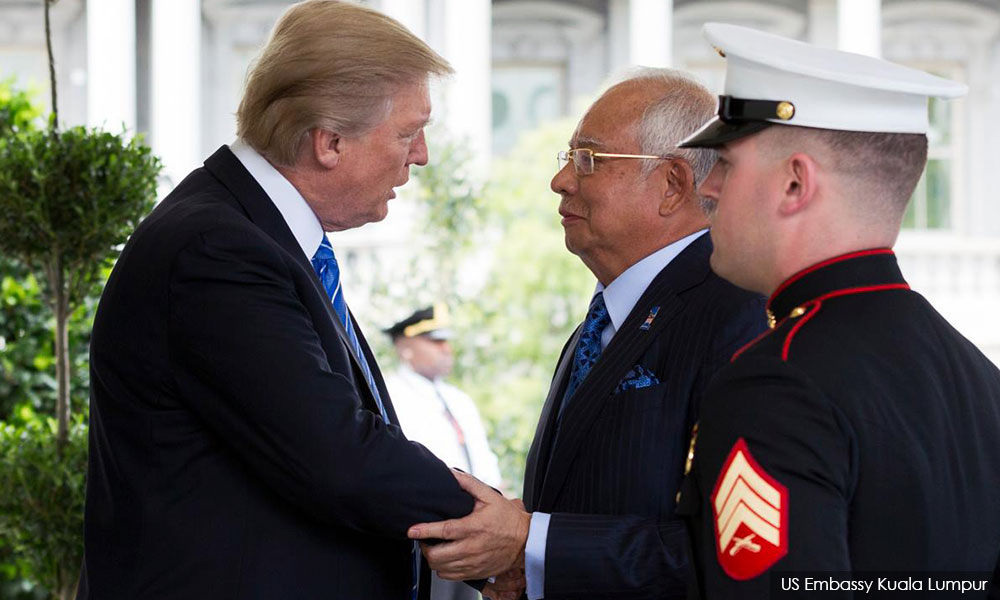
During Najib’s meeting with US President Donald Trump on Sept 12, Najib said the Employees Provident Fund (EPF) has close to US$7 billion in equities in Malaysia. This would be increased by US$3 billion or US$4 billion to support infrastructure redevelopment in the US.
He said the sovereign fund Khazanah Nasional would also increase its investments in Silicon Valley tech companies, while Malaysia Airlines would probably make US$10 billion in Boeing aircraft orders. He offered to persuade AirAsia to switch to the American-made General Electric engines as well.
The seemingly one-sided deal had drawn brickbats from critics at home, who argued that the money would be better used to boost Malaysia’s economy.
However, Mohamed Mustafa pointed out that the fruits of Najib’s meeting with Trump still remains to be seen, because the relationship between the two countries is a long-term investment.
“Of course with this new trade deal, we hope that there will be something in return from the US in terms of many other things that we may get. We hope that after this, the government will be able to shed some light on what benefits we will get.
“It (the benefits for Malaysia) was not mentioned during the visit, but this trade deal and relationship is long-term. We hope that in the long run there will be something that Malaysia will gain from this visit,” he said.
He said the meeting between the two leaders can also be seen as a renewal of relationships between the US and Malaysia under Trump’s administration, which began following the end the latter’s predecessor Barrack Obama’s tenure earlier this year.
This would help ensure that promises made during Obama’s administration would be honoured under Trump’s administration, such as cooperation towards enrolling Malaysia it the US’s visa waiver program, continued trade, and cooperation in counterterrorism efforts.
“Apart from that, I think we need to wait for the government to explain,” he said.
Separately, the former Malaysian ambassador Dennis Ignatius described Najib’s behaviour as “chequebook diplomacy” that is more typical of rich and powerful nations.
He said Najib had previously practiced chequebook diplomacy with China and now the US. He said better relations with Washington would allow him for political manoeuvring, and undercuts the opposition’s criticism that Najib had become too close to China.
“After this, expect European and Japanese salesmen-politicians to come knocking at our doors with hat in hand and high praise for Najib on their lips.
“For so long as there’s money to be made, inconvenient issues like human rights and good governance will not be allowed to get in the way,” he wrote in a commentary, which is published in Malaysiakini today.
However, he said this means that Malaysia would have to pay for Najib’s extravagance, while the opposition and human rights activists can expect no sympathy or moral support from US and other democracies.
Related stories:


Report this comment
Are you sure you want to delete this comment?
This action cannot be undone.