
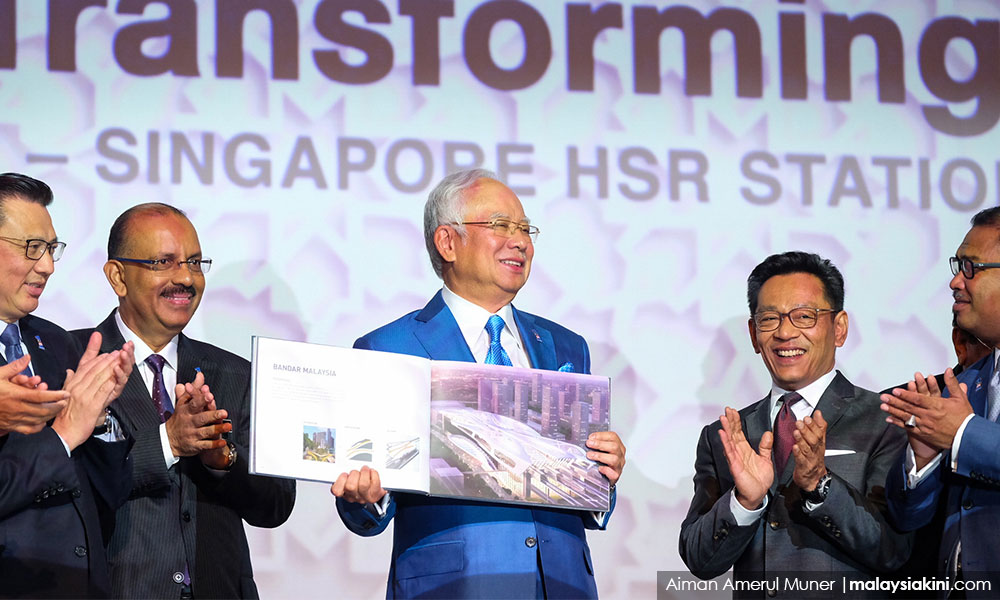

Prime Minister Najib Abdul Razak has promised that the Kuala Lumpur-Singapore High-Speed Rail (HSR) project will be delivered on-time and within budget.

Speaking at a ceremony today which unveiled the architectural concepts of Malaysian HSR stations, Najib said he was aware that "all eyes" were on how his administration would execute and deliver the project.

"I believe we can do it, as we have done with the Mass Rail Transit (MRT) project.

"We can set an example of how mega-projects like this can be delivered efficiently within budget and the time frame for the benefit of the country and the people," he said at the Malaysian International Trade and Exhibition Centre (Mitec) this morning.

With groundwork slated to begin next year, the reported completion date is 2027.

The HSR is expected to cost the public RM40 billion although some reports claim that the bill could go as high as RM70 billion.

Economy stimulus

Najib said the project was no normal transportation project and that it was a project that was close to his heart.

He said the HSR will not only provide an alternative means of travel between Malaysia and Singapore, but also stimulate the economy of Peninsula Malaysia's south-west corridor.

"Our vision is for each station to become a hub and a gateway to Malaysia's modern and most advanced cities.

"To achieve this, we are developing the HSR Corridor Socio-Economic Development Programme (SDP) which will focus on three main components: economy, inclusivity and sustainability," he added.

When completed, the HSR is expected to take passengers 90 minutes to travel from Bandar Malaysia, Kuala Lumpur to Jurong East, Singapore.

Other planned stations are Bangi-Putrajaya, Seremban, Melaka, Muar, Batu Pahat and Iskandar Puteri.

Both Malaysian and Singaporean Customs, Immigration and Quarantine (CIQ) facilities will be located at Bandar Malaysia, Iskandar Puteri and Jurong East stations.

Inspired by local heritage

Meanwhile, Najib explained that each of the seven HSR stations in Malaysia were designed to "ensure dynamic reflection of Malaysia's rich heritage and cultural diversity", with stations bearing distinct designs but representing a continuous journey as a whole.

The Bandar Malaysia station has been designed to resemble the confluence of the Klang and Gombak rivers while the Bangi-Putrajaya station will showcase Islamic architecture.

The Seremban HSR station resembles the Sri Menanti royal palace complete with a glass interpretation of the Minangkabau roof while the Melaka station resembles a merchant ship.

Inspiration was drawn from the rehal, the rack for placing the Quran, for the Muar station while the Batu Pahat station was designed after the kuda kepang.

The last station, Iskandar Puteri, has been designed to resemble a handshake.

Malaysian architecture practices Veritas and Ong&Ong worked with international firm Aedas to produce the designs.