




Gloom in Petaling Street: Do traders of fake goods pay GST, asks Umno man
Bukit Bintang Umno division leader Zainal Rafique has dismissed the claim that GST has led to a drop in customers at Petaling Street in Kuala Lumpur.
Speaking to Umno Online, he also asked if the traders in Petaling Street paid the tax.
According to Zainal, business in Petaling Street was not affected by the GST, but rather the influx of migrants who were trading in the area.
“The fact is customers no longer frequent Petaling Street because there are too many foreigners... Some of them also behave in a rude manner towards customers,” he said...
Bukit Bintang Umno division leader Zainal Rafique has dismissed the claim that GST has led to a drop in customers at Petaling Street in Kuala Lumpur.
Speaking to Umno Online, he also asked if the traders in Petaling Street paid the tax.
According to Zainal, business in Petaling Street was not affected by the GST, but rather the influx of migrants who were trading in the area.
“The fact is customers no longer frequent Petaling Street because there are too many foreigners... Some of them also behave in a rude manner towards customers,” he said.

Zainal was responding to Hawkers and Petty Traders Association (HPTA) chairperson Ang Say Tee (photo) who blamed the GST for the lack of revenue in recent years.
The Umno man said Ang should be aware that by allowing a large number of foreigners to trade in the area, Petaling Street had lost its Malaysian image.
Dismissing the MCA grassroots leader's argument that the GST is to be blamed as shallow, he also pointed out that most traders in Petaling Street dealt with imitation and counterfeit products, which were not taxable.
Therefore, Zainal requested that Ang, as the chairperson of the hawkers and traders association, work towards restoring the image of Petaling Street.
“Just because you want things easy, traders (in Petaling Street) should not rent their stalls to foreigners.
“They also prefer to hire foreign workers compared to Malaysians resulting in Petaling Street transforming into a foreigners' pasar malam (night market),” he added.
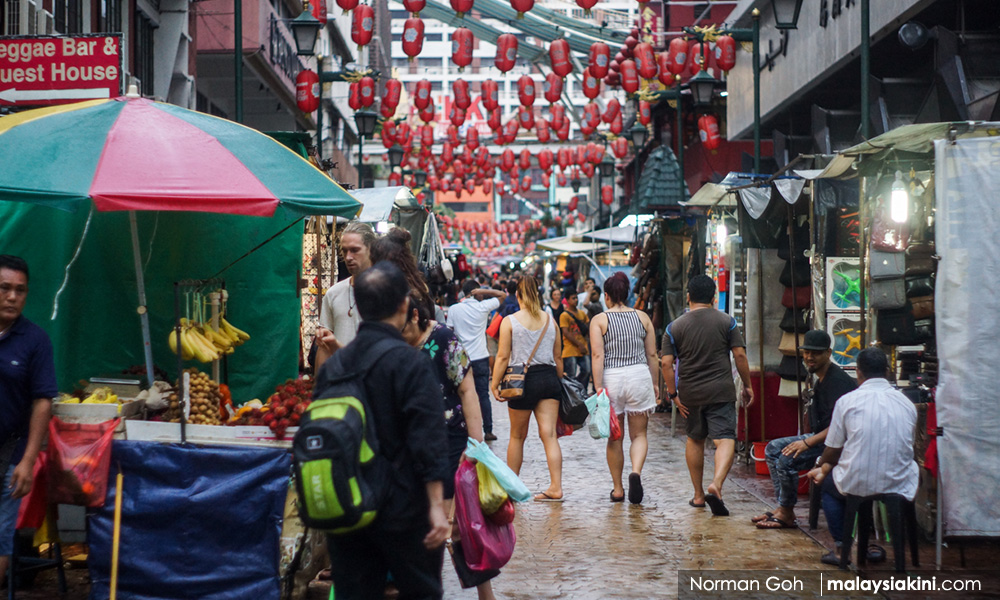
Yesterday, Ang told Free Malaysia Today that since the GST was implemented in April 2015, business in Petaling Street has been down. In 2017, the value of the ringgit dropped, causing prices of items to go up.
“However, our customers say their salaries are still the same and due to that, they are cautious in their spending,” he said.
“Look around, there is no crowd. Years ago, people could hardly walk here. It was so crowded,” he added.
According to Ang, about 10 percent of the traders have closed shop since 2015.


Are you sure you want to delete this comment?
This action cannot be undone.