


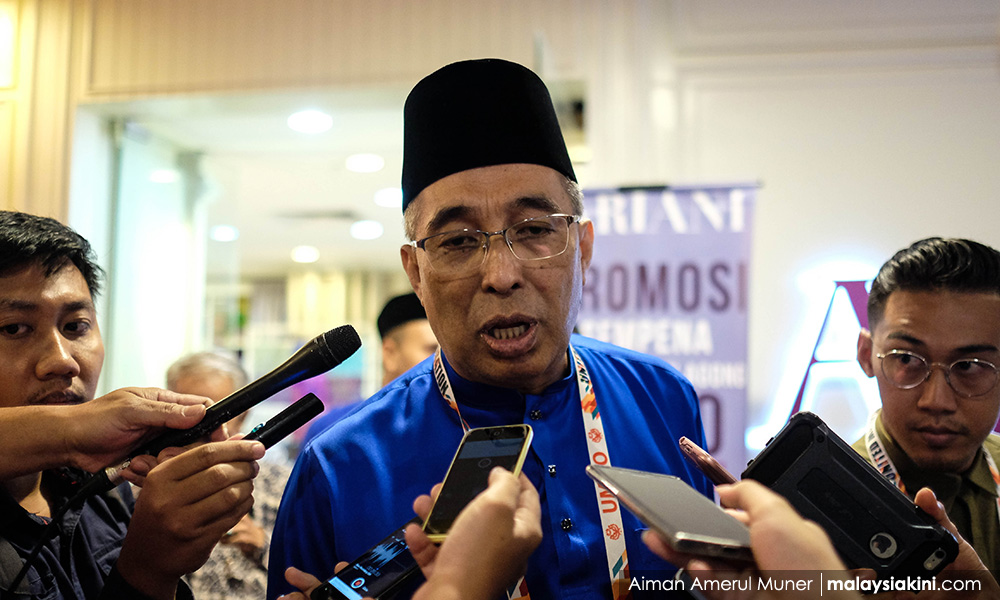

Fake news over Anti-Fake News Bill, says minister
Communication and Multimedia Minister Salleh Said Keruak has claimed that some of the coverage regarding the Anti-Fake News Bill has been deliberately misleading and in certain cases, completely false.
“For example, the definition of fake news in the Bill is clear and specific, freedom of speech as provided for under the Federal Constitution will not be curtailed, and the government will not itself decide what is fake news, but instead will allow a neutral party, namely the courts, to decide via independent legal process...
Communication and Multimedia Minister Salleh Said Keruak has claimed that some of the coverage regarding the Anti-Fake News Bill has been deliberately misleading and in certain cases, completely false.
“For example, the definition of fake news in the Bill is clear and specific, freedom of speech as provided for under the Federal Constitution will not be curtailed, and the government will not itself decide what is fake news, but instead will allow a neutral party, namely the courts, to decide via independent legal process.
“As we have seen since a former leader stepped down and judicial independence was recovered, Court decisions now frequently go against the government and senior ministers,” he added in an obvious reference to former premier Dr Mahathir Mohamad.
Salleh also pointed out that under Prime Minister Najib Abdul Razak's leadership, the government introduced the most far-reaching measures since independence to strengthen free speech and democracy.
“For example, the Internal Security Act was repealed, the state of emergency that had existed for over 60 years ended, media freedom was increased by scrapping restrictions on newspaper publishing licenses, the Universities and University Colleges Act (UUCA) was reformed to allow undergraduates to participate in political activities; and the Peaceful Assembly Act was passed, for the first time enshrining in law the right to peaceful protest.
“So it is clear that this Government will act when it is necessary to protect the security and freedoms of the people and our democratic process,” he added in a blog post.
Malaysia is not alone
However, Salleh argued there is no doubt that a law to curb fake news is necessary and Malaysia is not alone in this aspect.
“Countries around the world, including our Asean neighbours Singapore and the Philippines, are considering or have introduced similar legislation to combat fake news.
“Germany has implemented their own anti-fake news law which provides for fines of up to €50 million (RM241 million) for networks that fail to take down illegal content within 24 hours.
“In France, President Emmanuel Macron has promised to introduce a law to ban fake news on the internet during elections. He was uncompromising about the need for such legislation.
“And Britain's Prime Minister Theresa May is launching a fake news rapid response unit 'to deal quickly with disinformation and reclaim a fact-based public debate',” he added.
Salleh said these were not repressive regimes, but European countries known for promoting free speech and civil liberties.
“The trend is clear: countries that wish to promote healthy debate and a democratic process based on the facts are realising that they must act against the scourge of fake news,” he added.
Salleh pointed out that those who convey honest opinions, report conscientiously and truthfully according to proper journalistic protocols need not be concerned about fake news.
“No, the only people that need to be afraid are those that broadcast or pass on fake news – or lies, to you and me. If we are criticised for being on the side of truth, so be it.
“That is criticism we can take with a good heart. And we will not stop calling out the people who would confuse the facts – of which we are certain – with the spin and deceit of people who would subvert democracy for their own selfish ends.
“To be properly informed is the very least that the Malaysian people deserve. The opposition and some of the media outlets that support them seem to disagree. They may prefer, spin, smears and outright lies – but the government will continue to fight for the truth,” he added.


