


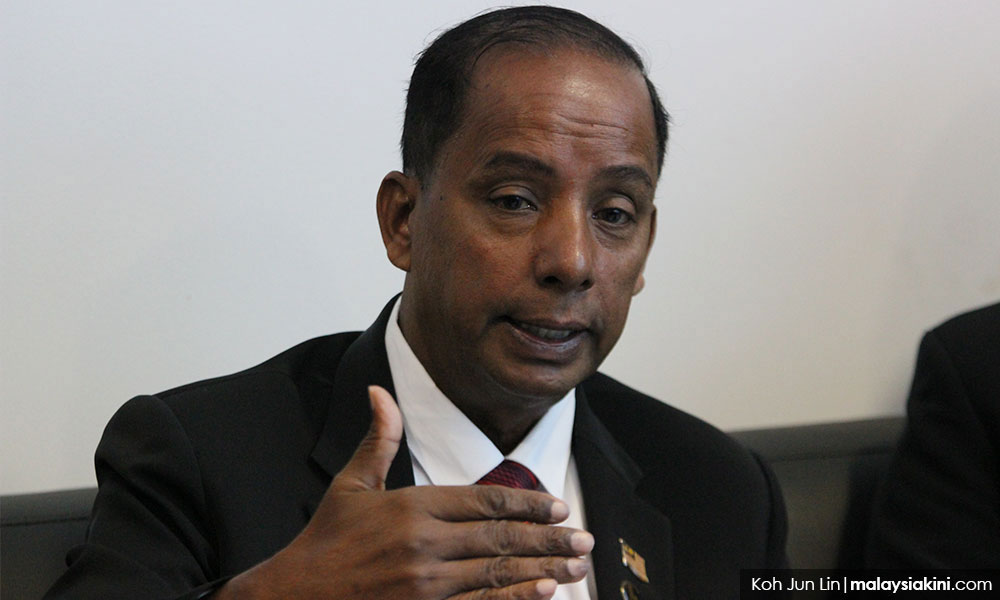

Deal to bring in 1.5m Bangladeshi workers under review - minister
The 2016 deal to employ 1.5 million migrant workers from Bangladesh over a three-year period will be among the agreements reviewed by the new Pakatan Harapan-led government, confirmed Human Resources Minister M Kulasegaran.
This is in line with the new government’s plan to reduce Malaysia’s dependence on foreign labour, he told a press conference at Wisma Perkeso in Kuala Lumpur today...
The 2016 deal to employ 1.5 million migrant workers from Bangladesh over a three-year period will be among the agreements reviewed by the new Pakatan Harapan-led government, confirmed Human Resources Minister M Kulasegaran.
This is in line with the new government’s plan to reduce Malaysia’s dependence on foreign labour, he told a press conference at Wisma Perkeso in Kuala Lumpur today.
“We will allow foreign workers out of necessity (but) priority will be given to our workers first. Think about our Malaysians first, others come second.
“All agreements and understandings with other governments, we will review. That is what (Prime Minister Dr Mahathir Mohamad) has said,” Kulasegaran said.
Asked if there will be problems filling vacancies left by the migrant workers, Kulasegaran said the process will take time and will not affect migrant workers who are already in Malaysia.
“But the incoming (workers), we will do what we can. But this filling up, we do agree there will be retraining and other factors (but) our priority should always be our workers,” he said.
To another question, Kulasegaran said the EIS introduced in January this year will continue for the time being, whereas a review of the minimum wage will begin within weeks.
Also present at the press conference was the Social Security Organisation (Socso) CEO Mohammed Azman Aziz Mohammed, who said there had been 7,112 applications for EIS funds to be disbursed, of which 5,867 had been approved.
Those approved will receive an interim benefit of RM600 per month for up to three months, and will receive help with employment services. The disbursements of RM3.5 million does not include the cost of Socso’s promotional activities and administrative fees.
Thus far, 407 had been successfully re-employed, Azman said.
The EIS scheme entails employers and employees each contributing 0.2 percent of wages to a fund, and eligible recipients are to receive temporary financial assistance for up to six months beginning January next year.
This is in addition to assistance to find a new job or obtain training, and other benefits.
However, the previous BN-led administration had also provided Socso with an RM122 million allocation to enable it to provide interim benefits this year.
It was previously reported that Socso aims to collect RM479.5 million in EIS contributions this year.
Meanwhile, Kulasegaran said the government will also work towards the speedy disposal of cases pending in the Industrial Court.
He said the Industrial Court chairperson Eddie Yeo has agreed to dispose of cases as soon as possible without compromising on the quality.
Thus far, he said there are 3,697 cases being handled by the court this year, of which 912 cases had been disposed and 2,775 cases are still pending.
He said there are also 1,970 cases pending his approval to be referred to the Industrial Court, and he has ordered this to be expedited as well.
“I have told them to finish it within one month. They may have to come back at night, on Saturdays, Sundays, and public holidays to dispose of all these cases.
“It is not fair for workers to wait that long. We want to finish as soon as possible,” Kulasegaran added.
He said he is also amenable to introducing legal amendments so that industrial disputes that cannot be resolved by industrial relations officers can be referred to the Industrial Court without ministerial approval.
“I'm agreeable to it. I think there is no reason why the minister is also a minister of justice. The filtering process doesn’t help.
“So, I’ve told the officers to let them (the workers) ventilate the issues in the court. Let them go, it doesn’t matter. The minister should not stop all these."
However, he said this process will take time and will have to wait until the Parliament reconvenes.


Report this comment
Are you sure you want to delete this comment?
This action cannot be undone.