


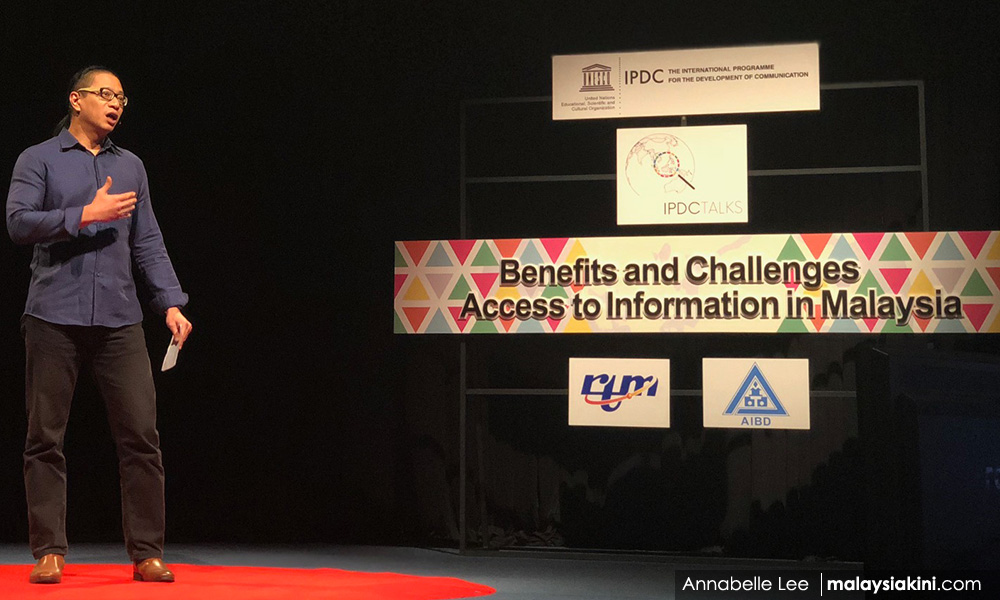

OSA will render Freedom of Information law useless - UM don
The upcoming Freedom of Information bill is predicted to have little effect if the Official Secrets Act 1972 (OSA) continues to exist, a forum heard today.
During the talk titled 'Benefits and challenges of access to information in Malaysia', Universiti Malaya law lecturer Azmi Sharom characterised the OSA as the “giant mad elephant” in the room as the government drafts a legislation allowing a right to information.
“Even if we have a national Freedom of Information (FOI) law, it will be useless if our OSA remains... We can’t go into the FOI with the OSA – this giant mad elephant rampaging around...
The upcoming Freedom of Information bill is predicted to have little effect if the Official Secrets Act 1972 (OSA) continues to exist, a forum heard today.
During the talk titled 'Benefits and challenges of access to information in Malaysia', Universiti Malaya law lecturer Azmi Sharom characterised the OSA as the “giant mad elephant” in the room as the government drafts a legislation allowing a right to information.
“Even if we have a national Freedom of Information (FOI) law, it will be useless if our OSA remains... We can’t go into the FOI with the OSA – this giant mad elephant rampaging around.
“We have to get rid of the OSA or modify to such an extent that it can’t be used with such ultimate discretion (by the government),” he said at the event which took place in Angkasapuri, Kuala Lumpur.
The OSA allows any minister, state chief minister or public official to declare government documents a state secret.
It was controversially used in 2015 by the previous BN government to classify the Auditor General’s final audit report on 1MDB.
Shortly after Harapan defeated BN in the 14th general election, Prime Minister Dr Mahathir Mohamad instructed that the report be declassified.
In line with Harapan’s election manifesto, Deputy Minister in the Prime Minister's Department Hanipa Maidin revealed last month that cabinet was in the midst of formulating a national FOI law.
At present, only Selangor and Penang have FOI enactments.
Amend or repeal OSA?
Also stated in the Harapan manifesto was a promise to review the OSA.
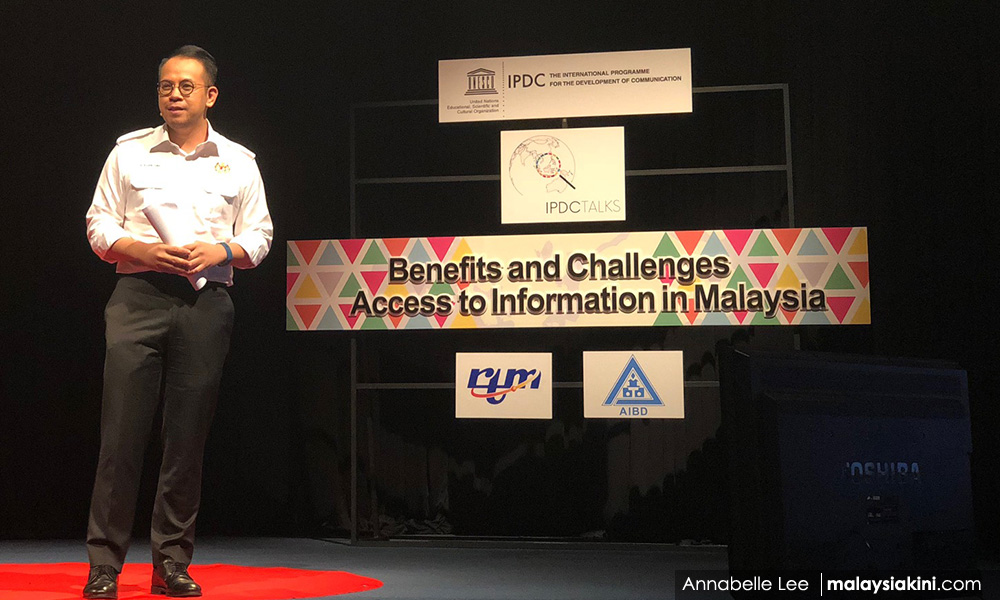
Deputy Youth and Sports Minister Steven Sim, also a speaker at the event, stated that the government was presently considering either amending it or repealing it altogether.
“There are suggestions which say ‘keep the OSA but amend it so that we don’t give so much power (to classify documents). Because as it is, the scope (of classification) is huge, we should not give individuals blanket power for exemptions of information.
“The second view is to do away with it, repeal it, have an FOI Act with specific exemptions. These two views are being deliberated at this point,” he said.
Read more: Deputy minister wants CEP reports made public
The Bukit Mertajam MP opined that government information should be made public by default, and that something should only be declared an official secret in “extraordinary” circumstances.
“Confidentiality or official secrets must be defined, they must be extraordinary, limited and specific (conditions).
“It can’t be broad-brush. For example, (you can’t say) ‘I can’t reveal this because of national security?’ Why national security?” he asked.
'Asian values' no excuse to override human rights
“Asian values” – a concept often touted by Mahathir during his first tenure as prime minister – was another issue that came under the spotlight during the talk.
During the question-and-answer session, a participant asked if domestic contexts should be taken into account when implementing universal human rights, such as the right to information, in Malaysia.
Most panellists, including Azmi, strongly disagreed.
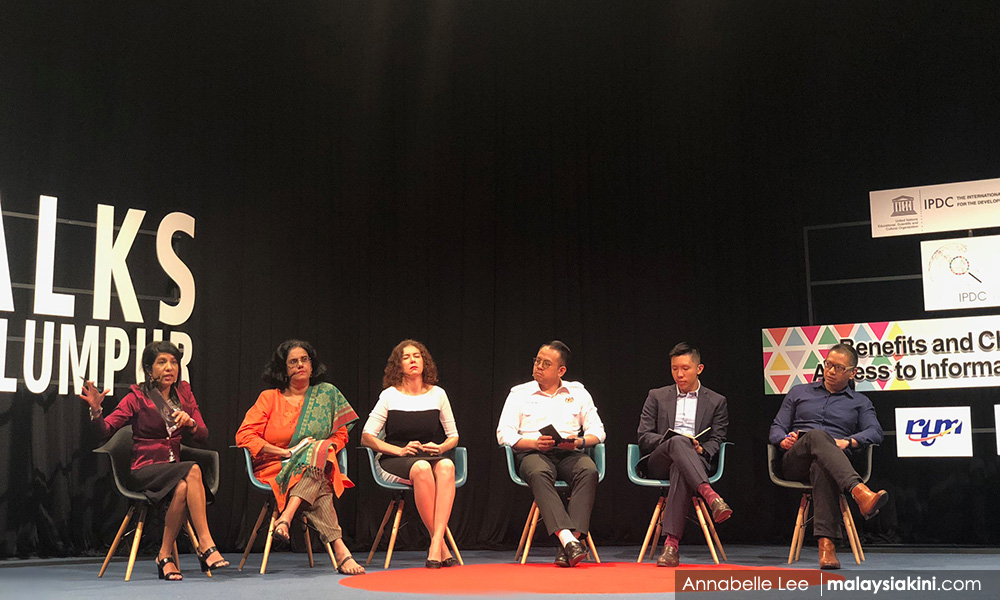
“That – cultural relativism – is used by dictators all over the world, particularly in Asia. Lee Kuan Yew did it, Mahathir did it, and he (Mahathir) seems to be doing it again.
“We (Asians) are different somehow. Fine, I guess Asian people do not like freedom of expression and Asian people like corruption... because we are Asian.
“It is an argument used by despots and it must never ever be accepted,” Azmi said.
Similarly, speaker Amos Toh, who serves as the legal advisor to the UN Special Rapporteur on the Right to Freedom of Opinion and Expression, underlined how access to information was not only a right, but essential to solving contemporary problems.
“This argument on ‘Asian values’ and (how) social and political rights deserve less priority in this region really does not hold any water, because of the independence between all human rights.
“In order to solve issues related to economic inequality and poverty, information is power. Information is required to help solve those kinds of problems on the ground,” Toh said.
The only person to dissent was Sim.
“It is also not fair for us to not take into consideration certain sensitivities – religious values, cultural or traditional worldviews – when it comes to governance, legislation and the rule of law.
“It is very easy and popular to say that everyone is universal and everyone has the same idea of freedom, human rights and freedom of information,” the DAP lawmaker said.
The event was jointly organised by Unesco, RTM and the Asia-Pacific Institute for Broadcasting Development.


Are you sure you want to delete this comment?
This action cannot be undone.