



More attention for opposition states under reprioritised 11th M'sia Plan
RMK11 | The issues of balanced regional development and good governance are now key pillars of the revised 11th Malaysia Plan (RMK11) after the incorporation of the Pakatan Harapan manifesto within.
While the opposition had complained of funding discrimination when BN was in power, the new Harapan government appears to be taking a different stance with its commitment to pour more resources into opposition states.
The pledge, outlined in the RMK11 mid-term review, has nothing to do with how the states voted during the 14th general election, but due to the fact that they happen to be the least developed states...
RMK11 | The issues of balanced regional development and good governance are now key pillars of the revised 11th Malaysia Plan (RMK11) after the incorporation of the Pakatan Harapan manifesto within.
While the opposition had complained of funding discrimination when BN was in power, the new Harapan government appear to be taking a different stance with its commitment to pour more resources into opposition states.
The pledge, outlined in the RMK11 mid-term review, has nothing to do with how the states voted during the 14th general election, but due to the fact that they happen to be the least developed states.
The beneficiary states are Gabungan Parti Sarawak-controlled Sarawak, PAS-controlled Kelantan and Terengganu, and BN-controlled Perlis. Special attention will also be given to Sabah and Kedah, both of which are under the control of the federal ruling coalition.
"The existing development gaps between states will be narrowed by giving greater emphasis to the less-developed states, particularly Sabah, Sarawak, Kelantan, Terengganu, Kedah, and Perlis to ensure more balanced regional growth," it reads.
Conventionally, the mid-term review focuses on the government's performance in the last two years, but in light of the change in government, the document tabled in the Dewan Rakyat today also outlines the new priorities by the Harapan administration.
The mid-term review also elaborates at length about the new government's priority on good governance.
"Cognisant of the issues and challenges faced by the new government, especially concerning the trust deficit of the previous government, significant changes are required to restore the trust and confidence of the public.
"Therefore, the government will introduce comprehensive reforms to strengthen administrative capacity and improve governance."
The document incorporates most of Harapan's promised reforms, including limiting to two terms the tenures of prime ministers, chief ministers and menteris besar; requiring parliamentary confirmation for key positions; improving the electoral system; and anti-corruption measures.
Economic Affairs Ministry secretary-general Nik Azman Nik Abdul Majid, whose team prepared the document, said Prime Minister Dr Mahathir Mohamad personally endorsed the incorporation of the promised reforms, including the limit on his term.
"We incorporated 57 out of 60 of Harapan's promises," he said, adding that the remaining three were not relevant to the plan, such as issues pertaining to Rohingya refugees.
Efforts to boost purchasing power
The 11th Malaysia Plan is meant to guide the country's socio-economic development for the period from 2016 to 2020.
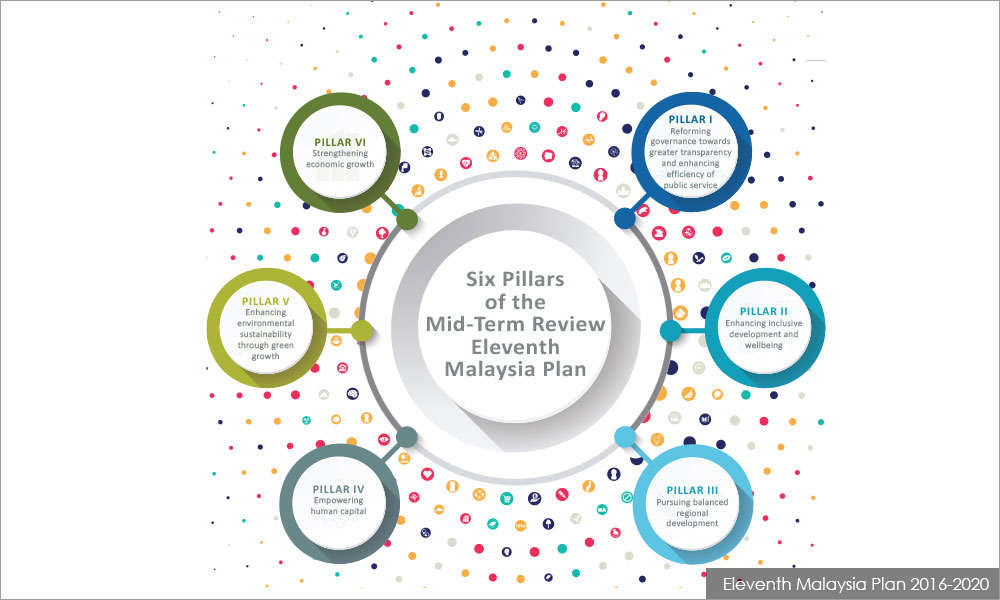
The other four pillars are enhancing inclusive development and wellbeing, empowering human capital, enhancing environmental sustainability through green growth and strengthening economic growth.
Under the previous BN government, the six thrusts were enhancing economic inclusiveness, improving the wellbeing of all, accelerating human capital development, pursuing green growth, strengthening the infrastructure for economic expansion and re-engineering economic growth.
The reprioritised plan also contained similarities with that of the previous BN administration, such as the focus on bottom 40 percent income earners.
However, the Harapan government stressed that an increase in income alone was insufficient, and must be accompanied by stronger purchasing power.
"The goal to become a developed and inclusive nation goes beyond attaining a high-income level, as it must also be accompanied by higher purchasing power.
"At the same time, the aspiration of becoming a developed nation requires Malaysia to progress in many other dimensions, such as economics, politics, culture, psychology, the spiritual and the social," the document reads.
RELATED REPORTS
Dr M hopes RMK11 review will turn M'sia from kleptocracy to democracy
RMK11: Gov't to empower minorities alongside bumi agenda


Are you sure you want to delete this comment?
This action cannot be undone.