
Finding my replacement for GE13 and the PKFZ scandal
Editor’s note: This is the third part of a series of excerpts from former health minister and MCA president Chua Soi Lek’s book, ‘Like Me or Hate Me: Rising from the Political Ashes’.
BOOK EXCERPT | About two weeks after my resignation in early January 2008, it became obvious that the general elections would be held in March. Hence, it was necessary for the MCA to decide who should stand in the parliamentary seat for Labis as soon as possible.
Despite the political problems generated by the distribution of the DVD, the MCA’s Labis division unanimously put forward my name. Since the DVD issue was very much alive, I was not particularly enthusiastic.
Although reliable sources indicated that the Special Branch had concluded that voters still regarded me as a winnable candidate, I declined. Instead, I suggested that the MCA’s Labis division convene a meeting to consider alternative candidates.
After the meeting, the division proposed these four names:
- Dr Chua Soi Lek
- Tan Kok Hong, incumbent YB for the Bekok state seat and chairman of the MCA’s Labis division
- Tee Siew Kiong, incumbent YB for the Pulai Sebatang state seat and also my political secretary
- My son Chua Tee Yong
Sometime before nomination day (24 February), President Ong Ka Ting asked me to meet him at the Palace of the Golden Horses Hotel in Kuala Lumpur.
It was a rather short meeting to discuss potential candidates for the Labis constituency. There was hardly any exchange of pleasantries.
This came as a surprise to me, especially since I had known Ka Ting since the early 1980s.
He was fully aware that when I resigned suddenly as a minister, it would definitely upset not only my family life but also my financial commitments. But he did not even bother to inquire about my family or my financial position. Anyway, I took it in stride that there will always be comrades who are only friends when the going is good.
He asked me whether I would be willing to campaign for any candidate put up by the party. He wanted to send in parachute candidates from other MCA divisions, and realised that my influence in the constituency would be important to ensure success.
I told him in no uncertain terms that for the sake of the party, I would help in the election, but only if the candidate was recommended by the division.
I reminded the president that MCA lost the Bekok state seat (in the Labis parliamentary constituency) in the 1990 general election even when the MCA candidate was an exco member. I also reminded him that Labis was a non-Malay majority seat in which Chinese and Indian voters made up more than 60 percent of the voters. In other words, it was not an easy seat for the government to win.
The MCA president went through the name list proposed by the Labis division. He told me that Tan Kok Hong was already an exco member and should not be shifted. Tee Siew Kiong was not suitable as a member of parliament due to his lack of tertiary education.
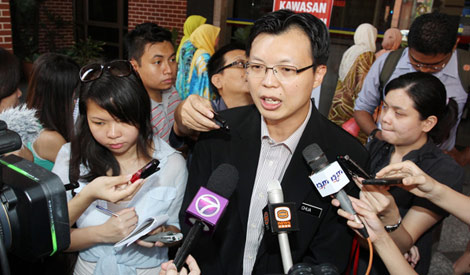
The choice was between Chua Tee Yong (above) and the two parachute candidates he had in mind. I reaffirmed my stance that I would only help the candidate recommended by the Labis division.
Ka Ting was disappointed with my attitude and we parted with no decision on who the candidate would be.
A few days later, I received a call from Ka Ting to say that he had decided to meet with Tee Yong. After the meeting, he called me to say that he had no objection to Tee Yong becoming the MCA’s candidate for the seat.
Tee Yong was working as a chief financial officer in DRB-Hicom Defence Technologies Sdn Bhd, a subsidiary of the government-linked DRB-Hicom. When he was named as a candidate, there were accusations within the party that the Labis parliamentary seat had become the private property of Chua Soi Lek.
Well, since Tee Yong was my son, such accusations were to be expected. But being named as a candidate did not automatically enable someone to be a member of parliament. It was the rakyat that decided. Hence, the accusation was misplaced...
Editor’s note: This is the third part of a series of excerpts from former health minister and MCA president Chua Soi Lek’s book, ‘Like Me or Hate Me: Rising from the Political Ashes’.
BOOK EXCERPT | About two weeks after my resignation in early January 2008, it became obvious that the general elections would be held in March. Hence, it was necessary for the MCA to decide who should stand in the parliamentary seat for Labis as soon as possible.
Despite the political problems generated by the distribution of the DVD, the MCA’s Labis division unanimously put forward my name. Since the DVD issue was very much alive, I was not particularly enthusiastic.
Although reliable sources indicated that the Special Branch had concluded that voters still regarded me as a winnable candidate, I declined. Instead, I suggested that the MCA’s Labis division convene a meeting to consider alternative candidates.
After the meeting, the division proposed these four names:
- Dr Chua Soi Lek
- Tan Kok Hong, incumbent YB for the Bekok state seat and chairman of the MCA’s Labis division
- Tee Siew Kiong, incumbent YB for the Pulai Sebatang state seat and also my political secretary
- My son Chua Tee Yong
Sometime before nomination day (24 February), President Ong Ka Ting asked me to meet him at the Palace of the Golden Horses Hotel in Kuala Lumpur.
It was a rather short meeting to discuss potential candidates for the Labis constituency. There was hardly any exchange of pleasantries.
This came as a surprise to me, especially since I had known Ka Ting since the early 1980s.
He was fully aware that when I resigned suddenly as a minister, it would definitely upset not only my family life but also my financial commitments. But he did not even bother to inquire about my family or my financial position. Anyway, I took it in stride that there will always be comrades who are only friends when the going is good.
He asked me whether I would be willing to campaign for any candidate put up by the party. He wanted to send in parachute candidates from other MCA divisions, and realised that my influence in the constituency would be important to ensure success.
I told him in no uncertain terms that for the sake of the party, I would help in the election, but only if the candidate was recommended by the division.
I reminded the president that MCA lost the Bekok state seat (in the Labis parliamentary constituency) in the 1990 general election even when the MCA candidate was an exco member. I also reminded him that Labis was a non-Malay majority seat in which Chinese and Indian voters made up more than 60 percent of the voters. In other words, it was not an easy seat for the government to win.
The MCA president went through the name list proposed by the Labis division. He told me that Tan Kok Hong was already an exco member and should not be shifted. Tee Siew Kiong was not suitable as a member of parliament due to his lack of tertiary education.

The choice was between Chua Tee Yong (above) and the two parachute candidates he had in mind. I reaffirmed my stance that I would only help the candidate recommended by the Labis division.
Ka Ting was disappointed with my attitude and we parted with no decision on who the candidate would be.
A few days later, I received a call from Ka Ting to say that he had decided to meet with Tee Yong. After the meeting, he called me to say that he had no objection to Tee Yong becoming the MCA’s candidate for the seat.
Tee Yong was working as a chief financial officer in DRB-Hicom Defence Technologies Sdn Bhd, a subsidiary of the government-linked DRB-Hicom. When he was named as a candidate, there were accusations within the party that the Labis parliamentary seat had become the private property of Chua Soi Lek.
Well, since Tee Yong was my son, such accusations were to be expected. But being named as a candidate did not automatically enable someone to be a member of parliament. It was the rakyat that decided. Hence, the accusation was misplaced.
Tee Yong and I took the criticism lightly and decided to focus instead on preparations for the election campaign. Even today, however, such accusations are still being heard within the party. But the fact that he survived the 2008 political tsunami and the 2013 general election certainly showed that he had the support of the people.
Port Klang scandal
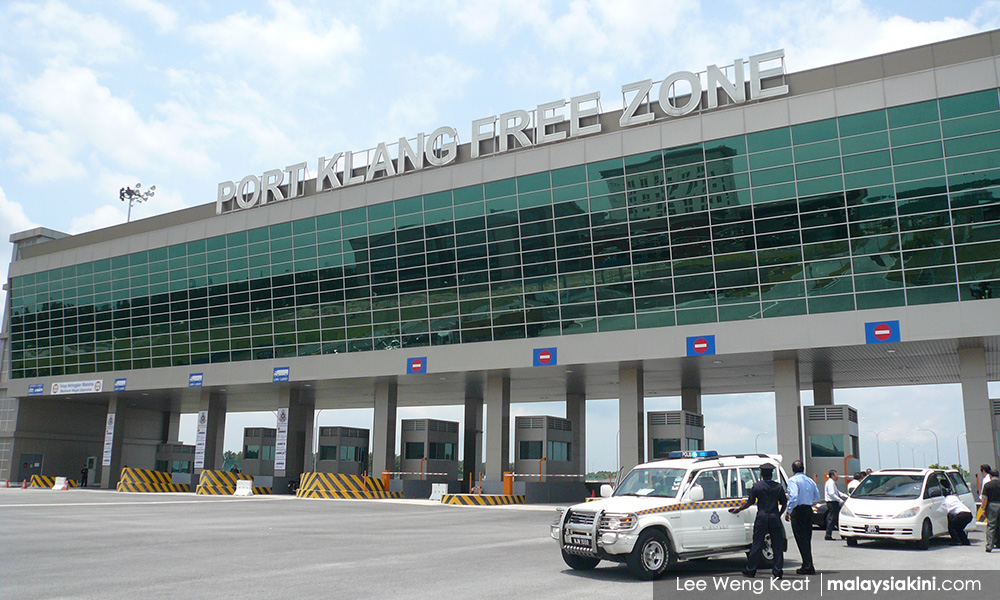
Meanwhile, MCA’s popularity was being affected by other issues. Sometime in mid-2007, the Port Klang Free Zone (PKFZ) scandal became a hot political issue.
The project was approved by the cabinet on March 24, 1999, during the period when Ling Liong Sik was the minister for transport. Since key MCA figures were allegedly involved, the MCA took much of the blame.
Modelled after the Jebel Ali Free Zone (Jafza) in Dubai, the PKFZ project was designed to be a mega distribution hub that would attract foreign investment.
In 2001, the cost for the development of PKFZ was set at RM1.957 billion. In 2002, Kuala Dimensi Sdn Bhd (KDSB) and the Port Klang Authority signed a deal in which the former sold 999.5 acres in Pulau Indah to the latter for RM1.09 billion.
KDSB was majority-owned by Tiong King Sing (below), the member of parliament of Bintulu and the treasurer-general of the Sarawak Progressive Democratic Party, a component party of BN. Among the board members of KDSB was Azim Zabidi, who was a one-time treasurer of Umno.

Also involved in the project was the former Umno Youth leader from Selangor, Faizal Abdullah, whose father-in-law, Onn Ismail, was another influential figure in Selangor Umno. Onn Ismail was the former chairperson of Pulau Lumut Development Cooperative that sold the land to KDSB.
The purchase of the land from KDSB was done despite the advice against it by the Attorney-General’s Chambers (AGC). The land was bought at RM25 per square foot, considerably higher than the RM3 per square foot KDSB paid when the cooperative purchased it.
Things moved rapidly after the purchase was finalised. The Port Klang Authority then appointed KDSB to develop the PKFZ. This included the construction of office blocks, warehouse and transhipment facilities.
In 2005, the Port Klang Authority and KDSB signed a supplemental agreement for additional development works, including building a business-class hotel.
All of these deals were done without competitive bidding. This was during the period when Chan Kong Choy was the minister of transport. By the time the massive 1,000-acre (400-hectare) industrial and trading hub opened in November 2006, the cost had ballooned to RM4.6 billion.
The Jebel Ali Free Zone in Dubai was appointed to manage PKFZ under a 15-year contract. However, this organisation prematurely terminated the contract on 18 July 2007, citing “strategic purposes”.
Newspaper reports, however, suggested that Jebel Ali quit because of excessive bureaucracy, political interference and the involvement of other vested interests. It certainly appears to have been an acrimonious separation.
Meanwhile, KDSB had funded the development by selling bonds. Altogether, four tranches of bonds were sold with letters of support from the Ministry of Transport. Many construed these letters of support as letters of guarantee, something that only the Treasury could issue. As a result, the bonds got an AAA rating from the Malaysia Rating Corporation Bhd.
The first letter of support was issued by Liong Sik on 28 May 2003, his last day as transport minister, while the other three were issued by his successor, Chan Kong Choy.
Massive cost overruns to develop the project forced the government to approve a loan in 2007 to rescue the Port Klang Authority from its enormous debts.
The PKFZ scandal therefore became hot news, putting the MCA under the spotlight. However, as far as I can recall, the project was never discussed in the MCA presidential council or central committee meetings.
In retrospect, this is not particularly surprising. President Ong preferred to avoid confronting major issues.

When the PKFZ financial fiasco became public knowledge, Chan Kong Choy (photo) took leave, citing health reasons. The Transport Ministry and the Port Klang Authority’s general manager were summoned to the Public Accounts Committee (PAC) to help with inquiries. PAC chairman Shahrir Abdul Samad expressed dissatisfaction with the answers he received about the project financing.
In the March 2008 general election, Chan Kong Choy did not seek re-election. There was speculation within the party that the chairman of Barisan Nasional had rejected his candidacy.
After the poll, President Ong Tee Keat became the minister of transport. He tried to capitalise on the issue by projecting an image of a no-nonsense minister.
He appointed Lee Hwa Beng, an accountant and former state assemblyman in Selangor, as the chairman of the Port Klang Authority, and asked PricewaterhouseCoopers (PwC) to conduct an audit of PKFZ.
He also promised that the PwC’s findings would be made public, and that he would submit its report to the Malaysian Anti-Corruption Commission (MACC).
In June 2009, Tee Keat told Parliament that the total cost of the PKFZ project was RM12.453 billion. Many police reports were subsequently lodged against KDSB by the Port Klang Authority for billing discrepancies. The result was an open media war between the minister of transport and the CEO of KDSB, Tiong King Sing.
Tee Keat vs Tiong
Then, on 12 August 2009, Tiong alleged that he gave RM10 million to Tee Keat (below). The transport minister responded by filing a RM500 million lawsuit against Tiong over the allegation. The MACC also investigated the MCA president. However, it was apparently a very low-key inquiry and little has been heard of it since.

In 2009, the government set up a special task force headed by Chief Secretary Mohd Sidek Hassan to look into the scandal. The prime minister said the government was committed to investigating the PKFZ issue thoroughly and urged the various parties to be patient while the relevant authorities completed their investigation. However, the findings of the task force were never released to the public.
Ong Tee Keat, as the minister of transport and president of the MCA, continued to refer to the PKFZ fiasco in most major MCA functions, hoping through this issue to consolidate his power within the MCA and to establish himself as a minister untainted by corruption. But the allegation that he received RM10 million from Tiong, together with the high-profile investigation by the MACC, has dented his image.
Opposition leader Lim Kit Siang has asked many questions about PKFZ in Parliament. But despite being the relevant minister, Tee Keat has often tried to avoid the issue. This serves only to reinforce the perception that Tee Keat has been using the PKFZ scandal for personal political advantage.
While it is commendable that the MCA president spoke openly about the matter, as the responsible minister, he also needs to fix the problem rather than just talk about it. Many members in the party, and even the public, believe that Tee Keat has no clue how to go about resolving the problem. He is a typical politician, long on talk but short on delivery.
One problem with the PKFZ issue was that it was simply too complicated for the public to understand. When the issue first came to public attention in the middle of 2007, I, as a cabinet member, was not fully acquainted with the facts either. This was especially so when it came to the financial figures. The ongoing media war between Lim Kit Siang and Tee Keat only served to muddy the waters even further.
The public was angry with both the MCA and the BN government. Finally, on 28 July 2010, former minister of transport Ling Liong Sik was charged in the Sessions Court in connection with the scandal. He pleaded not guilty to the three charges under Section 417 and 418 of the Penal Code for cheating.
After a lengthy trial, he was acquitted on 24 October, 2013. The then-High Court Justice Ahmadi Asnawi ruled that Ling could not be held accountable for mistakes, omissions, concealment, misleading information or inaccuracies presented in two Transport Ministry summaries and notes over the land. The testimony of Dr Mahathir Mohamad and some fellow cabinet ministers showed that they had not been misled by Ling with respect to the procurement of the PKFZ land from KDSB.
On 28 February, 2011, former transport minister and deputy president of MCA Chan Kong Choy was also charged with three counts of cheating in relation to the same scandal. Chan was acquitted after the prosecutor withdrew the charges against him in January 2014. The AGC came to this decision after reviewing a letter of representation by Chan’s lawyer.
When the two former ministers of transport were charged in court, there was much speculation that the move was designed to demonstrate the government’s commitment to fight corruption. At last, it seemed, the government was willing to go after the big fish.
However, many in the legal fraternity felt the charges were poorly framed. The charge of cheating the government was difficult to prove in court since it required prosecutors to show exactly how the government was cheated. The conclusion of the general public after the acquittals was that the trials were little more than a political show put on by the BN government.
Part 1: My resignation and its aftermath
Part 2: The sex DVD - who were the culprits?
Part 3: Finding my replacement for GE13 and the PKFZ scandal
Part 4: Opponents’ attempt to bury me made me work harder
Part 5: How MCA came to own The Star
Part 6: I ensured transparency in MCA's purchase of office tower
Part 7: ‘Avoid factionalism, embrace unity’ - Soi Lek’s parting words to MCA
Part 8: Setting aside personal feelings in 2013 MCA elections
Part 9: 'Muhyiddin told MCA to make a stand on 1MDB'
Part 10: The eclipse of Najib's achievements by 1MDB scandal
Part 11: Broken trust: The Chinese community’s frustration with MCA
Part 12: The hypocrites in the MCA
CHUA SOI LEK is a former health minister and MCA president. Like Me or Hate Me: Rising from the Political Ashes is now available in all good bookstores at RM59 (paperback, English and Chinese) and RM99 (hardcover, English only). It is also available at MPH Online.
The views expressed here are those of the author/contributor and do not necessarily represent the views of Malaysiakini.


Are you sure you want to delete this comment?
This action cannot be undone.