




Educate the public, instead of backtracking on promises - Ambiga tells Harapan
Pakatan Harapan should explain the basis of the reform to the public, instead of backtracking when faced the noise of opposition, said the former Institutional Reforms Committee member Ambiga Sreenevasan.
Speaking at a forum on the abolition of death penalty titled 'Rationale and Implication' held at the Bar Council tonight, Ambiga said it is important to educate the public on the reform process and the government must explain the concept and rationale behind every reform decision.
“You need to do your research before making any promise or announcement. And you need to explain to the public what the basis is...
Pakatan Harapan should explain the basis of the reform to the public, instead of backtracking when faced the noise of opposition, said the former Institutional Reforms Committee member Ambiga Sreenevasan.
Speaking at a forum on the abolition of death penalty titled 'Rationale and Implication' held at the Bar Council tonight, Ambiga said it is important to educate the public on the reform process and the government must explain the concept and rationale behind every reform decision.
“You need to do your research before making any promise or announcement. And you need to explain to the public what the basis is.
“Not announce, and then a minute later when there is a little bit of opposition, you backtrack. For me, that is not how you do reform,” said Ambiga.
On educating the people on the process of reform, Ambiga said the Bar Council is waiting to help the government.
“Going forward, in respect to all reform, the new government should set up a transition team comprising government representatives, NGOs and Bar Council to work on the reform. So that we can help you with the reform process.
“This transition team will be the one who explains the basis of the reform you are planning to put forward. They can be the one who answers the issues raised by the public.”
The Malaysian Bar Council had previously announced their official position of supporting the abolishment of the death penalty.
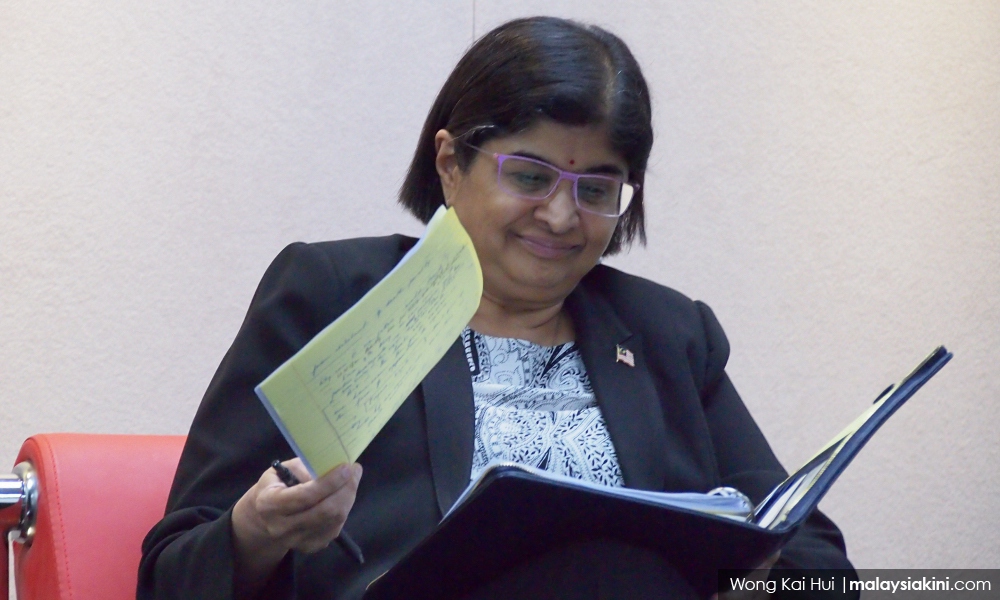
Ambiga (below) was a panelist at the forum alongside Bukit Gelugor MP and lawyer Ramkarpal Singh as well as Bar Council secretary and its Human Rights Committee co-chairperson Roger Chan Weng Keng.
As a representative of Pakatan Harapan at the forum, Ramkarpal was criticised by the panelists and some of the attendees.
Lawyer and activist Siti Kasim, who was among the attendees, said that the new government seems to rely too much on listening whoever makes the louder noise in the decision-making process but this is not a healthy way of ruling the country.
“The trend that we have seen is Pakatan Harapan relying very much on the opinion of the public in making their decisions. Whoever can make more noise than the other, Pakatan Harapan seems to think they are the majority opinion of the rakyat.”
Siti Kasim is of the opinion that killing by state is wrong, as well as potentially even worse than killing by an individual. She also “reminded” Ramkarpal not to become a monster when fighting one.
“I must say this, YB Ramkarpal. Remember there is a saying that when you are fighting a monster, you must take care not to become one yourself. ”
“The death penalty is morally, socially, and politically wrong. Morally, killing is wrong, killing on behalf of the state is wrong as well. Don’t be a monster like the killer.”
Ramkarpal said that Harapan is not backtracking on the abolition and claimed that they are just “taking a step back” to reconsider the views of the stakeholders.
“I would not say backtracking, I would say it is sort of taking a step back… to reconsider many views that have been added by many stakeholders.”
“The government’s view in principle is that the death penalty must go, there is no doubt about that. That has not changed, and there is no indication that it will change in the future.”
Ramkarpal said that there is no official reason why the bill might not be tabled in the current parliamentary sitting, but he added that it might be tabled in March next year.
In any case, the MP insisted that his personal stand is that capital punishment should be retained for some “rarest of rare cases”, for example, sexual offences against the children or repeated offences.
When asked the exact definition of “rarest of rare cases”, he answered that it is pending legislations and definitions as all the current existing offences don’t carry such definition.
Ambiga disagreed with Ramkarpal (below), adding that the exemptions are secondary to the abolition.

“We are not going to wait here for you to abolish the death penalty in all cases, while you figure out what the rarest of rare cases are. Because that are rare cases, that can take place later if you want to,” she said.
Ambiga stressed that, as she was sitting in the IRC committee, she knows that all the work and research have been carried out and that there are more than enough arguments to persuade the public.
She added that the consultation has been taking place for a long time and every argument raised now has already thought of before.
Thus, she urged the Harapan government to table the bill to abolish the death penalty as a “gift” on Human Rights Day, which falls on Dec 10.
“There is a concern that the reform agenda is grinding very slowly. We are very concerned that will grind to a halt. For me, always when there is a change of government like this, there are so many examples of failure, you have a very small window for reform.
“If we don’t take the opportunity now when the momentum is there, several months down the road, I don’t know when it is going to be,” said Ambiga.
The government’s recent announcement to abolish the death penalty with plans to replace it with at least a minimum of 30 years’ imprisonment has raised much debate among the public. Families of murder victims have cried foul while human rights advocates laud the government’s move.
According to de facto Law Minister Liew Vui Keong, the cabinet has decided that the death penalty for 32 offences under eight acts of law be abolished, and this includes Section 302 of the Penal Code (murder).
However, Deputy Prime Minister Dr Wan Azizah Wan Ismail claimed that Putrajaya is still studying whether to abolish the death penalty or remove the mandatory clause in laws related to capital punishment.
READ MORE
Death penalty: Six things you need to know
Should the state be given the power to kill?
The shadow of death: Living with a family member on death row


