




No link between M'sia and southern Thailand bloodshed
Malaysia has no connection with the insurgency in the predominantly-Muslim southern Thailand, according to a regional analyst.
Malaysia has no connection with the insurgency in the predominantly-Muslim southern Thailand, according to a regional analyst.
However, Francesca Lawe-Davies told a forum in Bangkok last night that separatist movements there were getting indirect support from individuals originating from the south.
She said Malaysian authorities had been very careful in dealing with the problem as they did not want to be seen as interfering with Thailand's domestic problems and jeapordise bilateral ties.
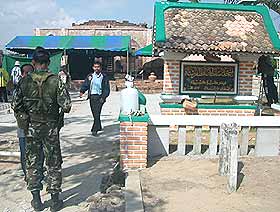 Davies, a Jakarta-based analyst for the International Crisis Group, who covers Thailand and Indonesia for the Brussels think-tank, said operative commanders of the unrest were operating from the south and not from within Malaysia as claimed by some Thai officials in the past.
"But they are in conversation with some people in Malaysia and beyond, including in Europe. But it's still murky who is giving the orders...the operating level is not clear, maybe they are operating in small and quiet cell," she was quoted as saying by Bernama.
Also on the panel themed 'Terrorism and Thailand: A Regional Perspective' were Zachary Abuza, a professor of political science at Simmons College, Boston and expert on Jemaah Islamiah and Don Pathan, an editor of The Nation daily.
Since violence escalated in the three southern provinces in January 2004, more than 1,200 people have been killed in the unrest blamed on a mix of Muslim separatism, organised crime and drug trafficking.
No more support
In the 70s, the Pattani United Liberation Organisation (Pulo) was established by ethnic Malays in the southernmost provinces of Yala, Pattani and Narathiwat seeking independence from Thailand but now different groups are waging the guerrilla war.
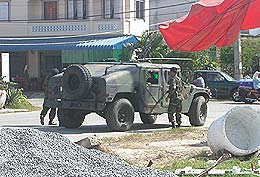 Davies said some people in Kelantan and Terengganu, many of whom originated from Pattani in the southern Thailand, were providing moral, logistic and financial support.
"In the 70s, one political party also gave moral, political and financial support at some point of time but (it is) now finished," she added.
She said although Malaysia and Thailand were involved in a diplomatic row over the fate of 131 refugees who fled to Kelantan last August, the situation was getting better after one of the refugees believed to be a militant was handed over.
She said both countries were working together to overcome the problem and suggested that Malaysia help at the operative level through sharing of intelligence information.
Davies said although Muslims were involved in the insurgency and there were elements of religion, the insurgents were more motivated by nationalism and to fulfil their decades-old dream of gaining independence from Bangkok.
 "They want to reclaim their Pattani kingdom rather than fighting for jihad although they are more pious than the 1970s and 80s group. They are angry at the Thai government for discrimination, forced cultural assimilation and violence against Malays there," she added
Abuza said although the Thai government was making more and more arrests of suspected insurgents, the unrest could prolong as militants would hide for some time before striking back.
"The insurgents will go back to pondoks (huts) which were their incubators for the past decade. No one in JI or other Muslim militant groups believe they can achieve their goal in their generation," he said.
Don, a frequent writer of the complex situation in the south, said the Thai government failed miserably to assimilate the locals who instead wanted their own culture, language and past history to be acknowledged.
"Their frustrations are channelled towards the state, not against the Chinese or the Buddhists who are staying there. When I asked them why they elect Chinese and not Malays as Governors of Yala and Pattani, they said these people are doing a good job," he added.
He said Prime Minister Thaksin Shinawatra's "Bangkok Knows Best" attitude was aggravating the situation.
Furthermore, he said thousands of students who went for studies overseas, especially in West Asia, were unemployed and ignored by state authorities, forcing them to travel to Malaysia, Indonesia and Brunei to seek employment.
Thaksin made it worse
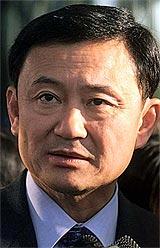 Asked whether the insurgency would have not happened if the Thaksin government was not in power, Davies said it would occur anyway as the militants had been planning for it way before Thaksin took the helm.
"But Thaksin's handling of the situation was bad and this made the situation worse. It's even difficult to overcome the problem as no one is showing up to claim responsibility for the insurgency," she said.
Abuza said inter-agency rivalry, especially between the local police and army was also aggravating the situation and there was no clear chain of command of who is in-charge of the south.
To a question on whether the United States should do more to help Thailand in dealing with the southern problem, Abuza said it would be counter-productive and could generate a backlash at the ground.
On whether there is still hope for calm to return to the south, Don said the huge turn out of voters in the 2005 general election was a good indication that the southern people still had faith in the system.
"They rejected the government (Thai Rak Thai Party) but not the system...so there is still hope," he added.


