




Reveal details of deal with Japan, govt told
Why the sudden special treatment for the Land of the Rising Sun? This is the question PAS wants the government to answer.
Why the sudden special treatment for the Land of the Rising Sun? This is the question PAS wants the government to answer.
In view of this, the opposition party demanded that the government makes public details of the Japan-Malaysia Economic Agreement (JMEPA).
"We want to know whether it brings benefits to the country. We are concerned about the impact. Why did the government suddenly give special treatment to Japan but not Asean countries?" PAS deputy president Nasharuddin Mat Isa asked at a press conference today.
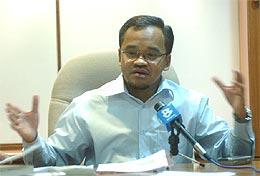 He claimed that the government had signed the agreement 'silently' despite it having a great impact on the country's economy.
"JMEPA is an agreement that has great impact on the Malaysian economy. We want to know whether it's advantageous or disadvantageous in the long run," he said.
JMEPA was signed between Prime Minister Abdullah Ahmad Badawi and his Japanese counterpart Junichiro Koizumi during the 9th Asean-Japan Summit held in Kuala Lumpur last month.
Too many concessions?
Following this, Bernama reported that the agreement was expected to further strengthen and enhance economic and industrial cooperation on a long-term basis apart from creating favourable conditions for bilateral trade and investment.
It added that Malaysia and Japan will substantially eliminate tariffs on industrial, agricultural, forestry and fishery products within the next10 years when JMEPA comes into force.
About 97 percent of bilateral trade or 94 percent of Malaysia's exports to Japan and 99 percent of Japan's exports to Malaysia will be duty-free.
Import duties on textiles and clothing, agriculture and wood products will be eliminated immediately.
Malaysia will eliminate import duties on rubber, food, plastic, paper and downstream iron products over the next six to eight years and abolish or reduce import duties on chemicals and petrochemicals, iron and steel, paper products, and automotive and automotive parts and components over the next 10 years.
Nasharuddin questioned if the agreement had provided too many concessions to Japan and this in turn could jeapordasise Malaysia's sovereignty in formulating its own economic policy.
"We understand from our sources that the agreement will have a great big impact on our automotive industry," he said.


Are you sure you want to delete this comment?
This action cannot be undone.