




MBSA rethinks conditions on dog licence
The Shah Alam City Council (MBSA) has backtracked on some of the conditions for dog licences that had previously gotten dog owners howling in protest.
The Shah Alam City Council (MBSA) has backtracked on some of the conditions for dog licences that had previously gotten dog owners howling in protest.
It has decided that among the contentious terms contained in its dog-licencing regulations that would be changed pertained to the requirement that residents obtain 'the agreement' of neighbours before acquiring a dog,
"Upon the advice of our legal officers, we decided to change the wording of 'obtaining the agreement of neighbours' to that of 'acquiring their views'," said Shah Alam deputy mayor Za'ba Che Rus when contacted.
He said this soon after being briefed on the results of a meeting of committee members who had been tasked with scrutinising the dog licence regulations.
"This is among some of the modifications after the committee decided we can loosen some of the regulations," he added.
The regulations were to take effect on Jan 1 this year, but was put off due to protests by Shah Alam dog owners.
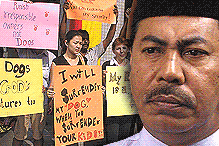
Dog owners had criticised the council for the strict requirements for dog licencing, which, they claimed, in effect punished responsible dog owners on account of the irresponsible few.
It is not about regulating the animals but about educating their owners, they said during a Dec 20 dialogue last year.
Training courses
In an apparent vindication of their point, Za'ba said the council has decided it would provide training courses to dog owners in Shah Alam on how to train and take care of their pets.
"These courses would also cater for the different breeds of dogs owned by the residents. There are some that are aggressive, there are those dogs that are naturally not as aggressive, and there are those that are very gentle and harmless," said Za'ba.
 While the principle of that decision had been reached, such details as those concerning the costs of the training courses and their implementation would have to be ironed out by the council, said Za'ba.
"We haven't decided whether or how much dog owners themselves would have to bear the costs, and whether and how much the costs would be split between the council, the state government and the Department of Veterinary Services," he said.
Za'ba also said the regulations would be loosened, or otherwise, depending on the composition of residents where the applications for dog licences originate.
"In those areas where Malays make up the majority, the conditions will be more strictly adhered to than those where there are less. In such areas, the conditions will be more relaxed," he said.
While he maintained that the regulation pertaining to such restricted dogs as Rottweilers would remain, even this, said Za'ba, "is subject to flexibility on the part of the council and can be wavered on a 'case-by-case basis'".
More conditions relaxed
Dog owners had earlier pointed out that such restrictions against dog ownership left many persons vulnerable and incapacitated, such as the elderly and the disabled.
Za'ba also reiterated his earlier stand that those who already had dogs but could not strictly fulfill all the conditions should still apply for the licence and get approval from the council.
Although the regulations stipulate that only those who live in "single-storey houses, corner terrace-houses, factories and executive clubs" can own dogs, for example, the conditions may also be relaxed for residents of intermediate houses, said Za'ba.
Furthermore, he said, the rule that a house may not contain more than two dogs may also be relaxed depending on the size of the house.
The council will maintain its restrictions, however, for residents who do not previously own dogs and are applying for licences to do so, said Za'ba.
Even these decisions made by the council would be subject to further discussions and negotiations with dog owners. These would be limited, however, to the next two weeks, he added.
"We will finalise the regulations as soon as possible. If we do not get responses from the dog owners and their representatives, we will go ahead and issue the final (draft) in two weeks."


