




Police lack transparency, accountability
The Royal Malaysian Police lacks transparency and accountability and yet remains resistant to change besides being insensitive towards human rights and dignity, the Commission to Inquire into the Standard Operating Procedure, Rules and Regulations in Relation to the Conduct of Body Search in Respect of an Arrest and Detention by the Police has concluded.
The Royal Malaysian Police lacks transparency and accountability and yet remains resistant to change besides being insensitive towards human rights and dignity, the Commission to Inquire into the Standard Operating Procedure, Rules and Regulations in Relation to the Conduct of Body Search in Respect of an Arrest and Detention by the Police has concluded.
 The five-member commission said in its report released this afternoon this lack of transparency and accountability was not just in terms of body searches carried out on detainees but 'also in its very function as law enforcer and peacekeeper of the nation'.
"In preparing this report, the commissioners noted an overall lack of publicly accessible information on the Standard Operating Procedures of the PDRM (the Royal Malaysian Police), the precise scope of its power over detainees, its methods of internal governance as well as recourse available to those who wish to make complaints against police officers," they said.
The commission led by former chief justice Mohamed Dzaiddin Abdullah noted that although various constructive recommendations had been made previously in the report of the Royal Police Commission to Enhance the Operation and Management of the Royal Malaysian Police released last May, no obvious actions have been taken by the police.
"Despite those recommendations and justified criticisms that have consistently been raised, the PDRM remains resistant to change and insensitive towards the most fundamental of human rights and dignity," their report said.
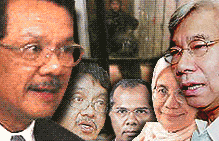
The other members of the commission are former Bar Council chairperson Kuthubul Zaman Bukhari, former MCA deputy president Lim Ah Lek, Wanita Umno Legal Aid Bureau chief Kamilia Ibrahim and Internal Security Ministry Deputy Secretary-General Hamzah Mohd Rus, who was the commission's secretary.
The five of them also sat on the Royal Police Commission to Enhance the Operation and Management of the Royal Malaysian Police.
Implementations
The commission members said although it was important to implement all recommendations made in both reports, there was a need for be 'a shift' in mindset of police officers.
 "[This] so that there is unwavering commitment to work towards a police culture that is more effective, responsibility driven and human rights sensitive," said one of the three conclusions in the 318-page report.
The commission was set up last December in response to public outcry over a video-clip showing a female police detainee being forced to perform 'ear-squats' in the nude at a police station.
In response to one of its four terms of the reference - to investigate the standard operating procedure for the handling of body searches and to propose any changes if needed - the commission has made seven recommendations including to pass a Code of Practice On Body Searches as a subsidiary legislation under the Criminal Procedure Code.
The commission also made 31 recommendations on the procedures for body searches.


Are you sure you want to delete this comment?
This action cannot be undone.