
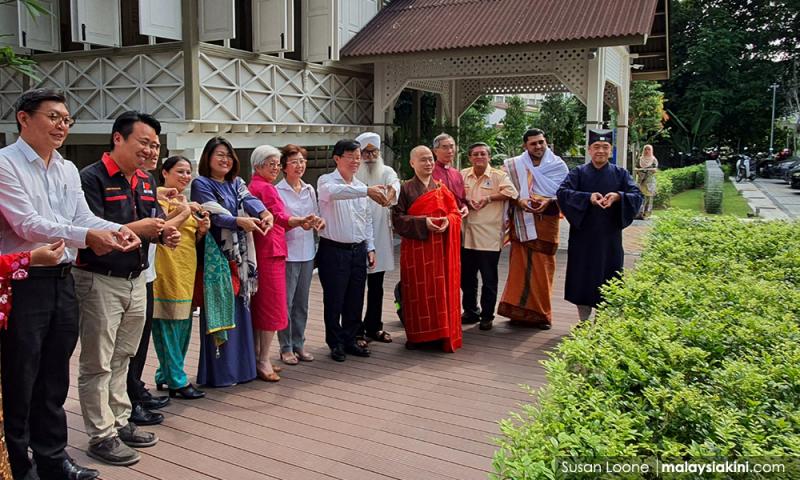
The Penang Harmony Centre should be supported by all communities, including Muslims, and their activities should be encouraged, said state Mufti Wan Salim Mohd Noor.

Wan Salim said participating in activities to foster unity among different religions at the centre does not contradict Islamic teachings.

"It does not contradict Islamic teachings whatsoever, rather it suits its rules and is in line with its spirit," Wan Salim told Malaysiakini.

"This is allowed in Islam so long as Muslims are not involved in practising rituals of other religions," he added.

"It is stated in the Quran that, 'You are free to practise your religion and I am (also) free to practise mine'," said the mufti. 

Wan Salim said in his view, Muslims should participate in such an organisation where they can be involved in dialogues and discussions with other religious groups.

"This is for the sake of understanding each other and to pave the way for unity among Malaysians of different ethnic, religious and cultural backgrounds."

Providing several verses in the Quran to back his claim, Wan Salim reminded that it was natural to have differences among religions. 

He said seeking unity among different religious communities and citizens was encouraged in Islam, including doing welfare activities.

"The reason Allah created humans from different races and ethnic groups is for us to get to know each other, from which we can share our views and help each other for the benefit of all (refer to Al-Qur'an; 49:13)."

Wan Salim was referring to the newly-opened Harmony Centre in Jalan Scotland launched by Chief Minister Chow Kon Yeow on Nov 14.

Housed in a traditional Malay house, the centre aims to conduct retreats, seminars, lectures and classes to foster unity.

"I hope all religious NGOs and groups, including Muslims, will make good use of the Harmony Centre in the spirit of togetherness," Chow had said.

Islamic Propagation Society International president Kamarudin Abdullah agreed with the mufti that Muslim's should participate in such an organisation, especially in dialogues and discussions.

He said this would help everyone "understand each other, to accept what it is, to tolerate where there is, to uphold the principles of the teachings, without getting into conflicts".

"The non-Muslims, the main caretaker of the Harmony Centre, should invite Muslim scholars to attend its activities from time to time," said Kamarudin, who is also state Syura Council member.

Saying he would like to participate in such events with other scholars but prefers sharing the platform to promote charity, understanding and helping each other towards achieving a Malaysia that is peaceful and harmonious while understanding the nature of each others religions.

"We can then unite, cooperate and we can help each other without selling out our own religious principals," he said.

"At the same time, Muslims can educate the non-Muslims that there are certain rituals we cannot participate with them.

"That does not mean we are enemies with non-Muslims. This is often the misconception," he noted.

"For example, when Jakim (Department of Islamic Development Malaysia) said we are not allowed to doa (pray) together, we hope the non-Muslims understand our view, this does not mean by not praying together we are enemies," he said. 

"In other areas like charity, protection of environment, animal rights, human rights, we should be together."