




Electoral roll: EC chief retaliates
Election Commission (EC) chief Abdul Rashid Abdul Rahman today lambasted an independent election watchdog for claiming that the electoral roll for the Sarawak elections was fraught with irregularities, including the presence of dead voters.
Election Commission (EC) chief Abdul Rashid Abdul Rahman today lambasted an independent election watchdog for claiming that the electoral roll for the Sarawak elections was fraught with irregularities, including the presence of dead voters.
He said such 'sweeping statements' by the Malaysians for Free and Fair Elections (Mafrel) would not do the country any good.
"It is most regrettable to note that for the past few days this organisation had been making its own assessments, judgments and conclusions without basic references to the established laws and regulations or even the prevailing situations and circumstances relating to the subject which they knew very little or even nothing about," he told a press conference in Kuching this morning.
 The irate EC chief reiterated that the electoral roll prepared by the commission was clean and free of discrepancies.
Abdul Rashid said the election laws and in particular laws relating to the registration of voters and the preparation of the electoral roll had been legislated to comply strictly with both the letter and spirit of the relevant provisions contained in the Federal Constitution.
"To amend the laws to circumvent the basic provisions of the Constitution would render these laws null and void unless the said provisions were amended as well," he said, adding that this was beyond the EC's jurisdiction.
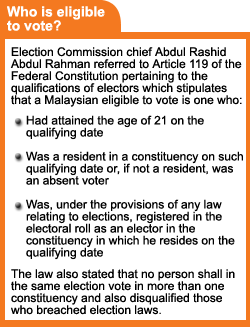 Under the existing law, he said a person might apply to be registered in a particular constituency, which he claimed to be residing in, and he was the only 'soul' who could vary that registration when he moves from the place.
"The EC is not given the power, and rightly so, under the law to move him or remove him from the constituency to be placed in another.
"Such an act would mean the EC had tampered or interfered with his right and privilege guaranteed by the Constitution to be registered as an elector in a given constituency on the day he qualified, that is on the day he applied to be registered," he added.
On the question of residential addresses used by the electors to register themselves, Abdul Rashid said it was only a matter of procedural requirement.
"It only acted as a guide or indicator to enable the EC to place the qualified elector in a particular locality and polling district in order to determine where exactly he should vote in the constituency," he explained.
Remote constituencies
He said in Sarawak, as in a few other states, about 80 percent of the constituencies were in rural and remote areas, where the voters were scattered about in interior villages.
"How does one get to be placed in a proper residential address and register as an elector in any of these constituencies?" he asked.
According to Abdul Rashid, the prevailing scenario in Sarawak was that even in the urban and suburban areas the address system had not been properly or satisfactorily established, except for properly-defined housing estates and residential areas covered by the local authorities.
He said before July 2002, the law on registration was liberal on the choice of constituency for each elector but after that, amendments required that a person be registered according to the address on his or her identity card.
"Even this (new) requirement had created problems," he said, adding that those in rural areas might not have the proper addresses on their ICs.
"These are the problems the EC had been grappling with for the last few years and no solution had been found as the choice to change the address on the IC or not was left to each individual to decide, a freedom each one of us enjoys in a democracy," he stressed.
The EC chief said the number of electors in the roll for the whole of Malaysia before July 2002 was around 9.5 million, of which some 3.8 million do not live at the address shown on their ICs.
In Sarawak, he said it was believed that at least 30 percent of 892,537 voters could no longer be located or traced in the constituencies they had registered.
"Yet on polling day, some of them may appear to cast their votes," he added.
Genuine voters
In view of this, Abdul Rashid said Mafrel should not waste its time and effort to locate and identify electors registered in big numbers at certain given addresses.
He said the voters were genuine citizens, qualified and had the right to be registered.
Circumstances do not allow them to be placed at a proper address in the constituency because they do not have a residential address they could claim as their own with the exception of those living in the thousands of longhouses which can be identified by their respective community leaders, he noted.
"What the Mafrel people should be concerned about is if whether these people are citizens and qualified as voters under the law.
"This is what the EC has always been concerned about and has done thorough checking. We can always give the assurance that no non-citizens are registered as electors and that the placing of electors in a given constituency in Sarawak contain no element of foul play such as 'planted voters'," he said.
Dead voters
On the question of dead voters, Abdul Rashid said Mafrel should not assume the role of the National Registration Department (NRD).
According to him, the EC depended entirely on the NRD for information on deceased voters to revise the electoral roll.
"There are thousands of deaths not being reported to or registered with the NRD," he added.
He said the EC was just as concerned as anybody else when the names of those said to have died continued to appear on the electoral roll.
In 2005, he said the EC expunged the names of 13,504 people from about 2,454 longhouses in remote districts who were certified dead from the list.
Another 287 units of longhouses had yet to be visited for verification, he added.
 Abdul Rashid said Mafrel could do justice to society if it could collect the data on dead electors in all constituencies which had not been reported and pass the information to the NRD for verification.
He said the EC was prepared to discuss the commissioning of Mafrel as its agent to trace unreported dead voters whose names were still on the electoral roll.
"As a business body, Mafrel may be the most appropriate to do the job, particularly when it is already voluntarily doing it, although they may be doing so now with hidden motives or agendas," he added sarcastically.
According to the EC chief, during the Pengkalan Pasir by-election in Kelantan last year, one political party - which he did not name - submitted a list of 93 names of 'dead' voters.
When EC agents checked just 10 names on the list, they found that nine of them were still alive, he added.
The Sarawak elections will be held on May 20.


Are you sure you want to delete this comment?
This action cannot be undone.