



MOH fears Covid-19 spike as infectivity remains at 'critical' level
COVID-19 | The Health Ministry today warned that the novel coronavirus pandemic in the country may spike again, after it recorded a high rate of infectivity over the past several days.
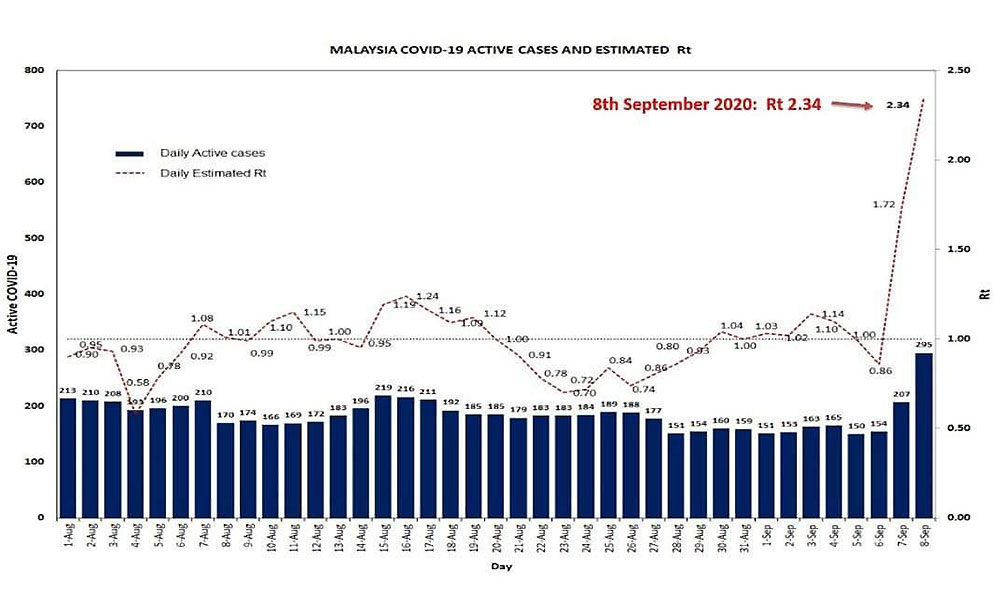
Health director-general Dr Noor Hisham Abdullah told a presser that the disease's reproduction number (R0) in the country had increased to 2.34 yesterday (Wednesday)...COVID-19 | The Health Ministry today warned that the novel coronavirus pandemic in the country may spike again, after it recorded a high rate of infectivity over the past several days.
Health director-general Dr Noor Hisham Abdullah told a presser that the disease's reproduction number (R0) in the country had increased to 2.34 yesterday (Wednesday).
He said the figure is considered to be at a critical level if it reaches 1.6
and above.
"Yesterday, we were informed that the R0 has increased to 2.34
"Today it has gone down to 1.78. But this is still considered as high.
"What is important now is that we must increase our preventive measures to ensure that we can control this pandemic," he said at the press conference in Putrajaya this evening.
The R0 is a term used by epidemiologists to describe how infectious a disease is. A rate above one meant that an outbreak is still growing.
An R0 of 1.78 meant that, on average, each Covid-19 patient is
causing 1.78 new infections, which will go on to spread further to the rest of
the population.
The health authority fears that if the R0 remains above the critical level for a week or more, it could result in a sudden jump in the number of new cases.
"The situation now is very critical for MOH. We only have a small chance to control the spread of Covid-19.
"This spread now is like embers (bara api), where we can still control. But, if it grows into a blaze, then it would be hard for MOH to take action and conduct public health intervention."
For example, he said, it would be impossible for the authorities to carry out contact tracing if the number of daily new cases spikes to 20,000 a day.
As of noon today, MOH recorded 45 new positive cases in the past 24 hours, including 44 that were locally transmitted.
No signs of 'Long Covid' yet
Meanwhile, asked about long-term effects on Covid-19 survivors, Noor Hisham said the ministry is still monitoring the situation.
So far, MOH has not found long-term effects in its former patients, like those had been reported overseas.
According to him, among the effects that they fear is pulmonary fibrosis, where patients developed scar on their lungs after suffering from pneumonia caused by the coronavirus.
This can affect the patient's ability to breath and lead to complications.
"We are also monitoring other complications, like blood clotting inside blood vessels. This blood clot can cause a heart attack if it occurs at the heart, or stroke if it occurs in the brain.
"There were also recent cases overseas where (former patients) had a blood clot at the retina arteries, and affected their eyesight," he said.
According to Noor Hisham, they are also monitoring the antibody responses of former patients.
In June, Noor Hisham had said hospitals have been following up on its most severely ill former Covid-19 patients over a period of three to six months.
These are for patients who had suffered lung inflammation and required either supplementary oxygen or ventilator support over the course of their illness.
He had said the Institute of Respiratory Medicine was studying the disease's long-term effects after recovery. So far, 9,167 people have recovered from the disease in Malaysia and have been discharged.
Earlier this week, the Washington Post had reported that in Bergamo - which had been the epicentre of the Covid-19 outbreak in Italy earlier this year - nearly half of Covid-19 survivors reported that they have yet to make full recovery even though their bodies have long been cleared of the virus.
The British Broadcasting Channel quoted epidemiologist Tim Spector saying that around 300,000 people in the UK have reported symptoms lasting more than a month, and about 60,000 had been ill for more than three months.
The BBC report stated that the Royal College of General Practitioners is urging the UK government to provide more support for the long-term care for Covid-19 survivors particularly in the form of rehabilitation centres.
In the two reports, the myriad of long-term symptoms included breathing difficulties and severe fatigue, heart abnormalities and blocked arteries, hair loss, memory loss, and depression.
This had included patients who were previously fit and self-reliant prior to contracting the disease.
Meanwhile, on social media platforms, Covid-19 survivors have also turned to the hashtag #longcovid to share their experiences and find mutual support.




Report this comment
Are you sure you want to delete this comment?
This action cannot be undone.