


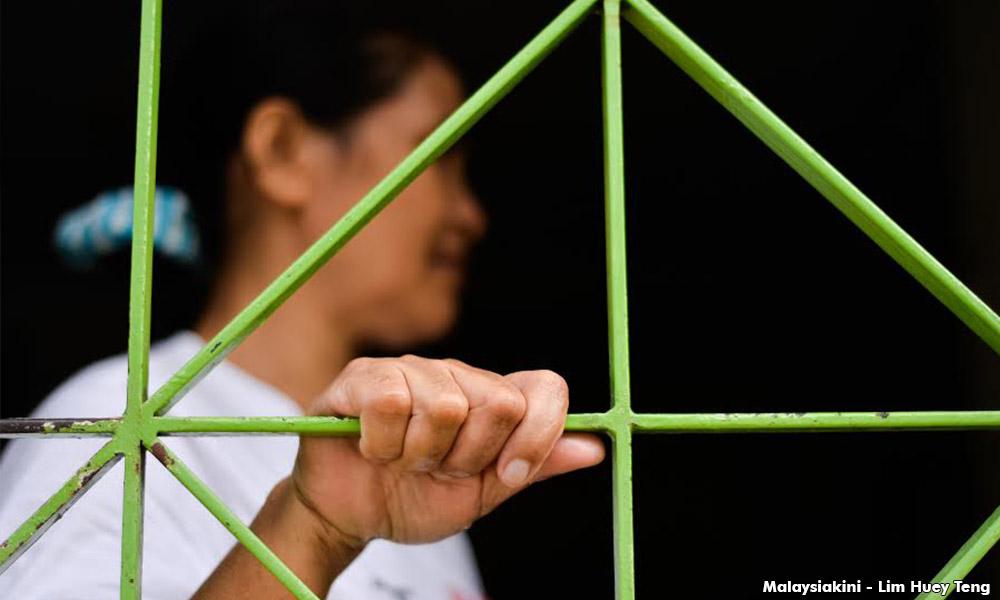

Honour Int'l Migrants Day by legislating against 'contemporary slavery'
Today marks the 30th anniversary of the International Migrants Day when the United Nations General Assembly adopted a resolution on the International Convention on the Protection of the Rights of All Migrant Workers and Members of Their Families in 1990.
Since then, each year on Dec 18, the UN through the UN-related agency International Organisation for Migration (UN Migration) uses International Migrants Day to highlight the contributions made by the roughly 272 million migrants, including more than 41 million internally displaced persons, and the challenges they face.
Malaysia's women workers rights group Persatuan Sahabat Wanita Selangor (PSWS) is calling on the government to recognise the role of migrant workers and acknowledge that this year, due to the Covid-19 pandemic and its accompanying movement control order (MCO), they have fallen deeper into servitude and forced labour...
Today marks the 30th anniversary of the International Migrants Day when the United Nations General Assembly adopted a resolution on the International Convention on the Protection of the Rights of All Migrant Workers and Members of Their Families in 1990.
Since then, each year on Dec 18, the UN through the UN-related agency International Organisation for Migration (UN Migration) uses International Migrants Day to highlight the contributions made by the roughly 272 million migrants, including more than 41 million internally displaced persons, and the challenges they face.
Malaysia's women workers rights group Persatuan Sahabat Wanita Selangor (PSWS) is calling on the government to recognise the role of migrant workers and acknowledge that this year, due to the Covid-19 pandemic and its accompanying movement control order (MCO), they have fallen deeper into servitude and forced labour.
"This is especially the case for those who are not recognised in the Employment Act 1955 (EA) as employees, like migrant domestic workers.
"This brings to mind the International Labour Organisation’s (ILO) Conventions 189 and 190, which cover domestic workers and the elimination of violence and harassment in the workplace.
"Domestic workers have borne the brunt of the shadow pandemic that was attacking women in the security of their own homes this year - domestic violence," PSWS executive director Irene Xavier said in a statement.
"Domestic workers had less access to recourse owing to the lack of legal protection where there are unjust voids in the country’s legislation," she added.
Irene said the MCO had forced entire families to spend more time in close proximity, which increased the workload on domestic workers.
"It was reported that the Ministry of Women, Family and Community Development’s (KPWKM) helpline, Talian Kasih, observed a 57 percent increase in overall calls from women, children, OKU and senior citizens.
"However, these shocking statistics do not reflect the actual number of domestic workers who were abused and kept in contemporary forms of slavery, which include slavery-like conditions, servitude and forced labour," she claimed.
According to Irene, these forms of oppression go unreported, unless there is a death similar to that of the 2018 case of Adelina Lisao, the 26-year-old Indonesian domestic worker who succumbed to multiple organ failure in Bukit Mertajam, Penang.

The situation was only exposed when photographs of Lisao sleeping outside her employers’ house, with dogs, went viral, but she was in a grave condition by the time she was rescued. She died shortly after.
"Unfortunately, Lisao’s case also served to demonstrate that even with the death of a domestic worker, it is hard to convict an employer for the alleged cruelty and abuse, as Lisao’s employer was acquitted on grounds of her health concerns and advanced age, in September this year," Irene said.
She said less than a handful of abuse cases were highlighted in the media this year and that Malaysia does not have any real statistics on the violence that domestic workers face every day, especially during the MCO period.
She did note one case of serious abuse that reached PSWS. An Indonesian domestic worker was apparently abandoned by her employer in Chow Kit, Kuala Lumpur.
The worker was left with no money, food and no belongings. Just the clothes on her back.
"A caseworker representing an international organisation and based in Malaysia revealed to PSWS that photographs sent to her during her investigation showed the mother of two children from Jakarta looking healthy when she came to Malaysia in March this year but she was disoriented, unresponsive to questions, and had lost more than 10kg in her weight at the time the caseworker rescued her in October," Irene said.

She said the caseworker also noted that the woman showed signs of physical injuries from harm and had to undergo an operation to her head, before she was sent back to Indonesia, empty-handed, in November.
Irene said firming up enforcement in Malaysia’s immigration route for migrant workers can also play a big role in curbing unassuming migrant domestic workers from being trafficked into the country and pushed into contemporary forms of slavery.
She said the government must be reminded that in 2019, a report by the United Nations Special Rapporteur on extreme poverty and human rights, Philip Alston, was critical of Malaysia’s failure to protect women migrant workers, and she pointed out that domestic workers in Malaysia were excluded from basic protections such as leave days, medical coverage and working hour restrictions.
"Alston's report explained that because of this, domestic workers were vulnerable to exploitation and also because they worked in isolation in private homes that are immune from regular monitoring," Irene said.
"Therefore, in the year of a global pandemic, as we observe International Migrants Day, PSWS joins fellow activists in calling on the Malaysian government to adopt international instruments like the ILO conventions to improve the country’s labour standards in the eyes of international investors and more importantly, improve the lives of migrant workers, both documented and undocumented.
"These decisive bold steps in the protection of all human beings who enter the country will help the nation recover quickly from a ravaging pandemic, stave off the spread of new coronavirus strains and reboot the economic development of Malaysia in an upward trend amidst a new normal," she added.



Report this comment
Are you sure you want to delete this comment?
This action cannot be undone.