


Covid-19: Health Ministry study finds vaccines reduce deaths by 88pct
COVID-19 | The vaccines used under the National Covid-19 Immunisation Programme has an overall effectiveness of 88 percent in reducing the risk of becoming infected with the coronavirus, a Health Ministry (MOH) study has found.
The risk of a symptomatic infection is similarly reduced by 86 percent.
In the event of a breakthrough infection, a complete vaccination also provides a similar level of protection against developing serious illnesses or death.
The study was conducted by the ministry's Institute for Clinical Research (ICR) involving 1.26 million individuals...
COVID-19 | The vaccines used under the National Covid-19 Immunisation Programme has an overall effectiveness of 88 percent in reducing the risk of becoming infected with the coronavirus, a Health Ministry (MOH) study has found.
The risk of a symptomatic infection is similarly reduced by 86 percent.
In the event of a breakthrough infection, a complete vaccination also provides a similar level of protection against developing serious illnesses or death.
The study was conducted by the ministry's Institute for Clinical Research (ICR) involving 1.26 million individuals, which found the AstraZeneca vaccine to be the best-performing of the three main vaccines used in the programme.
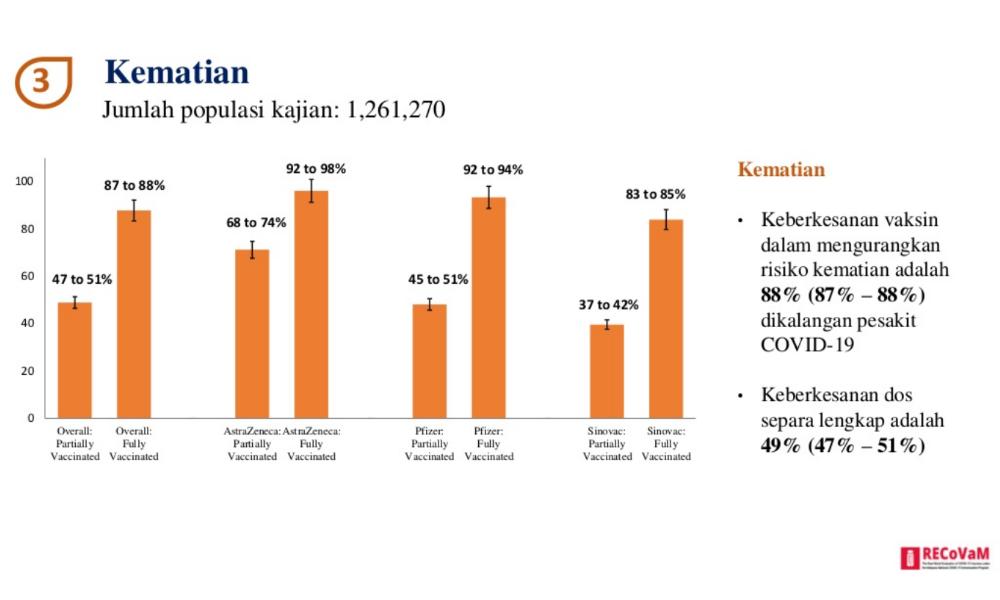
"Our study shows the AstraZeneca vaccine (complete dose) has 96 percent effectiveness in reducing the risk of Covid-19 patients getting admitted into the intensive care unit (ICU), and similarly for the risk of death," ICR director Dr Kalaiarasu Peariasamy told a media briefing today.

Admission to the hospital's ICU is among the measures used to gauge how serious the condition of a Covid-19 patient is. Generally, only Covid-19 patients who are in the late stages (Category 4 and 5), which require respiratory support, would be sent to an ICU.
For the Pfizer vaccine, the doctor said the ICR study revealed that it is 92 percent effective in preventing ICU admission, and 93 percent effective in reducing risk of death.
However, the figure has an overlapping confidence interval with the AstraZeneca vaccine, meaning the difference found between the two vaccines may not be meaningful.
The study showed that the Sinovac vaccine had the poorest performance of the three. Nevertheless, it still reduced the risk of ICU admission by 77 percent and deaths by 84 percent.

Kalaiarasu did not provide a breakdown of each vaccine's performance in preventing infections, only those for preventing ICU admission and deaths.
Different effects for different groups
The variations in performance level, however, may have been contributed by several factors such as the proportion of vaccine distribution, and the difference in demographics that receive each vaccine.
This was pointed out by Kalaiarasu when he was explaining to reporters about breakthrough infection, which showed similar findings in terms of performance between vaccines.
In the study on a population of over 14.5 million vaccine recipients, ICR found that there are only 0.0066 percent ICU admission and 0.01 percent deaths among the fully vaccinated.
It showed that AstraZeneca vaccine recipients have the lowest rate of ICU (0.01 percent) and deaths (0.02 percent); followed by Pfizer (0.002 percent for ICU, 0.005 percent for deaths); while Sinovac (0.011 percent for ICU, 0.015 for deaths).
"Why is there a variation? For AstraZeneca, the distribution was perhaps lesser in proportion. And also the population that received the vaccine was slightly different demographically (where) many of them were in the mid-adulthood age.
"Whereas Pfizer and Sinovac were very much more for the vulnerable population," Kalaiarasu said.
He added that the same issue was also seen when it comes to the proportion of deaths among Covid-19 patients who have comorbidity.
"That is something very important to recognise, where among the death cases that occurred following a breakthrough infection, 76 percent of them are aged above 60 and 92 percent of them have comorbidities.
"The same risk factors of Covid-19 apply for breakthrough infection, although it is low, it's still given by the risk of age and risk of comorbidity.
"So this is something we have to address and see whether there is something in terms of identifying the risk factors."
The Recovam study
He told reporters that the study - dubbed the 'Real-world Evaluation of Covid-19 Vaccines under the Malaysian National Covid-19 Immunisation Programme' (Recovam) - was done by combining national databases on Covid-19 cases, vaccination, ICU admissions, and deaths.
The study involved adults infected between April 1 and Sept 12, and accounts for participants' differences in sex, nationality, age, comorbidities, symptoms, and specific factors related to time and the state where they reside in.
He said they had employed the screening method in their study to calculate the reduction of risk of infection and symptomatic cases; while for ICU and deaths, they used a retrospective cohort method among Covid-19 patients.
For context, Malaysia reported its first case of the Delta variant in mid-May after finding several imported cases earlier that month. It became the dominant variant in Malaysia in less than two months – a period there the country saw record-high case numbers
In other words, most of the cases included in the study would have been Delta variant cases, though some earlier cases may have been the Beta variant that is less transmissible but more resistant to vaccine-induced immunity than Delta.

Overall effectiveness
Speaking on the overall effectiveness of Covid-19 immunisation, Kalaiarasu said that the number of positive cases has started showing a downward trend since late August after 46 percent of the country's population completed their vaccination.
Statistics on death cases had also shown a similar corresponding effect, with the number starting to go down in mid-September as 55 percent of the population were fully immunised.
"The MOH recorded the highest number of active cases in late August, but this has also gone down together with the decrease in daily new cases.
"So we hope that by the end of this year, we can bring the number of active cases to 4,000 or below.
"This is another indicator that vaccination is working to bring down Covid-19 cases," he added.





Report this comment
Are you sure you want to delete this comment?
This action cannot be undone.