


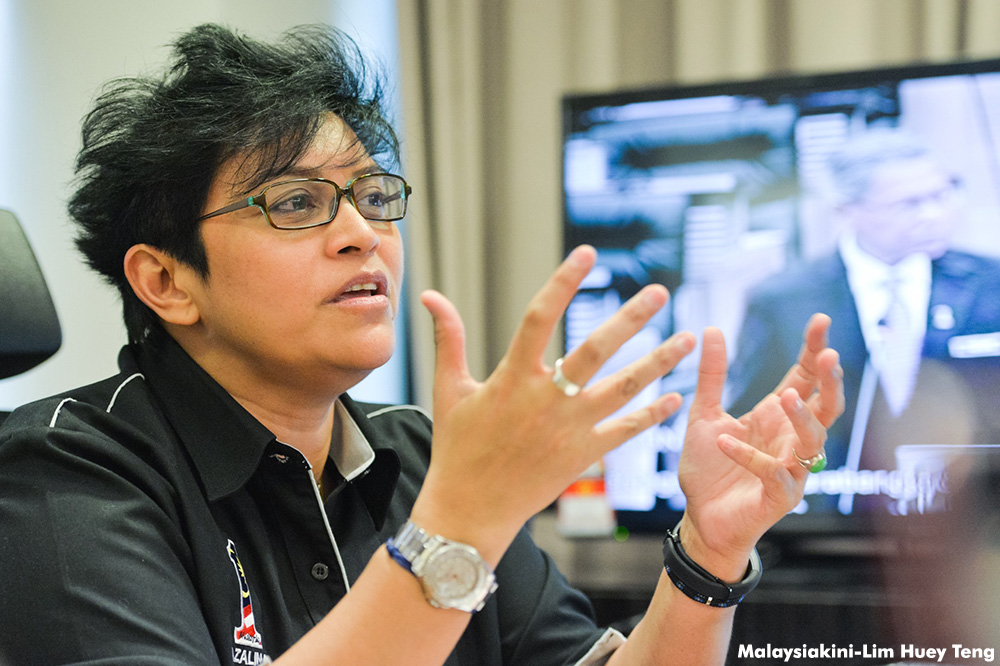

Hybrid bill still best option to address party-hopping woes, says Azalina
Pengerang MP Azalina Othman Said believes that the door is still open for her proposed hybrid bill of an anti-party hopping law and recall elections, as she urges for an all party-caucus to ensure it proceeds by the next Parliamentary sitting.
The special advisor to the prime minister on law and human rights told Malaysiakini in an exclusive interview via email that the memorandum of understanding (MOU) signed between the government and the opposition mentions an anti-party hopping law and the hybrid bill has two components which include that law.
"Many MPs have signed the MOU showing their commitment in taking a stand against anti-party-hopping.
"I hope the MPs from all sides will form a caucus for joint reform to ensure that the bill proceeds by the next sitting and there are no further...
Pengerang MP Azalina Othman Said believes that the door is still open for her proposed hybrid bill of an anti-party hopping law and recall elections, as she urges for an all party-caucus to ensure it proceeds by the next Parliamentary sitting.
The special advisor to the prime minister on law and human rights told Malaysiakini in an exclusive interview via email that the memorandum of understanding (MOU) signed between the government and the opposition mentions an anti-party hopping law and the hybrid bill has two components which include that law.
"Many MPs have signed the MOU showing their commitment in taking a stand against anti-party-hopping.
"I hope the MPs from all sides will form a caucus for joint reform to ensure that the bill proceeds by the next sitting and there are no further delays," she said.
The first submission of the bill was rejected by the speaker citing Article 67 of the Federal Constitution (restriction on the introduction of bills and moving of amendments involving taxation, expenditure, etc).
Azalina said that if these were the grounds on which the bill is rejected, the onus is on the finance minister to determine if any private member’s bill has substantial financial implications.
"At the last session, I wrote to the then law minister (Takiyuddin Hassan) on this matter, requesting for the law minister to include my bill according to Standing Order 49 at the last session. As a result, the bill was admitted and allowed by the speaker.
"However, the first submission has since expired which is why I submitted the bill for the second time, only for it to be rejected again on grounds of financial implications, which has been deemed irrelevant by the law minister as per the first submission and subsequently admitted and allowed.
"The rejection on the grounds of financial implications seems to me like a pausing act by the government," commented Azalina on its recent second rejection.
She said that since the first submission of the bill up until today, voters have clearly sent a message shunning the party hopping and frog culture in politics.
"The Malacca election is evidence of that. Malaysians have seen what party hopping can do to the political and economic stability of the country.
"If we are going to talk about cost, then we should very well consider the cost of not having an anti-hopping law to the political and economic stability of the country," she added.
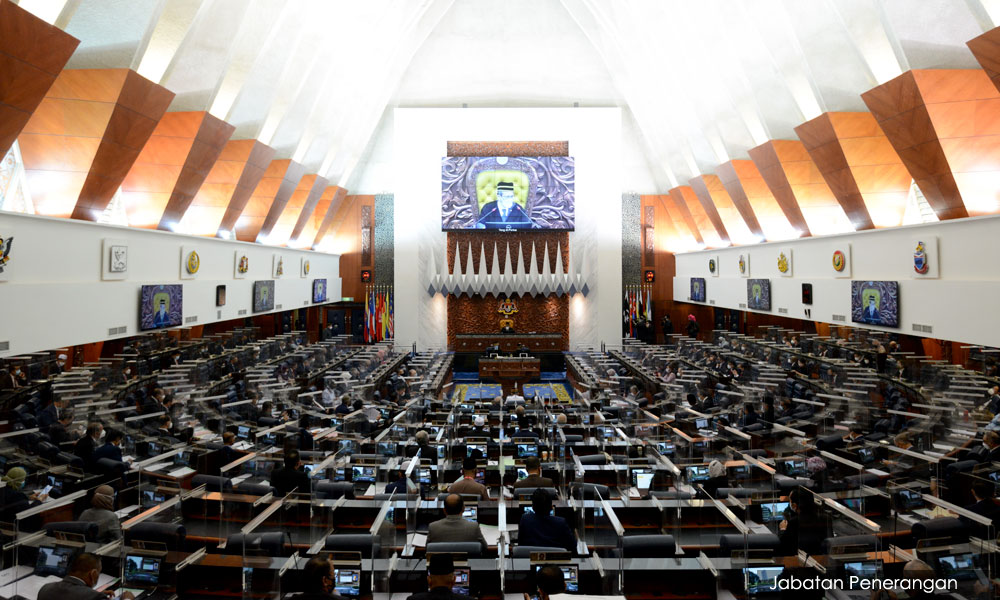
Azalina did however speculate that the government could intend to draw up its own law and that there was also the possibility that some politicians did not want party hopping stopped.
Starting with the notorious Sheraton Move in February 2020, defections and shifts of allegiance have played a part in the collapse of two federal governments and state governments in Kedah, Johor, Sabah, Perak and Malacca.
Moral obligation to voters
Azalina conceded that there is no way to impose pre-election agreements on candidates given freedom of association, but they can sign pre-election agreements not to party-hop as a moral obligation and a show of sincerity towards voters in their constituency.
"Of course political parties have their own equation to predetermine whether the party should enter into a pre-election agreement, but the individual candidate can make their own commitment not to party-hop.
"The first thing that comes to my mind as to why candidates would sign a pre-election agreement is to show their commitment towards anti-hopping, and as a moral obligation towards voters.
"I’ll use the analogy of selling a product. When you sell a product, you throw in certain other commitments as part of the sales package. Signing a pre-election agreement is an additional benefit to earn voters’ confidence," she said.
Azalina added that candidates can take a step further by suggesting they also sign statutory declarations ensuring they will not jump.
"If they jump, there will be legal repercussions," she said.
Ultimately, pre-election anti-hopping agreements in the absence of an anti-hopping law, she said, will provide candidates a way to show they are sincere in upholding a standard of morality and decent politics.
"It also gives voters confidence and is a preemptive measure against post-election political instability," she added.
Limited grounds for recall
One objection to the idea of recall elections is the possibility of it being open to abuse by every defeated candidate, which is why Azalina's proposed bill suggests only limited grounds to initiate a recall.
"The majority of politics that adopt a recall mechanism, for example, Taiwan, British Columbia, Alberta (Canada) and California (US), do not specify any grounds to initiate a recall against elected public officials.
"In other words, the voters may start a recall on whatever reasons from unethical conduct and voting against the voters’ preference to matters not related to the exercising of the public office’s duty (like appearance and personal affairs of the MP). Whether a recall on minor grounds will succeed or not is another issue.
"However, such a recall can be based on politically motivated reasons, such as revenge against political opponents, overturning an election result in marginally lost seats and others," she said.
If voters and society were mature enough to deal with it and ignore the unnecessary recall attempts, she said such abuse will be minimal.
"This is because, eventually to pass the recall, those proponents will need to seek a huge support from the society. However, unless we achieve such maturity, we would agree that such abuse is possible and not just an academic discussion."
Azalina said that in the hybrid bill submitted to Parliament, it proposed to limit the initiation of recall against MP and assemblypersons based on specified grounds only, such as changing party affiliation (including expulsion from the party), being convicted for offences serious enough but not amount to disqualification and being absence from House/assembly sittings for more than 50 percent within six months.
"Except getting sacked by the party, all other grounds are self-inflicted by the MP/state representatives themselves. If they do not commit any wrong, for example attending all Parliament sittings, not deliberately changing their party or not committing any crimes that may be convicted by the court, they are safe.
"They will not be recalled solely on political-motivated attacks and disagreement on house voting preferences. In such cases, the MP/state representatives will still enjoy their five-year tenure safeguard and are only subject to challenge in the next general election.
"For now, we only propose three grounds to start a recall and it may be increased for other objectively defined grounds to promote the accountability of elected representatives to the voters," she explained.
The lawmaker added that the hybrid bill proposes a threshold to initiate a recall.
"In my previous private member’s bill, I proposed that the proposal of recall shall be supported and signed by at least 1 percent of the total registered voters (who are the proponents of the recall) before it can proceed to the next stage.
"This process involves citizen-initiated joint signing to start the recall and submission of such proposals to the Election Commission or Recall Board for verification. Showing a substantial number of voters on the initiating stages may show that this recall is serious but not just a frivolous challenge.
"However, we received some feedback that the recall mechanism, as compared to classic anti-hopping law, cost too much time which will diminish the deterrence effect against party-hoppers, despite based on the bill I submitted to the Dewan Rakyat, the longest time to complete the recall process is just 80 days," she said.
With that, an alternative has been proposed, she added.
"This new proposal has no requirement on the number of proponents but allows any voter to start a recall proposal against an MP as long as they pay a RM10,000 deposit, as in a normal parliamentary contest."
The deposit would be returned unless the recall petition is not signed by more than 12.5 percent of the total voters. This will cut short the days to complete a recall since the processes to collect the signature for proposal and to verify the signatures by the EC (or a Recall Board at the state level) are not required.
She added that the threshold to pass a recall must not be too low as this will create further political instability and “devalue” the legitimacy of a recall, nor must it be so high as to make a successful recall impossible.
"We refer to the British Columbia version and propose that the threshold to pass a recall is 40 percent of all registered voters in the constituency to sign the recall petition.
"The recall mechanism will only serve a deterrent effect if there is a chance to succeed. If there are no chances for a recall to be passed, such a mechanism will be just a decoration without any substantial effects," she said.
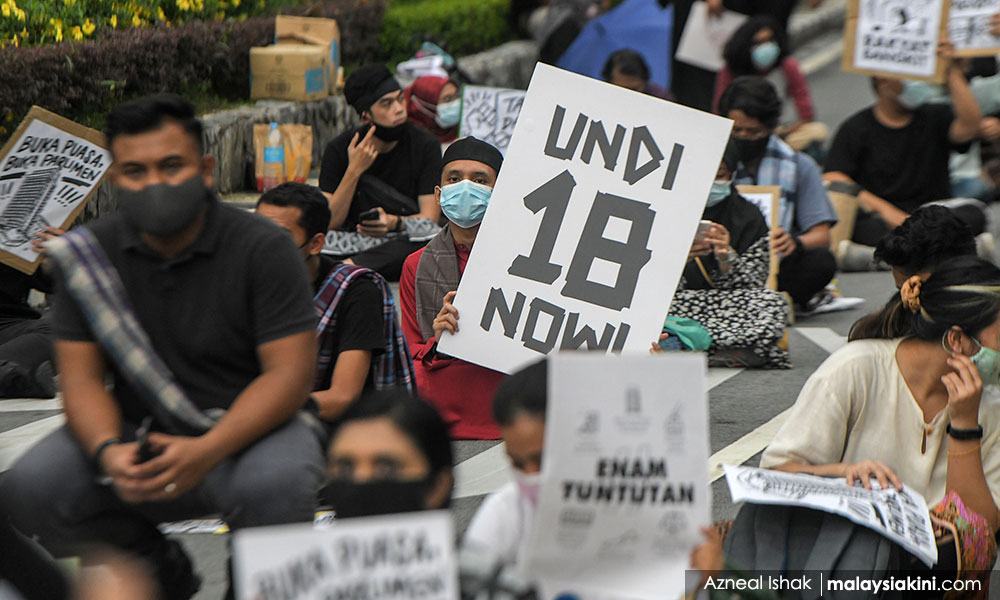
Azalina explained that the bill also considers in future the effect of additional voters due to Undi18 and automatic voters registration system, which will have a sudden and huge increase on the voter base that will make achieving 40 percent of the total voters’ threshold too hard to achieve.
"Thus, we also propose another set of thresholds – at least half of the previous turnout rate based on current total voters – and the recall is passed if either this threshold or 40 percent is achieved."
She gave the following example:
In constituency A in the past election 3,600 out of 6,000 voters cast their ballot (a turnout rate of 60 percent). Currently, the number of voters in constituency A has increased to 10,000. Thus, 40 percent of the total voters is 4,000, even higher than the turnout for the previous election. However, half of the previous turnout rate based on current total voters is 3,000. So, in order to pass a recall against the MP in constituency A, it needs at least 3,000 voters to sign the petition.
Other reforms needed
Azalina said that as much as there is talk of reforms, firm decisions and actions need to be taken for us to see legal changes.
"We need to walk the talk and do what we can to stop the frog culture in Malaysian politics, which is why this bill is being pushed. As Winston Churchill said “Fear is a reaction. Courage is a decision.”
She also advocated in the long term for a reform of the electoral process to incorporate a mixed-member system.
"I would like to see voters able to directly choose both their constituency representative and their preferred party.
"In other words, a mixed-member system where voters get two different ballots and MPs are divided into two groups - constituency MPs who focus more on local issues and party-list MPs who focus more on national issues, from social justice to climate change.
"While we need recall law to sack constituency MPs over party-hopping, an anti-hopping law works perfectly with party-list MPs – party hoppers’ seats can be vacated and filled by next available candidates from the same party with no by-election needed," she pointed out.
The party-list MP system had another advantage as it would allow parties to easily introduce quotas for women, youth, people with disabilities and so on.
"Lastly, as many small issue-based parties can get into Parliament from the party-list, they will have to be more serious about manifestos and policies, and consequently, parliamentary debates will also be more interesting," she added.
Current parties to stay
Malaysia is the only democracy in the world governed by political parties that are mono-ethnic in nature. Critics have charged that this has contributed to a toxic atmosphere with politicians competing to be ethnic champions instead of looking at the larger picture.
Azalina however does not agree with the idea of banning parties that are exclusively based on race, religion or region as a means of defusing this situation.
"Of course not. If the majority of the people want some mono-ethnic, mono-religious or regional parties, and they are not allowed to join such parties, are we still a democracy?
"We need to be inclusive in politics, but inclusion should be promoted by giving the right electoral incentives," she said.
Voters, she added, can encourage inclusive politics by voting for parties that come out with better policies and do not promote communal or regional hatred, even though those parties may not be from their communities.
"Don’t be obsessed with the labels 'multi-ethnic' or 'monoethnic', look at what they have to offer," said the fourth-term MP.



Report this comment
Are you sure you want to delete this comment?
This action cannot be undone.