


/file/publisher-c1a3f893382d2b2f8a9aa22a654d9c97/2022/11/18195cdbc9f334ac87a8be2a2be017eb.png)

Youth voters not clued in, but still eager to vote
In a survey of first-time voters aged 18 to 30, commissioned by Malaysiakini, 93 percent of the 1,084 respondents polled said they intend to vote.
This is despite a majority struggling to name cabinet ministers or politicians who they favour or dislike and being unable to answer basic questions on the electoral process.
Their enthusiasm was less about experiencing voting for the first time, and more to do with...
Be it knowledge of the political landscape or the electoral process, first-time youth voters are less aware but this has not dampened their enthusiasm to cast their ballots on Nov 19.
In a survey of first-time voters aged 18 to 30, commissioned by Malaysiakini through research company Vase.ai, 93 percent of the 1,084 respondents polled said they intend to vote.
This is despite a majority struggling to name cabinet ministers or politicians who they favour or dislike and being unable to answer basic questions on the electoral process.
Their enthusiasm was less about experiencing voting for the first time, and more to do with the view that voting is a duty for citizens.
The respondents were located in all Malaysian states and participated in an online poll by research company Vase.ai over three weeks starting Oct 5.
The poll was conducted in Bahasa Malaysia and English, with 66 percent of respondents aged 18 to 24, 32 percent aged 24 to 29, and three percent aged 30.
A total of 66 percent were Malay, 24 percent Chinese, nine percent non-Malay bumiputera and five percent Indian or other ethnicities.
They were asked questions that gauged their knowledge of the political landscape and the electoral process, as well as their attitude towards politics and political parties.
Vase.ai is an on-demand market research company in Malaysia that provides organisations with fast and reliable insights into consumers, markets, brands, products, and more, through its AI-powered, self-serve platform.
Call of duty
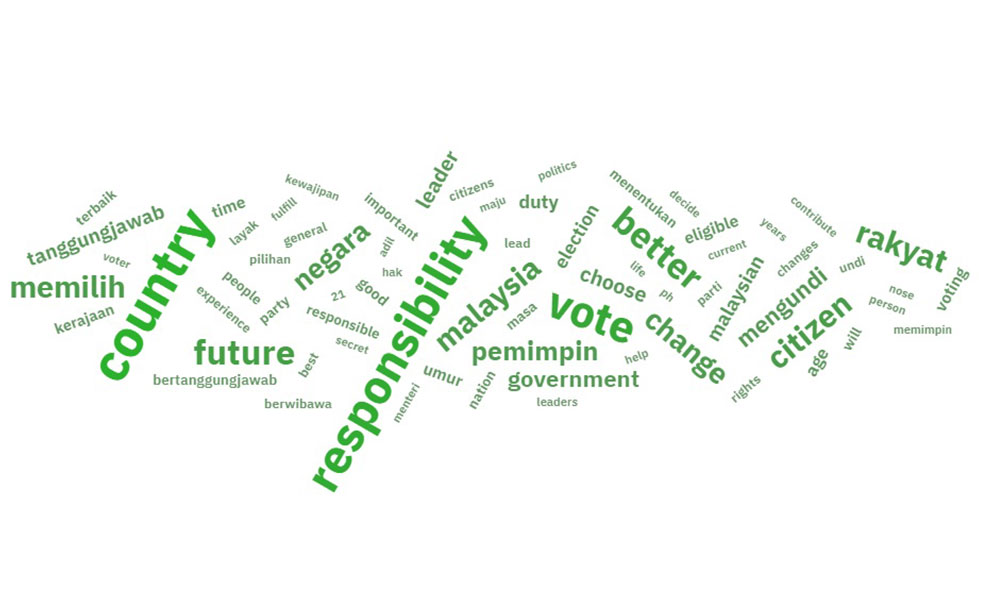
Those planning to vote were asked to state, in their own words, why they intend to do so, and the answers were categorised into recurring themes.
About a third used the word “responsibility” and “duty”, indicating their reasons for voting despite confessing little knowledge or interest in political ongoings.
Some among them also believed it is “compulsory” for Malaysians to vote once they are of age.
Similarly, although half of them were unable to name cabinet ministers or politicians they like or dislike, a third said they were voting to hold elected representatives accountable or for a better future.

Despite being largely unfamiliar with the political wranglings or the people in power, about a third said they wanted a change of government or simply wanted to vote for something “better”.
“I am voting because I want change in this country. I want to see ministers who don’t know how to do their work and are receiving salaries for nothing removed,” one respondent said.
The attitudes of young first-time voters are of particular interest in this election - the first after constitutional amendments were passed to allow automatic voter registration and bring down the minimum age of voting from 21 to 18.
Since the 14th general election in 2018, about seven million voters have been added to the electoral roll, making the number of total voters just over 21 million. Close to 30 percent are aged under 30. Those aged 18 to 21 make up 1.4 million votes.
Poor knowledge of the electoral process
A student, Shane Theseira, is among the millions of first-time youth voters heading to the polls.
Like many of the anonymous respondents polled in the Vase.ai survey, Theseira believes he only has a “very basic understanding of the country's political landscape.”
“But I believe knowing what’s going on in one’s constituency is enough to make a sound choice,” he told Malaysiakini in a series of interviews with several first-time voters, separate from the survey.
“I’ll be choosing my candidate based on merits. Even though the party may not be the one I want the ruling government to be, at least the candidate will take care of his/her constituents,” the Subang voter said.

However, even this would be difficult for about 18 percent of first-time youth voters polled, who said they do not know which constituency they are voting in.
Responses to a question on postal voting also indicate they may not be aware of whether they can vote by post.
For example, 35 percent of respondents incorrectly said a Sabah voter living in Petaling Jaya, Selangor, can vote by post, while 22 percent did not know that Malaysian students in Singapore, or Malaysians abroad in general, can register as postal voters.
They are also largely confused about the electoral system and do not know what it takes for a party or coalition to form the government, and are fuzzy over the concept of state and federal elections.
Asked what proportion of seats are needed to win the general election, 34 percent said they are not sure, while 33 percent said at least two-thirds.
Quizzed on when an individual would cast two ballot papers, only a third correctly answered that this happens when a state and federal election coincide.
Half of the respondents said they did not know, while 13 percent posited that it had something to do with local council elections - something that had not occurred in Malaysia since 1964.
I vote because it is my right
Ahmad Asyraf, 24, appears to be in the minority when it comes to his reason for wanting to vote.
The Klang Valley-based Tambun voter echoed the four percent of respondents polled who said they are voting because it is their right as citizens in a democratic country.
Asyraf, a software developer, said it would be “a waste” not to vote because “it is one of the few privileges working people have in a democracy.”
“I feel it would be a waste if I didn’t vote, even if the party I voted for loses in the end… I would feel glad that I participated in the democratic process,” he said.

Having a “medium understanding” of the electoral process and political landscape, the Tambun voter believes in casting his ballot strategically, in the hope of indirectly determining who will make it to the prime minister’s office.
“As compared to the United States, we don’t directly vote for who becomes PM. The party that won the election would put forward a candidate to become the PM.
“Therefore, I would be voting for my candidate based on their party even if that candidate doesn’t contribute enough to Tambun, as compared to the other candidates,” he said.
Asyraf’s knowledge of the political landscape comes almost entirely from social media, specifically Twitter and Reddit, sources he admits are “biased against BN/Perikatan Nasional”.
He is not alone. Among his peers polled in the Vase.ai survey, 89 percent of respondents said they get information on politics and current affairs from social media.
Other major sources of information are news websites (62 percent), friends and family (58 percent), and radio or television (58 percent).
Harapan favoured by hair’s breadth
If social media sources can be biased against PN and BN, as observed by Asyraf, it is perhaps unsurprising that Pakatan Harapan was named as the coalition which the respondents most favoured - but even this is only by a hair’s breadth.
Asked to choose three parties or coalitions they favour, Harapan came out tops, scoring an average 8.8 out of 12, versus BN at 8.48.
However, Harapan weighs more favourable in general, with component party PKR coming in third in a list of parties most favoured, followed by PN component party PAS.

Harapan chairperson Anwar Ibrahim, on the other hand, was most frequently named when respondents were asked to name three politicians they favour.
Although half of the respondents either said they did not know any politician or declined to answer. Those who did mostly chose Anwar, followed by Muda chief Syed Saddiq Abdul Rahman and Health Minister Khairy Jamaluddin.
Conversely, BN politicians hogged the top three spots when respondents were asked which politicians they disliked.
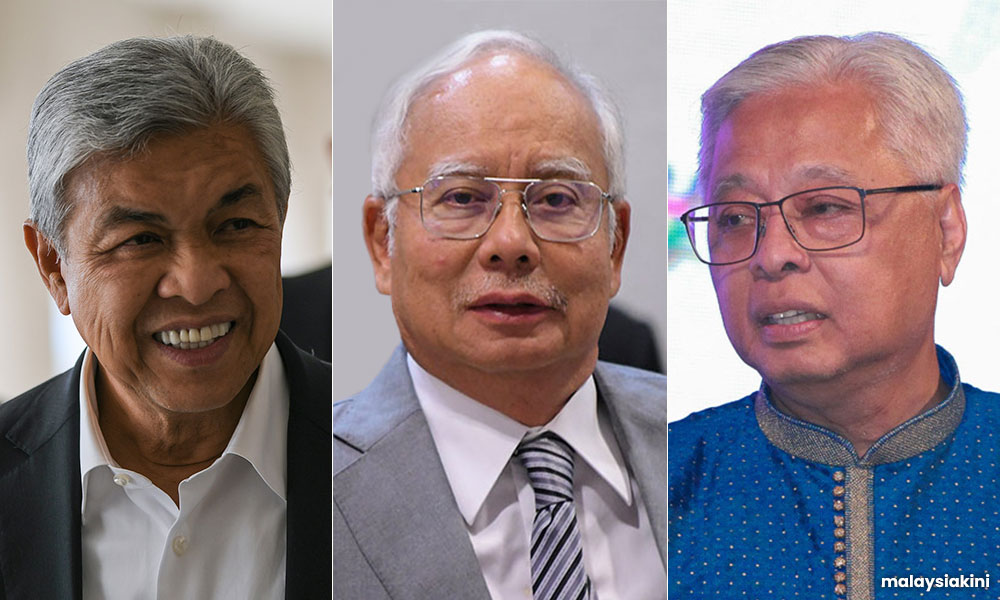
BN chairperson Ahmad Zahid Hamidi was most despised, followed by former prime minister Najib Abdul Razak, and caretaker prime minister Ismail Sabri Yaakob.
Correspondingly, Najib’s conviction for corruption in the SRC International case in July was the current topic that youths were most familiar with, from a list of topics provided to them.
The respondents were asked to select from a list of current topics which dominated headlines, pertaining to human rights, politics, corruption and the environment.
A total of 85 percent of them were aware of the Najib case, compared to the next most-selected topic - the December 2021 floods - which was on the radar of just 58 percent of respondents.
This was followed by the issue of citizenship for children born abroad to Malaysian mothers and foreign fathers, which 49 percent said they were aware of.
The case of unilateral conversion of children, as per the M Indira Gandhi case, and minority religious rights, as per the Pastor Koh case, were the topics selected by the least number of respondents.
It’s the economy, stupid… and also corruption
Reaching adulthood at a time of crisis, youth first-time voters - perhaps just like their older counterparts - are using their votes to speak out on two key issues: corruption and the economy.
“I want to make a change, so we can be ‘out with corruption’ and ‘in with prosperous growth of the country’,” said one respondent.
“I want the next government to help its citizens and for them to truly understand the problems we are facing, in regard to income inequality and marginal groups living in extreme poverty.”
The economy and job opportunities were the top two concerns of first-time youth voters surveyed, followed by corruption and governance.
Rembau voter Durrah Malek, 24, said she hopes to vote for someone who will be able to provide more opportunities for semi-urban areas like her constituency.
“I do think there needs to be more effort to rejuvenate the local economy, offer more opportunities for development and work for youths.
“I am looking forward to voting for candidates who pursue these changes,” the student said.
If anything, it is the issue of the cost of living that could persuade some reluctant first-time voters to the polls.

Phyllis Chong, 22, said she is still mulling whether to make the trip back from the Klang Valley to Johor where she votes.
Mostly, she is apathetic about voting because she is unconvinced that it will make a difference in her daily life.
One thing that will make a difference, she says, is if political parties address the issue of stagnant wages, particularly for graduates who are now offered just slightly more than the minimum wage.
“Let’s be honest - the minimum wage of RM1,500 a month for an individual in an urban area is barely enough for them to get by. What about those who are supporting their family?” Chong asked.
“This should be strongly addressed by political parties, not swept under the rug after an RM300 increment.”
READ MORE: First-time voter? Check out our GE15 guide
Reporting by Aidila Razak and Puteri Aisya Sufian, with additional reporting from Zikri Kamarulzaman and Wan Irdina.
/file/publisher-c1a3f893382d2b2f8a9aa22a654d9c97/2022/07/c04546cfd853101c4e0a2dea23df03a3.jpg)
/file/publisher-c1a3f893382d2b2f8a9aa22a654d9c97/2022/11/8cbd57b9ffaa6c0b6dfaa2093c8bf975.jpg)
/file/publisher-c1a3f893382d2b2f8a9aa22a654d9c97/2022/03/0da8742ad1847bb5837cbc574217cbd0.jpg)
/file/publisher-c1a3f893382d2b2f8a9aa22a654d9c97/2022/10/5891d71a63d170d9315745de57538e19.jpg)


Report this comment
Are you sure you want to delete this comment?
This action cannot be undone.