


/file/publisher-c1a3f893382d2b2f8a9aa22a654d9c97/2022/12/f729c0f59e2b3c2252bd3755add31bb1.jpg)

Minister: Education curriculum on par with Singapore, Japan
PARLIAMENT | Malaysia’s curriculum is comparable to its neighbouring countries such as Singapore and Japan, said Education Minister Fadhlina Sidek.
This was based on a comparative study the ministry conducted which also involved comparing Malaysia’s curriculum to that of Australia, the United Kingdom and Finland, she explained.
“The findings showed that the school curriculum in Malaysia is comparable to the curriculum of the other countries,” she said in a written parliamentary reply yesterday.
Fadhlina (above), who is the Nibong Tebal MP, was responding to a question by Sri Gading MP Aminodhuda Hassan who had asked about the ministry’s action on the discrepancy of Level 1 curriculum with...
PARLIAMENT | Malaysia’s curriculum is comparable to its neighbouring countries such as Singapore and Japan, said Education Minister Fadhlina Sidek.
This was based on a comparative study the ministry conducted which also involved comparing Malaysia’s curriculum to that of Australia, the United Kingdom and Finland, she explained.
“The findings showed that the school curriculum in Malaysia is comparable to the curriculum of the other countries,” she said in a written parliamentary reply yesterday.
Fadhlina (above) was responding to a question by Aminolhuda Hassan (Pakatan Harapan-Sri Gading) who had asked about the ministry’s action regarding the discrepancy of Level 1 curriculum with the ages of Standard One to Standard Three pupils.
The Nibong Tebal MP said the aim of the primary school curriculum, especially at Level I, was to foster physical, cognitive, mental, emotional, social, spiritual and moral development.
“The focus of the Level I curriculum is on the mastery of reading, writing, calculating and reasoning skills, basic information and technology skills, and creativity.
“The implementation of subjects at Level I allows each child to build a foundation of good values, develop self-confidence and a positive attitude as well as acquire basic knowledge and skills in preparation for further learning,” Fadhlina added.
Increasingly concerned
On Tuesday, Syed Saddiq Syed Abdul Rahman (Harapan-Muar) claimed that parents were becoming increasingly concerned about the standard of the national syllabus in comparison to private education.
He told the Dewan Rakyat that both Singapore and Japan outranked Malaysia on the global Programme for International Student Assessment (Pisa) used to evaluate educational systems by measuring 15-year-old students’ scholastic performance in mathematics, science, and reading.

He added that up to 20 percent of the national expenditure was typically allocated to the education sector, a higher figure when compared to Singapore and Japan.
Syed Saddiq said the shifting trend was a sign that the education sector was in crisis and required urgent reforms.
He also pointed out that teachers at national schools faced a heavy burden with clerical duties, administrative tasks, and juggling two or three roles - which was putting aside their main duties, that is to teach.
No plans for teaching assistants
In a separate parliamentary reply, Fadhlina said the ministry had no plans at the moment to create any teaching assistant positions, be they permanent or contract, to deal with the issue of teachers’ workload.
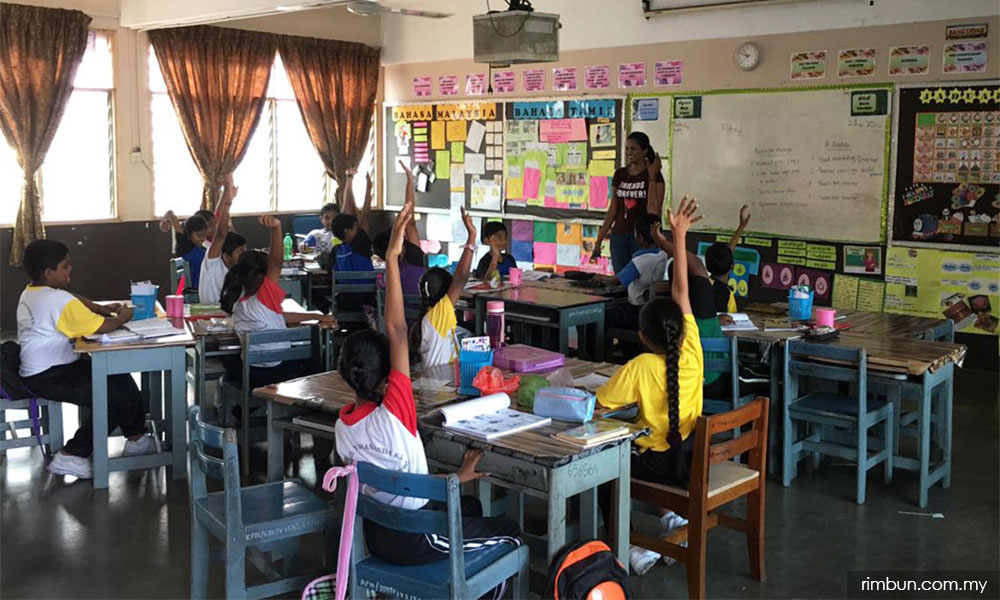
She pointed out that the ministry had implemented a pilot programme from 2013 to 2019 to appoint teaching assistants to carry out clerical work, data and information management as well as tasks related to library management.
However, she said that the programme was stopped in 2020 due to staffing and financial implications to the government.
The minister was responding to Sabri Azit (Perikatan Nasional-Jerai) who had asked if the ministry would provide teaching assistants as promised in Harapan’s GE15 manifesto.
/file/publisher-c1a3f893382d2b2f8a9aa22a654d9c97/2019/08/7472bb2bebf71d71778b4e02fe7f1404.jpg)
/file/publisher-c1a3f893382d2b2f8a9aa22a654d9c97/2023/01/457260bb662da1f511f2fe124df3e8e5.jpg)
/file/publisher-c1a3f893382d2b2f8a9aa22a654d9c97/2020/06/068b276465587eb9dceb8346db782617.jpg)
/file/publisher-c1a3f893382d2b2f8a9aa22a654d9c97/2022/12/0b2376b2db75c2521cfca0cefd3a911f.jpg)
/file/publisher-c1a3f893382d2b2f8a9aa22a654d9c97/2022/12/f729c0f59e2b3c2252bd3755add31bb1.jpg)
/file/publisher-c1a3f893382d2b2f8a9aa22a654d9c97/2021/10/1fc7ff837c360522896f421ce1ae9c2f.jpg)


Are you sure you want to delete this comment?
This action cannot be undone.