




Kwong Wah enters the ring
Major Chinese dailies in the Klang Valley are expected to face a stiff challenge from Kwong Wah Yit Poh , which plans to spread its wings to central and south Peninsula.
Major Chinese dailies in the Klang Valley are expected to face a stiff challenge from Kwong Wah Yit Poh , which plans to spread its wings to central and south Peninsula.
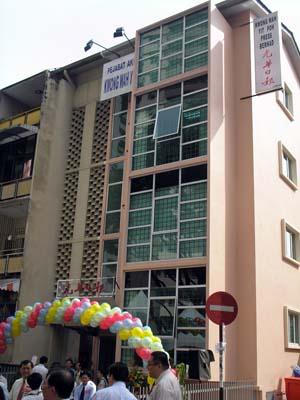
 After launching its new four-storey office in Kuala Lumpur today,
Kwong Wah
general manager Lee Hin Chin (
photo
) told reporters that the daily is here to start a new trend of "independent news reporting."
After launching its new four-storey office in Kuala Lumpur today,
Kwong Wah
general manager Lee Hin Chin (
photo
) told reporters that the daily is here to start a new trend of "independent news reporting."
Kwong Wah , owned by the family of the late transport magnate Low Boon Siew, was set up in 1910 by Chinese revolutionary Sun-Yet Sen. It is one of the oldest operating Chinese dailies in the world.
At present, the daily is popular in Northern Malaysia, especially Penang, which makes up 70 percent of its 100,000 circulation.
"We are aiming to increase our distribution outside of Penang. Today's launch is quite symbolic for the company. This will be our starting point," said Lee.
The company has also increased its staff presence in Kuala Lumpur from five to over 40.
News sharing
According to Lee, the company's signature trademark will be its co-operative news sharing with some 30 Chinese media organisations worldwide.
The daily, he said, will also place emphasis on the "independence of opinion."
 Kwong Wah will compete with five other Peninsular-based Chinese dailies, four of which
Sin Chew Daily
,
China Press
,
Guang Ming Daily
and
Nanyang Siang Pau
are owned by Sarawakian timber tycoon Tiong Hiew King.
Kwong Wah will compete with five other Peninsular-based Chinese dailies, four of which
Sin Chew Daily
,
China Press
,
Guang Ming Daily
and
Nanyang Siang Pau
are owned by Sarawakian timber tycoon Tiong Hiew King.
The other, Oriental Daily , is owned by Sarawakian tycoon Lau Hui Kang and his family.
"There is a trend in the country, that the media is being consolidated into monopolies. We believe (our style) will gain support among readers," said Lee.
As for their target audience, he said Kwong Wah wants to appeal first to north Malaysians who work in Kuala Lumpur.
Today's opening ceremony was attended by MCA president Ong Ka Ting, Chinese ambassador to Malaysia Cheng Yonghua and leaders from opposition and ruling parties.
In his opening speech, Ong expressed hope that there will not be a "cut throat competition" among Chinese dailies.
 "There are many Chinese newspapers in the country, but I believe if
Kwong Wah
can make use of the blue ocean strategy, they can penetrate the market to find their special position.
"There are many Chinese newspapers in the country, but I believe if
Kwong Wah
can make use of the blue ocean strategy, they can penetrate the market to find their special position.
"They shouldn't fight for the same audience. It would harm everyone," he said.
Blue ocean strategy is a term coined by business authors W Chan Kim and Renee Mauborgne to describe running a business in uncontested market spaces.
Watch the 3-minute video.


Are you sure you want to delete this comment?
This action cannot be undone.