


/file/publisher-c1a3f893382d2b2f8a9aa22a654d9c97/2024/01/2bead3ca883647c17fc46b852fdd01e7.jpg)

Kam Raslan and his 'Old Boy' revival
Dato Hamid was a Malay College Kuala Kangsar Old Boy, who would describe his adventures and love for luxury in KL, London, Switzerland, France, and Algeria, from the 1940s to the present day.
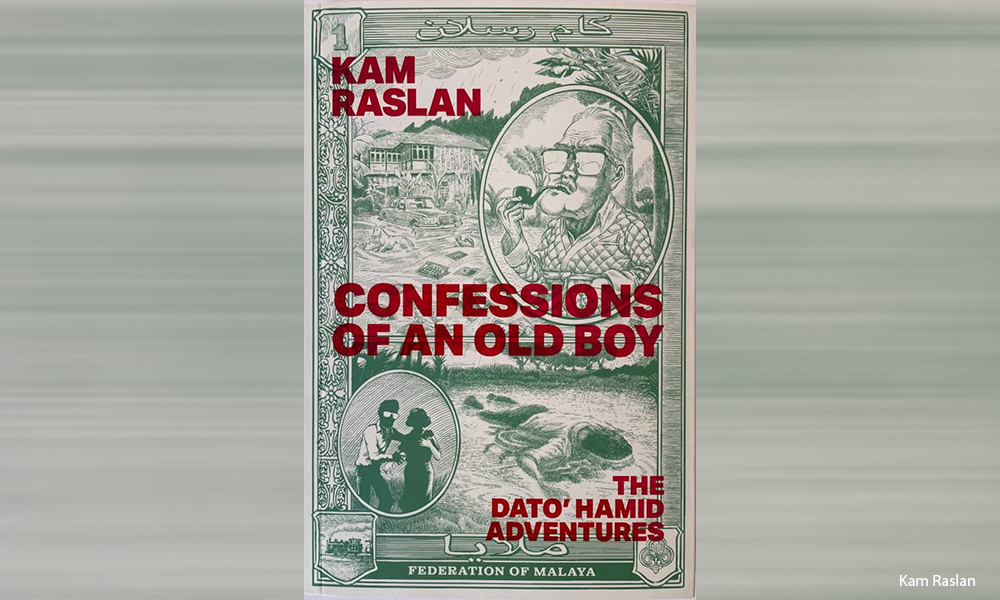
His weak, cowardly personality combined with his misadventures made for hilarious reading and now author Kam Raslan has reissued ‘Old Boy: The Dato’ Hamid Adventures’ a full 15 years after it was first published in 2007.
The chapter entitled Disco is a new addition to the recent reissue of the book which is published by Maya Press (previous issues were by Marshall Cavendish).
Many readers assumed that Dato Hamid was based on Kam’s father, although he has, over the years, denied that it was. Kam’s father passed away when he was a very young boy.
So we started this interview by asking if Hamid’s formidable Eastern European wife...
MALAYSIANSKINI | Regular readers of the local magazine Off the Edge may recall stories on retired civil servant Dato Hamid that were published from 2005 to 2006.
Dato Hamid was a Malay College Kuala Kangsar Old Boy, who would describe his adventures and love for luxury in KL, London, Switzerland, France, and Algeria, from the 1940s to the present day.
His weak, cowardly personality combined with his misadventures made for hilarious reading and now author Kam Raslan has reissued ‘Old Boy: The Dato’ Hamid Adventures’ a full 15 years after it was first published in 2007.
The chapter entitled Disco is a new addition to the recent reissue of the book which is published by Maya Press (previous issues were by Marshall Cavendish).
Many readers assumed that Dato Hamid was based on Kam’s father, although he has, over the years, denied that it was. Kam’s father passed away when he was a very young boy.
So we started this interview by asking if Hamid’s formidable Eastern European wife, whom he refers to as ‘The Wife’ was inspired by Kam’s mother.
The writer/director noted that many people from his father’s generation, who came of age around independence, returned from their studies or work abroad with European wives.
“It was quite a phenomenon. My mother did tell me things and I met other wives. It may sound strange, but it may sound in many ways (The Wife) like she’s my wife, and she’s very much Malaysian. All those women that I’ve just mentioned, these wives, none of them were Eastern European.
“The Wife is Eastern European, which is a bit unusual. I don’t think I met anybody like her. The women I knew were English, German, French, and Australian,” Kam clarified.
Generational differences
An interesting aspect of Hamid’s story is the generational difference between him and his conservative politician son, whom he calls The Ayatollah, and his grandson, who is Americanised.
Kam said when our colonial masters left, they assumed that different races wanted different things.
“But there are generational differences. And I wanted to point that out because I did not go to Malay College Kuala Kangsar myself. But my father did briefly. In the 1990s, I was invited to a Malay College old boys’ reunion.
“It was strange because there were these completely different generations of Malay boys. I was sitting with the old fellas because they were my father’s generation. You had this big group that was the Anwar Ibrahim generation which really couldn’t be more different from my father’s kind of age group.
“Then there were these younger guys who were different again.”
Excerpt from the chapter entitled Dato’ In Love:
“I gazed at the majestic mountain again. Sadly spoilt by having The Ayatollah standing in front of it. Fortunately, he was surrounded by a flock of sheep so he blended in well. But that barn looked familiar. And so did that middle-aged Swiss man.
“Goodness gracious me!” exclaimed The Wife. “You two could be brothers. Don’t they look similar, Hamid?!”
“Don’t be ridiculous darling.” The sheep looked far more intelligent.
So, in his book and the stories, he wanted to show how, within a family, there could be a great difference. Both Hamid and his son The Ayatollah studied in London, but while Hamid embraced all things Western, his son was very conservative.
Hamid’s character is also the stereotypical upper-level civil servant. No one is sure what he does other than being ordered by his boss to attend events or travel abroad. Every time Hamid’s boss looks for him, he is at home.
“Perhaps I’m feeding off the cliché. My friend Hamid is very much living that life. I remember I once went to RTM, and I was doing a pitch for a TV show. I stumbled into this room where no one had gone before.
“I stumbled onto this fellow who looked petrified about seeing us because I don’t think anyone ever went in there. He was just like ‘Oh my God, they’ve finally come to check up on me.’
“So, in a way, I kind of have that kind of look of fear, imprinted on me whenever I think of Hamid. As long as they don’t find me, I’ll be okay,” Kam explained.
“Hamid is living the high life but what he really wants is respect. It’s something that connects the Malays and the English, the honours system. The desperation to have the titles and to be respected for that.
“So he loves that. He’s very clear on the fact that he’s a state Datuk. He’s not a federal Datuk. That is very important to him,” said Kam.
Stealing Hamid's thunder
Another classic character is Irma, Hamid’s old kampung friend who got it into her head that they were supposed to marry and felt betrayed when she showed up with his European wife.
Excerpt from the chapter entitled Disco, when Hamid runs into his old acquaintance Irma who is still angry that he has married someone else:
“Why do you talk like that, Irma? And stop saying I should have stuck with you.”
“You promised you would marry me.”
“All I said was, ‘Let’s have tea sometime.’”
“That was a legally binding contract back in the 1930s!”
“I was thirteen, and you were ten!”
“I developed very early. I know you remember.”
Kam explained that Irma was inspired by several people. The first was a friend who used to break into characters, mimicking people that they had met.
“Also, a long time ago, there had been this woman that I met from my father’s generation. She was a few years younger than my father. The story went that she was due to marry my father, but then he went overseas to study and came back with this British wife.
“Heartbroken and upset that she then left the country,” recalled Kam, who had actually met the lady.
The third inspiration was a travel agent that he knew who had a boss, a Nyonya lady who was always dressed in fabulous kebayas.
“This was in the 90s. She was tiny, and she had this tight bun on her head. You could just sort of sense this kind of, like, power about her.“
Smart, not finding his own place
Another stand-out character is Hamzah, who appears in ‘Murder In Parit Chindai’. Hamzah is a very well-read young man who simply could not find a job that fit his interests and qualifications. He follows Hamid and The Wife on a trip to meet the extremely rich Tan Sri Desmond Ong.
Despite having a motive for the murder himself, Hamzah drags the extremely reluctant (and terrified) Hamid into his investigation to find the killer.
Hamzah is an interesting contrast to Hamid. He is well-read and extremely intelligent but somewhat lazy. For all his cleverness, Hamzah has not found his place in Malaysia.
Kam identified himself a little with Hamzah.
“I mean he’s way smarter than me, but the marketplace in this country is very small. It is possible to cut a slice for yourself abroad in places like the US, Great Britain, France, or Australia.
“If you’re in government, you’re protected, and you have a nice little pension and health benefits. It is similar if you are in the corporate world. if you’re on the outside of that, it’s tough, unless you have inherited money.
“I was thinking that a guy like Hamzah is ill-served by Malaysia. Perhaps in another country, he could have made it.”
‘Murder In Parit Chindai’ was especially good and when asked if he ever planned to write a crime series featuring Hamzah, Kam said he had thought about it.
“I was thinking of pursuing that more because everywhere he goes, someone dies. That he should be the chief suspect every time,” he said.
View on the arts
Kam recalled how vibrant the art scene in the 1990s was and how certain personalities like Jo Kukathas made many people think theatre was something cool to be involved in.
“Jo Kukathas is one of the bravest people I know. Because she’s the daughter of K Das, the journalist, she grew up with the special branch sitting in a car outside the house all day. She lived in fear that her father was going to get taken away,” described Kam who recalls the days when the Instant Cafe Theatre (ICT) was pushing the envelope with their shows.
“The rest of us in Instant Café would follow her lead. It’s like, well, okay, Jo’s not scared, and let’s do it. I wouldn’t have greenlit half the stuff that Jo said was good.”
While most politicians at that time were fine with ICT’s brand of humour, some simply did not like it. But the show did go on and in the 1990s the live arts scene was thriving.
“There were a lot of spaces available in those days for a very cheap price and the audiences also thought theatre was a natural thing to go to,” said Kam, who feels the younger audiences do not feel the same way, unlike Singapore which has a thriving arts scene.
“Just last year there was a federal allocation for the arts. But that’s like the first time it has happened,” Kam said.
He said arts organisations generally do not make a profit and this is evident anywhere you go in the world.
“So it needs state funding. If the state doesn’t fund, then corporations will not join in. The fact that the state is not funding them tells corporations that the arts are a dangerous thing. So they’re not going to come in. A handful, a tiny handful, might occasionally come like a champagne company used to sponsor ICT.”
“The situation is, it’s more difficult now because it’s more hopeless now. But there is still this sort of fixation, even amongst young, bright young things who think they’re going to change the art world, that the arts can make a profit for themselves.
“They cannot. They simply cannot. Blockbuster movies like Polis Evo, sure. Mass entertainment, if you’re lucky, is possible. All the things that perhaps middle-class, English-speaking, Klang Valley-type people might want to see are not going to make any money. It needs funding,” he said.
He also believes young people are not taking up performing arts because they can and do make films on their phones and put them on the internet.
“It’s a completely different medium now. We moved from the stage to film.
“I went the other way around because I'm a filmmaker by training. So I got into theatre and stuff because it was a way to be able to do things with less money.
“If I were a young person now, I would just stick to making films. That’s the only way to go.“
Another book on Hamid
“The thing is, I would love to write one with Hamid in The Emergency (The guerilla war involving the Communist Party of Malaya from 1948-1960). Have him being caught in jungle ambushes.
“I knew this English guy once, who told a story about how he was in a lonely police station in the middle of nowhere, and they were besieged by communists.
“I sort of imagine Hamid being in that situation and being sent out to negotiate a truce with the communists. And then being taken in by the communists and being forced to become a communist in the jungle. Hamid would be listening to their policies and saying, ‘Well, that’s very reasonable. I think that, yes, the workers should have a share.
“I’d love to do that. I do have a sequel.”
As things stand, Kam is in the process of speaking to a publisher right now about his next book.
“Well, I’d love to have it come out this year. I wrote it. I finished it a few years back, and it’s been sitting on my computer. It’s set in 1953 in London, England, which are two different countries, and Berlin and in Malaya 1953. It’s called Malayan Spy, but Hamid is the central character.”
Kam will be speaking about ‘Confessions of an Old Boy’ on Jan 27 at Lit Books. For more details click here.
MALAYSIANSKINI is a series on Malaysians you should know.
Graffiti artist Octo - Malaysia's answer to Banksy?
Jagat director's new film to premiere at prestigious festival
Young Kadazan keeps hope alive for rural communities in need
'I wanted to be a rock star' - distinguished don recalls his roots
Tower runner won’t stop racing to the top
Theatre veteran D’Cruz is back after battling cancer, lockdown
Padma Panikker didn’t let MS stop her from living a full life
/file/publisher-c1a3f893382d2b2f8a9aa22a654d9c97/2024/01/32b10e0566e7b377d7d42eae84f39765.jpg)
/file/publisher-c1a3f893382d2b2f8a9aa22a654d9c97/2023/12/233b7d2862a4d19f2e26547909b6f752.jpg)
/file/publisher-c1a3f893382d2b2f8a9aa22a654d9c97/2023/12/1e5da84f055cec19d87f37cebcec7f39.jpg)
/file/publisher-c1a3f893382d2b2f8a9aa22a654d9c97/2023/12/05192de11707d12bc025ce05100dad60.jpg)


Are you sure you want to delete this comment?
This action cannot be undone.